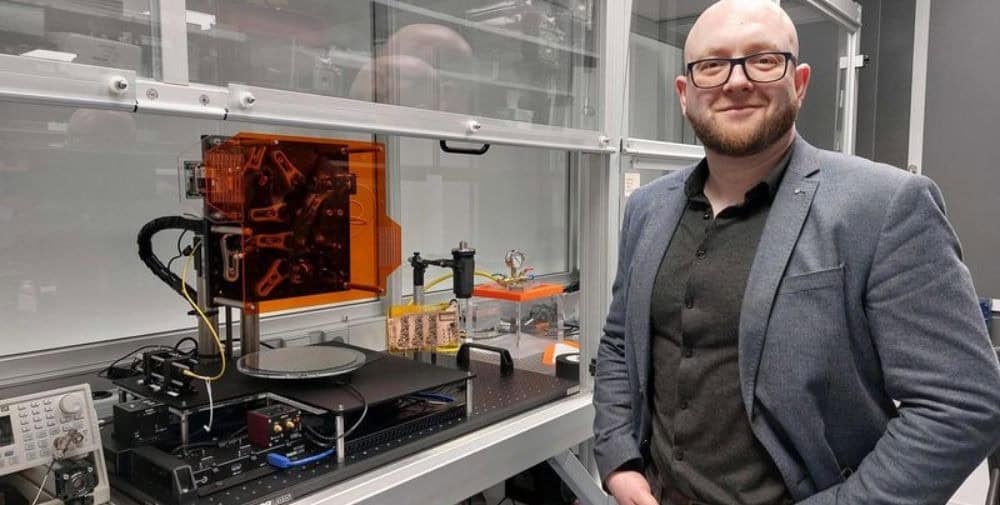
“Through his work, Alexander Kabardiadi-Virkovski demonstrates how physical knowledge and artificial intelligence can be meaningfully combined. This not only improves the transparency of AI models but also opens up new possibilities for industrial measurement technology,” says Prof. Dr. rer. nat. habil. Peter Hartmann, head of the Optical Technologies Research Group and of Fraunhofer AZOM.
AI Doesn’t Just Learn from Data
Many AI methods require large amounts of data and produce results whose origins are difficult to trace. Experts refer to these as “black-box” models.
This dissertation takes a different approach: Instead of training AI exclusively with measurement data, existing physical knowledge is specifically embedded into the architecture of the models. Physical relationships are not merely taken into account but are integrated into the model as structuring elements. As a result, the models require less training data while simultaneously delivering more transparent results. “I was interested in the question of how artificial intelligence and physics can be combined in such a way that reliable conclusions can be drawn even from incomplete measurement data. At the same time, the models’ decisions should remain transparent,” explains Dr. Alexander Kabardiadi-Virkovski.
The developed methodology was tested, among other things, in the analysis of light propagation in optical fibers, the evaluation of high-precision interferometric measurements, and the determination of material properties. The results show that physical expertise can be systematically integrated into modern machine learning methods, thereby opening up new application possibilities.
From WHZ Student to Research Group Leader
Dr. Alexander Kabardiadi-Virkovski’s academic career exemplifies the opportunities for professional development at WHZ. Since beginning his studies in 2009 in the Physical Engineering program, he has progressed from student to research assistant to a researcher with a Ph.D. and is now the head of a research group at Fraunhofer AZOM.
About the “Optical Technologies” Research Group at WHZ
The “Optical Technologies” research group at the Leupold Institute for Applied Natural Sciences at WHZ develops solutions for metrology tasks in fields such as medical technology, photonics, semiconductors, and automotive applications. The emphasis is on optical sensing, imaging, and data-driven analysis, with a clear focus on transferring these technologies into robust applications.
About Fraunhofer AZOM
The Fraunhofer Application Center for Optical Metrology and Surface Technologies (AZOM) is a joint research facility of the West Saxon University of Applied Sciences Zwickau and the Fraunhofer Institute for Materials and Beam Technology (IWS). The center combines application-oriented university research with the expertise of the Fraunhofer Society and develops innovative solutions in the fields of optical metrology, image processing, artificial intelligence, and photonics.
Contact
Prof. Dr. rer. nat. habil. Peter Hartmann
West Saxon University of Applied Sciences Zwickau
Faculty of Physical Engineering / Computer Science
Head of the Optical Technologies Research Group / Fraunhofer AZOM
Peter.Hartmann[at]whz.de
+49 375 536-1538
+49 1522 9262090
– – – – –
Related Links
👉 www.whz.de
Photo: Ivonne Mallasch/Fraunhofer IWS