“If the planning doesn’t reflect reality, even the best AI won’t help—it only amplifies systematic errors,” explains Dr. Kirsten Hoffmann, product manager at DUALIS.
AI does not correct inaccurate data
Production planning is based on a wide variety of information. This includes master data such as work plans, bills of materials, and setup times, as well as feedback from production regarding actual processing times, disruptions, or scrap. Added to this is contextual information, such as qualifications, seasonal influences, or logistical constraints.
Inaccuracies in this database often creep in gradually. If, for example, the duration of a work step is consistently underestimated, subsequent operations are delayed. If a machine’s availability is set higher in the system than it actually is, the system plans with capacities that are not available in reality. Even unrecorded disruptions can affect on-time delivery, capacity planning, and prioritization.
The “garbage in, garbage out” principle therefore also applies to the use of AI in production planning. While AI can recognize patterns in existing data, it cannot automatically assess whether the underlying assumptions accurately reflect reality. If the data is systematically distorted, there is a risk that these distortions will carry over into forecasts and planning recommendations.
Plans and reality must be comparable
Data quality alone is therefore not sufficient. Companies must also be able to track what a production plan looked like at a specific point in time, what changes were made, and how production actually proceeded afterward. To achieve this, different plan versions must be stored and linked to the corresponding actual data. This makes it possible, for example, to identify which operations regularly take longer than planned, where bottlenecks recur, or how often plans must be adjusted due to specific events.
Only by comparing data over a longer period of time can individual deviations be turned into reliable patterns. This makes the quality of planning measurable and creates a foundation from which systems can learn.
Analytics Must Feed Insights Back into Planning
“Many companies already have key performance indicators, reports, and dashboards that allow them to track what has happened in their production. In some cases, they can even identify the causes of deviations. However, looking back at the past is not enough for better production planning. The next question is crucial: What is likely to happen? And what does that mean for tomorrow’s production plan?” says Dr. Kirsten Hoffmann.
This is where data analytics plays a central role. Insights into recurring delays, capacity risks, or unrealistic operation durations must not end with reporting. They must be fed back into production planning to improve forecasts and decisions.
It is precisely at this juncture that many AI approaches reach their limits. If consistent data or the necessary temporal context is missing, identified patterns remain incomplete. Furthermore, if analysis results are not integrated into the planning process, while this may provide greater transparency regarding the past, it does not yet allow for reliable decisions to be made for forward-looking planning.
AI Helps Planners Make Better Decisions
When the data foundation, historical data, and analytics are interconnected, AI can create targeted added value. Actual processes can, for example, be used to estimate operation durations more realistically, identify risks earlier, and make production plans more resilient to deviations.
The goal here is not fully autonomous production planning. AI provides forecasts and possible courses of action. The planner evaluates these against the specific production situation, sets priorities, and makes the decision.
Even more advanced concepts, such as agent-based planning, require this foundation. As individual resources or systems operate increasingly autonomously, a consistent information base becomes even more critical. Without reliable data, historical records, and analytics, complexity is merely shifted, not resolved.
GANTTPLAN Analytics lays the foundation for adaptive production planning
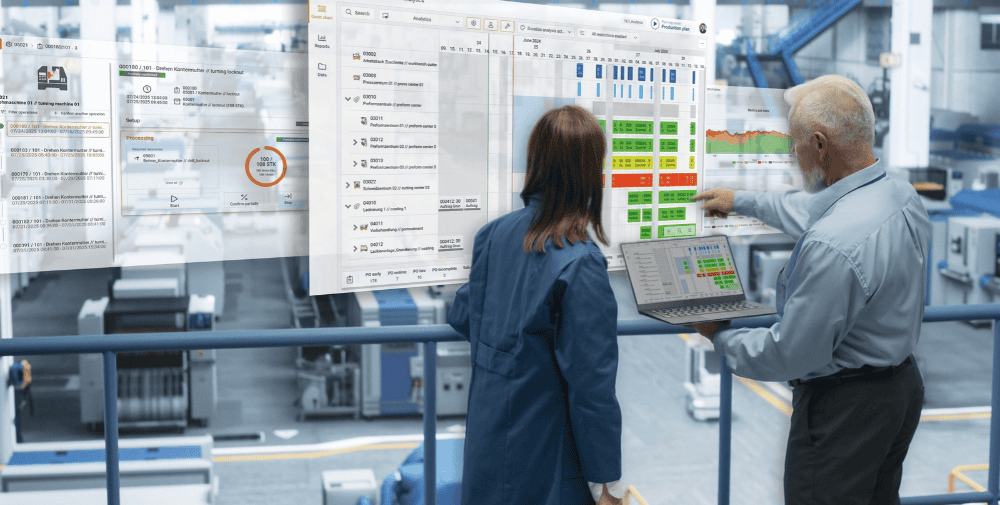
With GANTTPLAN Analytics, DUALIS bridges the gap between planning and reality. The tool extends the GANTTPLAN Advanced Planning and Scheduling (APS) system with functions for the automatic collection and analysis of historical planning data. It compares planned processes with actual implementation and highlights deviations and trends over time. This makes it possible, for example, to determine how stable production plans were, how often rescheduling was necessary, and at which points planning assumptions regularly deviate from reality.
This historical perspective also creates an important prerequisite for the meaningful use of AI in production planning. Instead of relying exclusively on current planning data, correlations and recurring deviations can be analyzed over longer periods.
DUALIS’s goal is a learning-based planning workflow: Experience gained from actual production is systematically fed back into the planning process and helps improve future plans. AI can support this cycle with forecasts, risk assessments, and recommended actions. The decision remains with the planner.
About DUALIS GmbH IT Solution
Founded in 1990, DUALIS GmbH IT Solution —a subsidiary of iTAC Software AG and part of the Dürr Group—specializes in the development of software and services related to simulation, process optimization, and production planning. Its product portfolio includes the APS system GANTTPLAN, the 3D simulation platform Visual Components, and the facility planning tool AREAPLAN. DUALIS products are used by numerous companies in large-scale industry and the industrial SME sector. Consulting and services for strategic and operational planning round out DUALIS’s range of offerings.
The Dürr Group is a leading global manufacturer of machinery and equipment with particular expertise in the technology fields of automation, digitalization, and energy efficiency. Its products, systems, and services enable highly efficient and sustainable manufacturing processes—particularly in the automotive industry, among manufacturers of furniture and wooden houses, as well as in the assembly of medical and electrical products and in battery production. In 2025, the Dürr Group generated revenue of just under €4.2 billion and currently has approximately 17,500 employees and 123 locations in 32 countries.
– – – – –
Related Links
👉 www.dualis-it.de
Photo: Image composition by DUALIS / 792699099_Gorodenkoff@AdobeStock