The most common form of attack is deceptively authentic phishing emails: 90 percent of affected companies report experiencing them. With the help of AI, such messages can be worded very convincingly and tailored specifically to individual people or companies. Forty percent cite automated attack scripts that independently search for vulnerabilities in IT security and adapt dynamically in the process. Eleven percent report deepfakes—that is, fake audio or video recordings. These are used, for example, to imitate the voices of executives and persuade employees to make wire transfers (“CEO fraud”).
Most companies are inadequately prepared for AI-powered cyberattacks: Only 31 percent of companies using AI employ it to improve their IT security. Dedicated procedures for handling AI-related security incidents are also rare even among companies with existing or planned AI use: Only 11 percent have such processes in place. Forty-three percent rely on their general IT security processes but have not yet supplemented them with AI-specific rules. Another 20 percent are currently developing such procedures, while one-quarter (25 percent) have no regulations in place for this yet.
According to the survey, 49 percent of companies use AI, and another 9 percent plan to do so within the next twelve months. 42 percent of companies do not currently use AI and do not plan to do so. More than half of them (53 percent) cite data protection or security concerns as the reason. The only reason cited more frequently is a lack of benefit (58 percent). Other hurdles include high integration costs (44 percent), legal uncertainties (43 percent), a lack of expertise (39 percent), and anticipated high costs (36 percent). In addition to protecting against external attacks, companies must tackle a second security challenge: securing their own use of AI. 56 percent offer their employees general or role-specific training. Forty-five percent conduct risk assessments and classifications of AI applications, and 45 percent have established formal approval processes. Forty-two percent vet AI suppliers or providers. Just under one-third (29 percent) have not yet implemented any of these measures.
In addition to clear rules for AI use, many AI-using companies have implemented protective measures directly within the applications: 67 percent rely on quality assurance and human review of critical AI results—that is, outputs, decisions, or impacts of an AI system that pose a high potential for harm. 64 percent have restricted access rights, and 62 percent protect sensitive data, for example, through anonymization. 52 percent test AI applications for security and other criteria before deployment. In contrast, only 40 percent log or monitor AI usage. 8 percent have not implemented any of the technical safeguards mentioned.
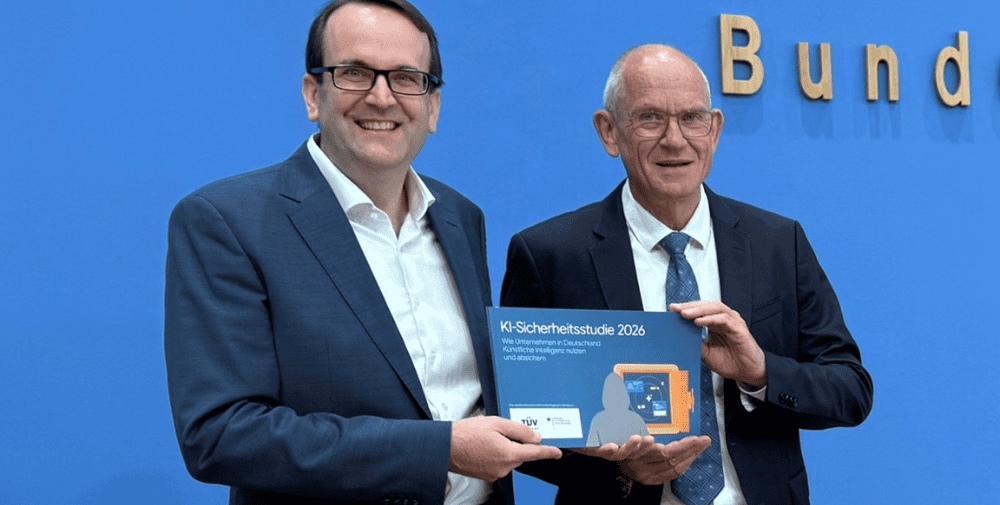
Dr. Dirk Stenkamp, President of the TÜV Association: “AI exacerbates external threats and creates new risks within a company’s own operations. Attackers can use AI to automate their attacks and deceive people in a more targeted manner. For employees, it is often nearly impossible to tell whether an email was written by a human or generated by AI. What companies have detected so far may therefore be just the tip of the iceberg. This makes it all the more important to supplement existing security and emergency procedures with AI-related scenarios. At the same time, the use of AI in businesses carries its own risks. However, AI does not need to be hacked to cause harm. It can disclose sensitive data or make decisions based on false information. The current debate surrounding frontier models underscores how justified security concerns regarding AI use are. Trust in manufacturers’ mere self-declarations has been shaken. Independent audits can bridge this trust gap. This principle has long proven effective in chemical plants, power plants, and medical devices. At the same time, the potential of artificial intelligence in cyber defense is still far from being fully realized. This creates a vulnerability, because while attackers are becoming faster and more targeted with AI, cyber defense must also keep pace technologically. AI can help detect attacks earlier by identifying suspicious patterns and new attack methods.”
From the perspective of the surveyed companies, independent audits can help ensure the secure use of AI. Sixty-nine percent of companies that use AI or plan to do so expect independent audits and certifications to result in greater security and reliability of their applications. For 51 percent of these companies, certification by an independent testing organization is already an important selection criterion. The TÜV organizations are working with TÜV AI.Lab to develop a framework for the certification of AI systems. It is currently being tested with pilot partners and is expected to be available by the end of this year.
BSI Vice President Thomas Caspers: “Artificial intelligence is a key technology with immediate and strategic implications for national security, the government’s ability to act, economic competitiveness, and social stability. High-performance AI models already possess significant capabilities in the areas of knowledge and information processing, software development, the automation of complex decision-making processes, and cyber operations. Our study shows that their potential has not yet been fully realized. This also applies—and particularly so—to resilience aspects: Companies should address AI in the short term as a critical measure for their own cybersecurity. It is important to understand that even companies that do not use AI themselves are at risk from AI-enabled cyberattacks. A thorough examination of the issue is therefore worthwhile for all businesses—regardless of their own AI strategy. However, those who use AI must also know where its protective mechanisms fail. This includes targeted testing and monitoring during ongoing operations.”
For small and medium-sized enterprises, the Alliance for Cybersecurity (ACS), based at the BSI, has published a handout titled “Protection Against AI-Enhanced Cyberattacks” alongside the study, offering concrete recommendations and immediate measures. With the AI Safety and Security Institute Germany (AISI Germany), the federal government has established a national center of expertise and evaluation for high-performance AI systems. In an initial phase, the BSI and the Federal Network Agency form a “virtual” core of the AI security institute and have been entrusted with the corresponding tasks by the Federal Ministry of the Interior (BMI) and the Federal Ministry for Digital Affairs and State Modernization (BMDS).
– – – – –
Related Links
👉 www.bsi.bund.de
Photo: BSI