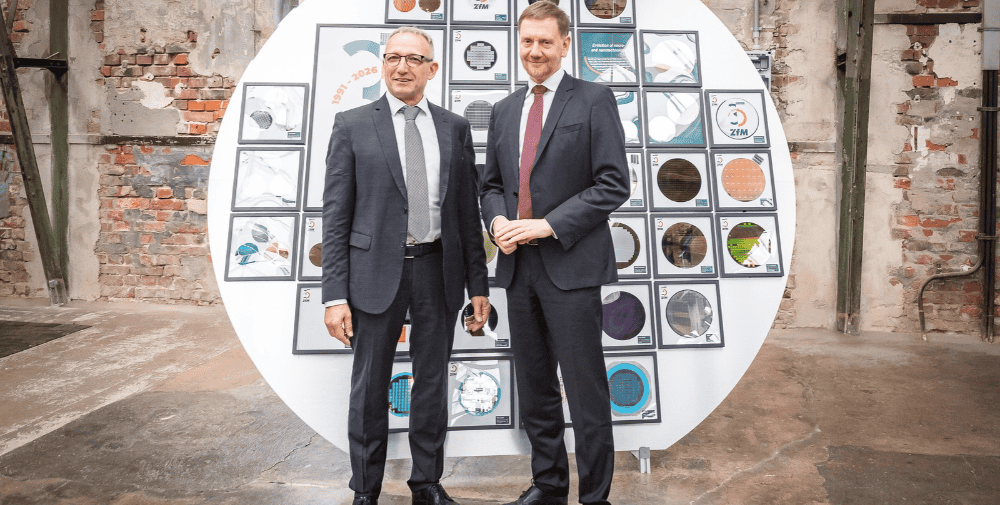
Saxony’s Minister President Michael Kretzschmar emphasized in his speech: “The Center for Micro- and Nanotechnologies at Chemnitz University of Technology is among the world’s leading institutions in the field of microsystems technology and nanotechnology. The valuable work carried out here over the past three and a half decades, in collaboration with partners such as the Fraunhofer Institute for Electronic Nanosystems, has contributed to Saxony’s status today as Europe’s most important microelectronics hub.”
Representatives from Chemnitz University of Technology, Tohoku University in Japan, IMEC, the University of Schmalkalden, as well as company representatives from Robert Bosch GmbH, Infineon Technologies, and scia systems impressively demonstrated developments from recent years and current research topics in their presentations.
The roots of microtechnologies in Chemnitz date back well before the founding of the Center for Micro- and Nanotechnologies. As early as the 1970s and 1980s, the then-Technical College and later Technical University of Karl-Marx-Stadt laid the essential foundations in microelectronics and microsystems engineering. Thus, in 1979, the Microelectronics Technical Center at the Karl-Marx-Stadt Technical University not only established a cleanroom but also formed a team that was already working closely with industry on new technologies in microelectronics.
The ZfM is known not only for its developments in BEOL technologies—particularly copper technology as used today in IC metallization systems—but also for its technological developments in high-precision MEMS components, micro-optical components such as Fabry-Perot filters, as well as nanodevices. Today, the ZfM makes significant research contributions in the field of 1D and 2D nanomaterials (carbon nanotubes, graphene), spintronics and photonics, and nanopackaging, as well as in the development of new process modules and the integration of new materials, and is committed to sustainable microelectronics and sensor technology. As a member of the FORLAB consortium, the ZfM plays a key role in networking the microelectronics infrastructure at German universities and in providing excellent training for young scientists.
In his address, the director of the ZfM, Prof. Dr. Harald Kuhn, emphasized how important the center’s opportunities and challenges are for the world of tomorrow: “Micro- and nanotechnology are the foundation of modern innovation in today’s world. In every industry and every aspect of life, they make an invaluable contribution to making systems smarter, better, and safer. The significance of this technology has grown dramatically in the 35 years since the ZfM was founded—and that was just the beginning!”
Subject to approval by the European Commission, the cleanroom—which went into operation in 1979 and was renovated in 1995–96—will be replaced by a new cleanroom in the coming years. This will enable the ZfM to further expand its expertise in the fields of micro- and nanotechnologies, particularly in sustainable microelectronics and sensor technology. The new infrastructure will lay the groundwork for cutting-edge research and technology development while also intensifying collaboration with non-university research institutions and companies.
Some speakers, as well as visitors to the symposium, immediately set new tasks for the honoree. Dr. Elisabeth Steimetz of the European Smart Systems Platform (EPoSS), for example, specifically addressed the development of marketable products based on research into quantum technologies and the focus on autonomous systems. She emphasized, “The trend is shifting from smart systems to autonomous systems, such as drones or self-driving cars.”
In the coming years, we can certainly look forward to a series of new research findings and product developments emerging from the ZfM in collaboration with research institutions such as Fraunhofer ENAS and industry partners.
– – – – –
Related Links
👉 www.zfm.tu-chemnitz.de
👉 https://www.tu-chemnitz.de/tu/press office/news/13638
👉 https://www.tu-chemnitz.de/tu/pressestelle/aktuell/13631
Photo: ZfM at Chemnitz University of Technology