Air-Take-Off focused on developing solutions for detecting and localizing drones, as well as for automated conflict avoidance. The project investigated various technical approaches to determine the position and flight behavior of aircraft as reliably as possible and to detect critical situations early on. The full project report will be submitted upon the project’s completion in October.
“With Air-Take-Off, we were able to develop various building blocks for the safe interaction of manned and unmanned aviation and test them under real-world conditions. With the help of these technologies, we can address a wide range of application scenarios and sustainably improve air traffic safety,” says Prof. Hartmut Fricke, holder of the Chair of Air Traffic Technology and Logistics at the “Friedrich List” Faculty of Transport Sciences and project leader.
Technologies for Safe Drone Operations
Part of the research focused on the cooperative detection of aircraft and unmanned aerial vehicles (UAVs), such as drones, based on position information transmitted via standard transponders like Mode S or Remote Identification. In addition, methods for non-cooperative detection were investigated: camera systems can automatically detect and distinguish flying objects such as airplanes, drones, birds, or balloons and estimate their distance. Based on this air situation picture, a UAV has sufficient data available—thanks to the technology developed at TUD—to avoid other airspace users.
Applications in Disaster Management
Another focus was the development of an aircraft-based transport and deployment system for UAVs. In this system, a manned aircraft can transport a drone to a specific mission area and deploy it there. Such applications could be relevant, for example, in providing aerial support for operations in hard-to-reach disaster areas—such as during wildfires and when transporting relief supplies to remote areas. This application concept also gave the project its name: Air-Take-Off.
Enabling Seamless Communication
The close-proximity deployment of manned aircraft and unmanned drones requires reliable communication, which was also a focus of the research. To this end, the researchers compared various wireless connection technologies, including Wi-Fi and cellular networks. This is a crucial component, particularly for applications in disaster zones where the reliability of the ground-based network can no longer be guaranteed. In this scenario, the manned aircraft serves as an access point for the drone, as demonstrated using the 5G campus network.
Real-World Test Site at the Kamenz Airfield
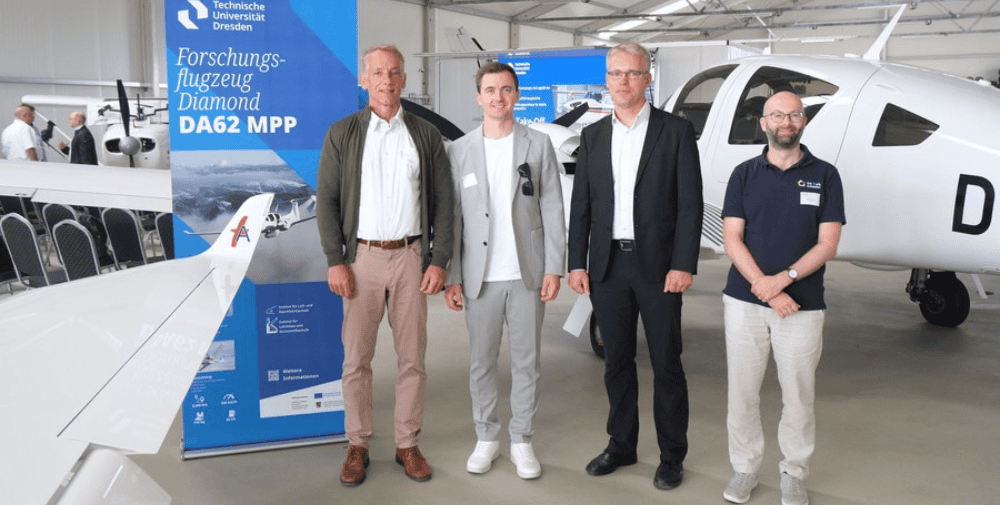
The Kamenz airfield serves as an important test site for research into autonomous air mobility. Among other things, the site features a mobile 5G campus network, a center of excellence for autonomous flight, and the TUD’s Cessna 172 research aircraft, which serves as a technology and test platform.
Background: “Air-Take-Off” Research Project
The “Air-Take-Off” research project runs from June 2024 to October 2026 and received a total of approximately 2.1 million euros in funding as part of the 2021–2027 EFRE/JTF research and development grant program. Participants included the Chair of Aviation Technology and Logistics, which served as project leader, the Chair of Aircraft Engineering, and the Vodafone Chair for Mobile Communications Systems at TUD.
Contact
TUD | Chair of Aviation Technology and Logistics
Prof. Hartmut Fricke, Project Leader
Email: hartmut.fricke@tu-dresden.de
– – – – –
Related Links
👉 https://tu-dresden.de
Photo: Lisa Dreßler