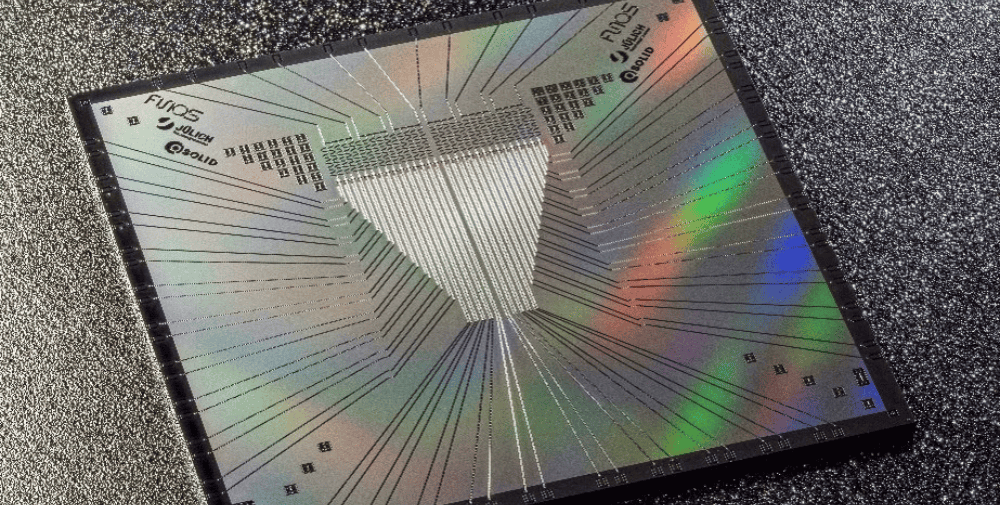
Among the project’s technological achievements is the development of an exceptionally fast quantum gate that sets new international standards for switching speed. These gates fulfill an important function within the quantum computer: They act as computational operations that can change the state of a qubit, thereby forming the basis for information processing in a quantum computer.
“The performance of a quantum computer depends crucially on how many computational steps can be executed with as few errors as possible. There are two key factors here: We can ensure that qubits maintain their quantum state for longer, or we can speed up the gate operations—that is, perform more computational steps in the same amount of time,” explains Prof. Frank Wilhelm-Mauch of Forschungszentrum Jülich, who is coordinating the large-scale project.
“Especially when it comes to gate speed, we have made important methodological advances in QSolid that extend far beyond the scope of the project and demonstrate that we have very powerful components and that the integration of hardware and software has already reached a high level of maturity,” says the quantum physicist and director of the Peter Grünberg Institute for Quantum Computer Analytics (PGI-12).
Fraunhofer IPMS: Established semiconductor technology supports the scalable fabrication of quantum processors
Fraunhofer IPMS has made important contributions to the development of scalable quantum processors in QSolid. The focus was on the cryogenic characterization of CMOS circuits in collaboration with GlobalFoundries, ADMOS, and RacyICs. In addition, an innovative advanced packaging solution was developed jointly with Fraunhofer IZM-ASSID as part of the Center for Advanced CMOS and Heterointegration Saxony (CEASAX). So-called interposers are used to connect the quantum chip and the control chip in a space-saving manner. The key challenge is to reliably transmit signals while simultaneously protecting the sensitive quantum chips from heat. The work builds on proven methods from industrial silicon semiconductor manufacturing and contributes to the future realization of quantum processors with significantly more qubits.
Dr. Benjamin Lilienthal-Uhlig of Fraunhofer IPMS explains: “Through our work on the QSolid project, we have demonstrated how proven technologies from industrial semiconductor manufacturing can be leveraged for the development of future quantum computers. The combination of cryogenic control electronics and innovative interconnect technologies is an important step toward making quantum processors more powerful and more scalable in the future.”
Collaboration Between Science and Industry
A key achievement of QSolid is bringing together expertise—previously spread across numerous locations and partners—in the joint development of a large-scale scientific facility.
“With QSolid, we have demonstrated that here in Germany we can design, manufacture, and operate functional quantum processors from the ground up in a short period of time. This is a crucial prerequisite for the further development of the German quantum ecosystem and a major success for the highly qualified students, scientists, and engineers who made this possible,” explains Prof. Rami Barends, director of the Peter Grünberg Institute for Functional Quantum Systems (PGI-13) at Forschungszentrum Jülich, which was founded shortly before the project began.
Professional systems engineering, based on methods originally developed for space exploration, enabled specialized partners to test their technologies in combination and successfully develop them into joint quantum systems. In addition to Forschungszentrum Jülich, the Leibniz Institute for Photonic Technologies (Leibniz-IPHT) in Jena, the CiS Research Institute for Microsensor Technology in Erfurt, the Karlsruhe Institute of Technology (KIT), and the Physikalisch-Technische Bundesanstalt (PTB) in Braunschweig contributed their expertise.
The software also reflects the well-coordinated collaboration within the consortium. The software stack of the current demonstrators combines solutions from Zurich Instruments, Qruise, Bull, ParityQC, and HQS Quantum Simulations. Innovative hardware components, such as connectors from Rosenberger and cables from Supracon, also played a key role in enhancing the performance of the quantum computers.
Successful Completion of the Project
From October 27 to 29, project participants from all over Germany will gather in Jülich for the closing event to present results and discuss insights gained from their joint work. The achievements range from tested quantum computer prototypes with external cloud access to expertise that has already been incorporated into specific products and services.
The project, which received 76.3 million euros in funding from the Federal Ministry of Research, Technology, and Space (grant number 13N16150), pooled expertise from across the country and brought together partners from academia and industry. Through the joint development of a quantum ecosystem, companies gained early access to this future technology and were empowered to act more effectively in the technological arena.
About Fraunhofer IPMS
Fraunhofer IPMS is a leading international research and development service provider for electronic and photonic microsystems. Our technologies find applications in industry, mobility, biotechnology, and medical technology. At the same time, we address key future fields such as quantum technologies and neuromorphic computing. Through our research in the field of green microelectronics, we contribute to a resource-efficient and sustainable world. Through the Center for Nanoelectronic Technologies (CNT), Fraunhofer IPMS offers applied research on 300-mm wafers for microchip manufacturers, suppliers, device manufacturers, and R&D partners.
About the QSolid Project
Acronym: QSolid
Title: Solid-State Quantum Computers
Duration: January 2022 – December 2026
Budget: €76.3 million (89.8% funded by the BMFTR)
Partners: Jülich Research Center, Fraunhofer IZM and IPMS, Karlsruhe Institute of Technology, Leibniz IPHT, ParityQC, HQS Quantum Simulations, Rosenberger, University of Ulm, Physikalisch-Technische Bundesanstalt, Qruise, University of Stuttgart, Free University of Berlin, IQM, University of Konstanz, University of Cologne, Heinrich Heine University Düsseldorf, Supracon, ParTec, Racyics, AdMOS, LPKF Laser & Electronics, MKS Atotech, s+c / Eviden, Globalfoundries, CiS Research Institute for Microsensors, Zurich Instruments
Website: www.q-solid.de
– – – – –
Related Links
👉 www.ipms.fraunhofer.de
👉 www.q-solid.de
Photo: Jülich Research Center / PGI-13