Many AI tools write a script that someone runs later. Autonomous Instrument Control runs the measurement itself. The connections to the instruments stay open for the whole session, and the agent works its way through a loop of hypothesis, trial, error and retrial until something works. Every command and every measured value is logged along the way.
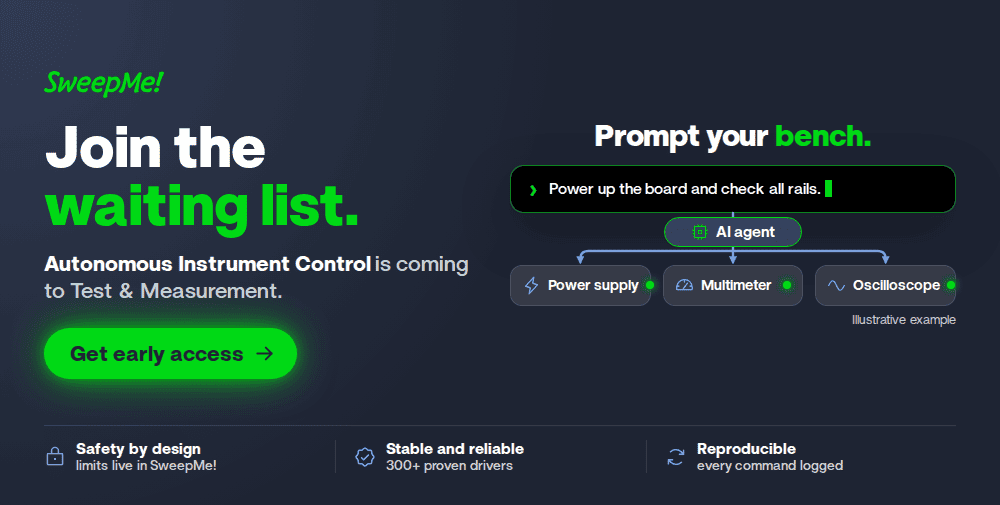
For example, the agent is asked to power up a new board and check all supply rails. It switches on the power supply, measures the voltages with the multimeter, captures the ripple on the oscilloscope and uses the values to decide where to look next.
SweepMe! stays the host
The agent communicates with the bench over MCP, the Model Context Protocol, an open protocol for connecting AI models to tools and data sources. SweepMe! is the host: the software manages the drivers, ports, folders and safety rules, and gives the connected AI agent access to a clearly bounded and described part of the bench.
This is how SweepMe! addresses the obvious concern that an AI model at the bench could damage the device under test. Limits, allowed ranges and permitted actions are defined in SweepMe!, not in a prompt, and the agent works within these limits. Thanks to the SweepMe! driver library with more than 300 instruments, many devices can be integrated easily and reliably. Because every session is logged, an AI-driven experiment can be reviewed, handed over and repeated. On request, the agent also creates summaries, plots and illustrations of the results.
Made for bring-up and debugging
The feature is intended for the bring-up and debugging of hardware, from ASICs to boards to any other device under test (DUT). It comes into play wherever the next step depends on the last measurement: when powering up a new circuit for the first time, when chasing a fault across several instruments, or when exploring an unknown parameter space before a fixed measurement procedure exists.
Autonomous does not mean unattended. The agent takes over the time-consuming loop of trial and error. Control and the final interpretation of the results stay with the human at the bench.
Autonomous Instrument Control complements the SweepMe! sequencer and does not replace it. The sequencer remains the tool for defined procedures that need to run reproducibly. The new feature is aimed at everyone who works their way toward a task step by step, command by command. What works can then be saved as a setting and run as often as needed.
“We have always seen SweepMe! as an open platform that brings together instruments from different manufacturers,” says Dr. Axel Fischer, founder and CEO of SweepMe! GmbH. “With Autonomous Instrument Control, we are opening this platform to AI agents without giving up the safety and reproducibility that our users rely on in the lab. Now we are looking for labs and development teams who want to try the feature early on their own bench.”
Waiting list for a small first group of testers
SweepMe! is opening Autonomous Instrument Control to a small first group of testers. Everyone who signs up on the waiting list will hear from SweepMe! before the feature becomes publicly available.
Join the waiting list: https://sweep-me.net/pricing/ai-instrument-control
About SweepMe!
SweepMe! GmbH, based in Dresden, is a spin-off of the Institute of Applied Physics at TU Dresden. With its software SweepMe!, measurement procedures are built by drag and drop of modules in a tree-like sequencer, with no programming needed for standard tasks. Any instrument can be integrated through an open Python driver interface, and the drivers are shared with all users. More than 300 instruments are ready to use, connected via GPIB, USB, Ethernet, COM and other interfaces. SweepMe! is used by more than 100 companies and research institutions.