“Becoming a boss isn’t hard. Being a boss, actually, isn’t much harder either.” No, this isn’t a dig at all executives. Rather, it’s the new reality of a still-young tech trend—the Agentic Enterprise. In the wake of artificial intelligence, this new corporate structure is currently sailing toward us. For all those who are now asking, “What on earth is an Agentic Enterprise?”, here is a hopefully enlightening explanation from one of the main protagonists of this development—Artificial Intelligence (AI):
“An Agentic Enterprise is a corporate organization in which autonomous AI agents and human employees work together seamlessly. Unlike in traditional automation, agents independently break down overarching goals into subtasks, make data-driven decisions, and execute processes, while humans primarily monitor the results.”
Early adopters are currently creating exciting AI experiments
In short, we’re all (except our bosses) well on our way to getting promoted. Great news, even if only in the rarest of cases will a pay raise enrich our bank accounts or a fancy title grace our business cards. True, at the moment there are only a few companies that are actually trying to consistently democratize leadership. But they do exist—the early adopters—those people and companies brave enough to try out tech trends long before the masses.
One of these early adopters in the field of the Agentic Enterprise is the exciting experiment that Dominic von Proeck and his startup “Leaders of AI” launched not too long ago. With a maximum of ten human employees, von Proeck aims to scale his company as far as possible. The goal is to find the point at which either the “Agentic bubble” bursts or the ten human employees, along with the company, reach the limits of what is humanly possible.
New employees are created on the basis of “Make a wish!”
That point is still a long way off. So far, those ten full-time human equivalents are supported by just over 50 AI agents. Each human employee now manages digital personas—sometimes a larger number, sometimes a smaller one. The team is growing, and it’s growing nonstop. Hiring no longer happens through HR professionals, headhunters, temp agencies, or even the employment agency. No, at Leaders of AI, new hires—at least according to the entertaining story—are sometimes simply generated in-house over weekends with plenty of pizza and little sleep. Only a mischievous mind would think ill of it.
The trusted HR manager is the Chief Technology Officer (CTO). Using code and plenty of caffeine, Stephan Hartmann initially programmed what was needed for corporate development or as team support for real employees. Now even Hartmann has his own agents working for him. AI is thus programming AI. Human colleagues now “only” provide their requirements—from skill sets to personality traits. Every new hire—or rather, new development—is assigned its own scope of responsibilities, a distinctive character, and the skills that are urgently sought or will be needed in the future. Unlike on the open job market, “make a wish” is the only valid option here. The result is non-physical employees who cannot be poached, nor are they expected to cause their bosses any other problems after an extended training phase. Von Proeck explains with a smile: those AI employees treat their “big” boss significantly better than the ten human team members. No mood swings, no misconduct disrupts daily work. What happens is programmed and thus intended from the outset. What a brave new world it is to be a boss.
Real code pros and clear goals ensure success
Von Proeck was willing to pay a premium for this feel-good luxury and brought a true AI whisperer, Stephan Hartmann, on board. There’s no “trial-and-error” coder sitting at the keyboard here. “With a master’s in Artificial Intelligence from the University of Würzburg, experience in machine learning at Volkswagen, and AI projects worth millions at EY, he knows how to turn ideas into functioning (AI) systems,” according to the company’s website. Accordingly, at least according to the company’s public image and as long as the world doesn’t face a “Terminator” moment, the startup is achieving what it desires and needs in its daily operations.
Here, humans ceaselessly optimize and maximize the output of their personal work areas. The goal is an “average annual revenue of 1.5 million euros per human employee,” according to the company’s own target. The million-euro mark, as is openly communicated, has long since been surpassed. While others struggle with DIY or tool-integrated AI Frankensteins, here they’re effortlessly rocking the business with AI personalities like Hansi, Elli, and Franz. That’s why tech giants like Google and Microsoft—for good reason—are coming to a small company with ten employees to experience Agentic Enterprise live and in action.
Let AI agents tackle manageable subject areas with clear skills
From developing scalable, high-quality processes to social media, podcasts, news, and research to sales and accounting, AI agents are available at various levels of work and decision-making. If an AI team—for example, in marketing—becomes too large, it is assigned its own AI team lead who distributes tasks, monitors work, consolidates information, and forwards it to a human for final review and approval. “Nothing leaves our company that hasn’t been approved by human employees,” explains von Proeck. Despite the AI agents having full access to all platforms, action is only taken once the human supervisor issues the “command” to execute or implement.
“Behind every great AI is a great person pulling the strings,” reads a banner at the Vodafone GO AI SUMMIT – a phrase that seems particularly apt in this context. During the event, von Proeck presented his Agentic Enterprise in Dresden to a high-level audience of experts and, surprisingly, offers a different take on the reality of AI. Because pulling the strings isn’t quite as simple as that, as the CEO reports. After all, as already mentioned, the code for AI agents no longer comes from the CTO; instead, specially developed AI agents are creating new AI agents. The new virtual employees are also trained by other AI agents. Even the prompts for tasks to be completed come from the AI—and they’re better than any human could write them. So it seems the AI is now pulling the strings. Humans are trying to control and utilize the web spun by the AI, as well as the results it generates, as best they can.
AI experts are warning more loudly than ever before about the emerging dangers
And this is precisely where the alarm bells are ringing for AI experts. In several recent articles, specialists such as AI researcher and computer scientist Stuart Russell have warned against what they see as a dangerous trend. “Humanity is in a bad situation. All the tests are sounding the alarm, the sirens are wailing. And we’re just ignoring it. That’s madness,” Russell said recently in an interview with Der Spiegel. “We don’t know what they ‘think.’ We don’t even understand exactly how they work.” That might be tolerable in a social media post or a podcast. A small startup risks its own reputation if AI agents make mistakes or commit potential abuses. However, there is no need to fear the end of the world here. But what is going on behind the closed doors of large corporations and their far more powerful AI systems?
For von Proeck, pulling the strings is of secondary importance. His AI agents are specialists in “narrow fields.” This isn’t where the fate of the world is decided. His goal is rather to free up time for all human employees. Not to get even more work done, as he credibly assures us, but to make personal contact with people—his customers. The goal is to inspire them. Through closeness, trust, and a professional personal relationship. Because even if routines and entire fields of work are handled exclusively by AI agents, direct contact with people is handled exclusively by humans.
Humans and machines can currently be distinguished—but for how much longer?
How can you tell the difference between an AI post and a human message? “When you write to me, you’ll realize I’m the one replying,” von Proeck explains with a grin. “Because my answers are short and mean.” There it is again, the reference to the consistently friendly and purely fact-based communication of his virtual employees. And likely also the reason why human employees occasionally lose their friendliness toward their boss. As a bonus, and setting aside all interpersonal challenges, AI agents neither get sick nor pregnant, do not go on vacation or to a health resort, cannot be poached nor do they quit, do not need to be brought into line during performance reviews, do not expect pay raises, nor do they expect a boss who keeps an eye on their needs with kindness and care.&
So is this the Garden of Eden whose gates we are just opening, or is it Pandora’s box?
The fact is, despite all the warnings from AI experts, artificial intelligence still has a tough time right now. Everyone wants it. Many think they need it. But if you believe surveys and studies like the one on “Democracy in the AI Age” by the Vodafone Institute for Society and Communication, very few people really trust it. People from twelve European countries were surveyed. The results are, to put it diplomatically, mixed. Even though the focus here is more on threats to democracy and freedom of information, this general mistrust can also be applied to the business world. Or would you trust a colleague at work whom you find suspicious in your personal life or who even poses a threat?
Artificial intelligence is not (yet) a job killer, but a results accelerator
Added to this is the fear held by many that AI agents could take over jobs, displace people, and create a new reality of work. Uli Irnich, CIO Advisor EMEA at Salesforce, offers some reassurance here. Salesforce, one of Europe’s largest software companies, currently employs 12,000 software developers. Here, too, the company is striving toward the “Agentic Enterprise,” though on a far larger scale than the “Leaders of AI.” Nevertheless, the company is no longer considering reducing its human developer workforce. “If every developer is assigned five AI agents to assist them, we turn 12,000 developers into 60,000. Projects can then be implemented faster and rolled out to customers,” explains Imich. It remains to be seen whether this view will still hold true once AI executives and AI agents outshine their human bosses.
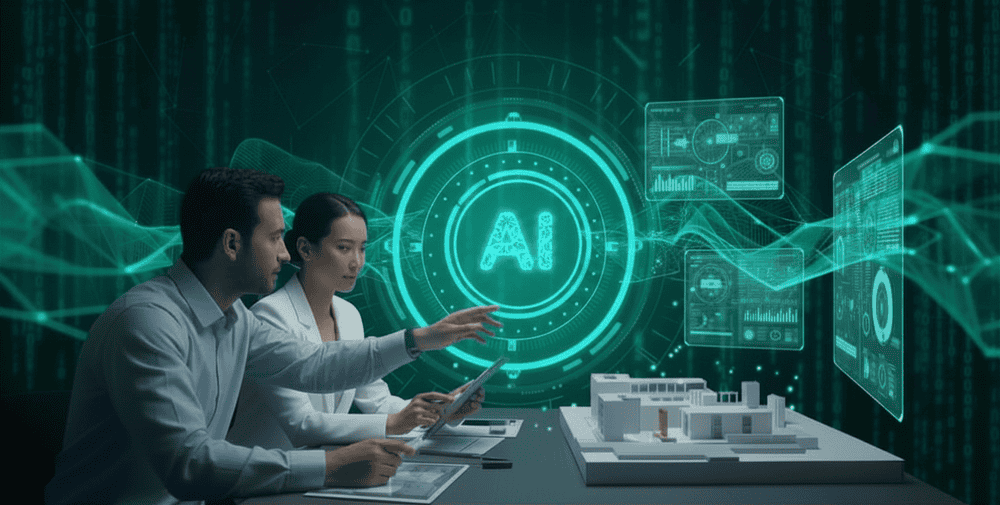
Artificial intelligence can then worry about tomorrow’s problems. At the very latest when the first Agentic Enterprise is no longer led by a human, but by the AI itself. So far, most companies are still grappling with clunky and mostly rather slow-witted standard AIs. They create mediocrely designed images with Canva (see header), consistently structured texts with ChatGPT, and—hopefully—research that isn’t a collective hallucination with Perplexity. The new AI world is often not yet as brilliant as exceptions like “Leaders of AI” make it seem. But as we know, AI learns quickly. In a few months, all of this could look very different. So be patient with your AI agents; be friendly and kind. Who knows what the future holds and who will be calling the shots soon.
– – – – –
Further Links
👉 https://www.leadersofai.com
👉 https://www.vodafone-institut.de/publication/democracy-in-the-ki-age/
👉 https://www.salesforce.com/de/agentforce/agentic-enterprise/
👉 https://www.ey.com/de_de/agentic-enterprise-ai-drives-digital-transformation
Photo: Canva AI