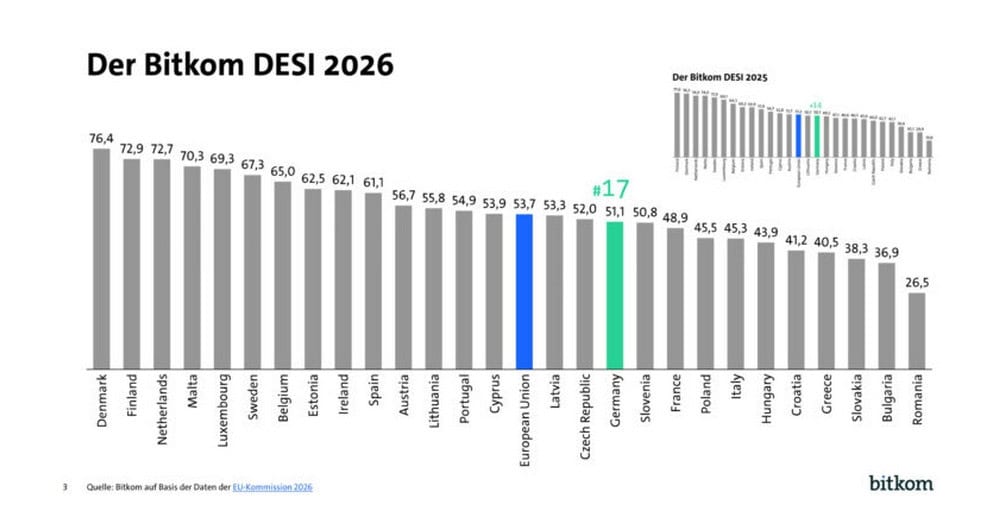
“Germany is making progress in digitalization, but other countries are moving faster. If we want to take the lead in the digital race, we must not only improve but also accelerate our efforts,” says Bitkom President Dr. Ralf Wintergerst. “Ranking 17th cannot be Germany’s goal. This calls for simultaneous action by policymakers at the federal and state levels, the business community, and educational institutions, among others.”
Since 2014, the European Commission has been compiling comprehensive data on the digitalization of member states. Until 2022, it published the so-called DESI—the “Digital Economy and Society Index”—based on this data, featuring an overall ranking of EU countries. Since 2023, such an overall ranking no longer exists. Instead, as part of the “2030 Digital Decade Report,” the European Commission reports on the relevant individual indicators, such as digital skills, 5G coverage, fiber-optic availability, the use of digital technologies in businesses, and digital public services. Using this set of indicators and the established EU methodology, Bitkom once again compiles individual, sector-specific, and overall rankings. The new Bitkom DESI comprises 44 indicators. In the 2026 overall ranking, Denmark takes first place with 76.4 points, followed by Finland (72.9 points), the Netherlands (72.7 points), Malta (70.3 points), and Luxembourg (69.3 points). Wintergerst: “A large, federal country like Germany can only be compared to a limited extent with Luxembourg, Estonia, or even Denmark. Among populous, geographically large countries, Germany is well positioned. Spain, which also has a federal structure, is a pioneer in this regard and shows that Germany, too, can do better.” At the bottom of the rankings are Romania (26.5 points), Bulgaria (36.9 points), and Slovakia (38.3 points).
For Germany, the rankings in the individual categories are as follows:
- In the “Digital Transformation of Businesses” category, Germany ranks 11th in the EU, down from 8th the previous year. Among the five largest EU countries, Germany ranks first. Here, Germany showed a slightly better performance than the EU average, particularly in terms of the number of unicorns—that is, startups valued at more than one billion euros. Denmark ranks first in this category, followed by Finland, the Netherlands, and Belgium.
- In terms of “quality of digital infrastructure,” Germany also ranks 11th (up from 9th the previous year) and 2nd among the five most populous EU countries. 5G coverage now reaches 99.5 percent of households, exceeding the EU average of 96.8 percent. In terms of “use of digital infrastructure,” Germany ranks only 21st, as the vast majority of households do not use the super-broadband and fiber-optic connections available in their area. Only 7 percent of the population uses a broadband connection with a speed of at least 1,000 Mbit/s.
- In the “Digital Skills” category, Germany has improved by four ranks, moving from 15th place in 2025 to 11th place today. Among the five largest EU countries, Germany ranks second. The proportion of IT professionals is encouraging: They account for 5.5 percent of the workforce in Germany, compared to the EU average of 5.0 percent. Germany also exceeds the EU average of 5.5 percent with a 6.2 percent share of graduates in IT disciplines. Ireland, Finland, and the Netherlands achieve the highest scores in digital skills.
- In terms of the “digitization of public administration,” Germany ranks only 22nd out of 27 EU countries, down from 21st the previous year. Although progress has been made here as well—for example, with pre-filled forms—Germany’s score has risen to 52.0 points but remains well below the EU average of 75.9 points. Digital government services are used by 69.6 percent of internet users in Germany, compared to 76.0 percent across the EU. Malta ranks first in digital government, followed by Estonia and Finland. Among the five largest EU countries, Germany ranks third in this segment.
Wintergerst: “The key question is: How do we put Germany on a faster path to digitization—and thus to growth? It’s important that we accelerate our digital projects—from company incorporations in 24 hours to faster approvals for data centers, cell towers, and factories, all the way to the widespread use of AI in businesses. And we need smart regulation: less bureaucracy, simpler reporting requirements, digital identities, and the ‘once-only’ principle, so that citizens and businesses only have to provide their data once. Digital transformation must not remain piecemeal. Germany needs a digital North Star—for greater prosperity, competitiveness, resilience, and sovereignty.”
– – – – –
Further Links
👉 www.bitkom.org
Image: Bitkom