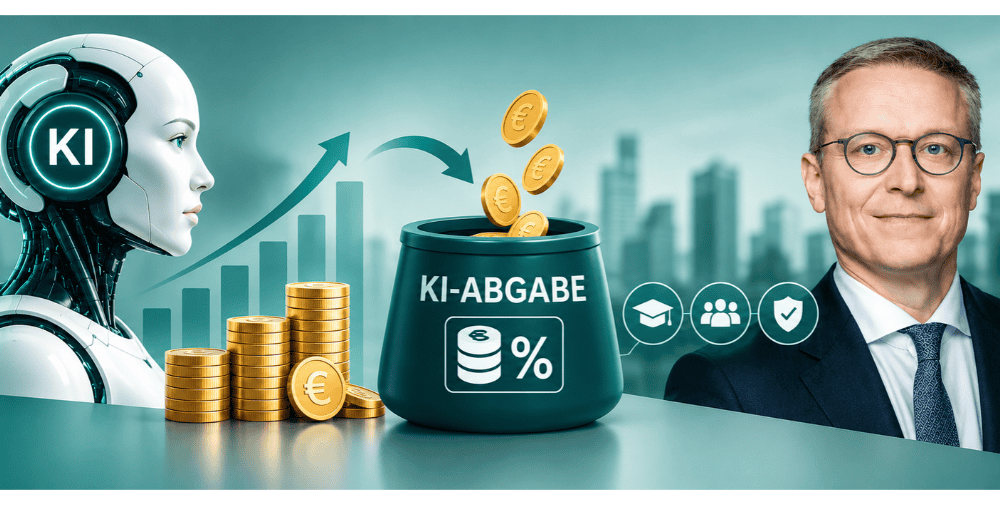
A tax is intended to finance the AI transformation without hindering it. A contradiction?
On October 13, 2026, Wildberger spoke out in an interview with the Tagesspiegel in favor of taxing revenue generated by artificial intelligence. The revenue is intended to prepare people for a changing job market, finance retraining, and open up new career opportunities. Wildberger expects AI to fundamentally transform the job market, even though companies are currently still creating additional jobs through the development or use of AI.
The proposal is noteworthy because it brings together two political debates: the taxation of large technology companies and the financing of social change driven by technology. The underlying idea is that a portion of the economic returns from AI could help cushion or even cover the costs of the upcoming labor market adjustments.
However, exactly what such a tax might look like remains entirely open at this time. Wildberger’s political initiative and his demands do not currently specify a tax rate, a precise tax base, or binding rules. Nor is it clear whether only providers of AI products should be taxed, or whether companies that use AI in their services and production processes should also be taxed.
Unfortunately, this proposal for an AI levy is being made alongside other European tax proposals that currently appear uncoordinated and could directly impact Europe’s attractiveness to innovative technology companies. After all, Europe’s direct competitors in AI—namely Asia and North America—are still holding back on such initiatives. The focus there is currently more on regulations designed to make the development of AI solutions safer. This is a step that Europe has already taken. But more on that later.
Digital tax, AI levy, or robot tax—what’s behind these ideas?
The terms digital tax, AI levy, and robot tax sound similar but represent fundamentally different approaches to how Europe intends to tax technologies—or the companies that create or use them.
A digital tax covers certain digital business models, such as online advertising or digital intermediary platforms. France and the United Kingdom have already introduced such taxes. The central issue here is where internationally active companies generate their revenue and where they should pay taxes accordingly.
An AI levy , on the other hand, could specifically target revenue from AI products and services and tax it. The question here is whether only the sale of AI solutions or the provision of AI services should be taxed, or whether the use of AI solutions in companies—provided it yields monetary benefits for the companies—should also be taxed.
A robot tax would be an even more far-reaching approach. It could, in principle, tie in with general automation and, specifically, with the tax advantages that arise when companies replace human labor with machines or technologies. Automation would then be subject to taxation and could include an AI levy.
The current situation is: Germany and Europe have not yet implemented any of these proposals.
In Germany, however, a digital tax was discussed this year. The Greens proposed a levy of 10 percent on certain digital revenues of large corporations, similar to the French or British model. It was intended to apply to companies with at least 750 million euros in global annual revenue and at least 50 million euros in relevant revenue in Germany. However, the Bundestag’s Finance Committee rejected this proposal on June 24, 2026.
This initiative by the Greens must, however, be clearly distinguished from Wildberger’s proposal. The digital tax was primarily intended to cover large digital business models. Wildberger, on the other hand, focuses his proposal on the economic returns from AI and the financing of labor market restructuring.
The Costs and Profits of AI—An International Issue
The question of how automation might affect tax revenues and social security has also been a concern for international organizations in the past. For example, in 2024, the International Monetary Fund examined how tax policy could help distribute the monetary benefits of generative AI more widely.
The analysis conducted in this context already identified the fundamental tension. AI can increase productivity and create new economic opportunities. At the same time, it can displace workers, prolong transition periods in the labor market, and increase economic inequality.
However, the IMF did not consider a blanket robot tax to be the appropriate approach. It could slow investment and innovation and would be difficult to define. Instead, the IMF recommended examining tax incentives that favor the use of human labor and, where appropriate, imposing higher taxes on capital gains from AI. At the same time, education, continuing education, and social security would need to be strengthened—an approach similar to the one Wildberger has now proposed.
The reasoning behind this seems clear. It is not necessarily the technology itself that needs to be taxed. Rather, what could be decisive is how the profits from its sale and/or use are taxed and whether the resulting public revenue is sufficient to cushion the impact of the transformation triggered by AI.
Europe, the U.S., and Asia have very different priorities
International AI policy, on the other hand, does not usually revolve around taxes and strengthening social systems. Countries such as China and the U.S. set very different priorities—ranging from binding rules for companies to promoting their own industries. In both nations, however, social considerations clearly take a back seat.
For its part, the European Union has already created a comprehensive legal framework with the AI Act that classifies AI applications according to their risk level. Certain applications are prohibited, and special requirements apply to high-risk systems. The goal is to limit risks to fundamental rights and security and to establish common rules for the European single market. Now, ideas for financing the AI-driven transformation are to follow.
China, meanwhile, combines the regulation of generative AI with state control, security requirements, and the development of its own technology industry. Japan is heavily investing in AI, semiconductors for the AI sector, and computing infrastructure. South Korea combines the promotion of the AI industry with legal requirements for trustworthy systems. Singapore, in turn, is working with practice-oriented guidelines for the responsible use of AI.
These differences in approach demonstrate that international AI policy sets very different priorities. For the most part, the focus here is not on social aspects, but solely on technological ones. Holding the technological lead is often seen as more crucial than managing the changes brought about by AI—particularly in society and, specifically, in the context of work. Governments frequently attempt to influence technological development solely through safety regulations, public investment, or industrial policy programs. However, the long-term consequences that this development has or could have are of a rather secondary nature. In this regard, credit must be given to Germany and Europe for at least taking a broader view and working on solutions to impending challenges that go beyond the technology itself.
And the tax issue in particular—as cumbersome and problematic as it may sound at first glance—has the potential to provide a platform for addressing the public’s fears, ranging from job losses to the widening of the social divide. After all, especially when it comes to large technology companies, the question of where profits are generated, where they are taxed, and how to prevent international corporations from minimizing their tax burden—to the detriment of national economies—by shifting profits has been on the table for quite some time.
Who bears the costs of progress without hindering progress?
One argument in favor of an AI tax is that it could provide additional funding for the education sector and social services. Both of these are areas that have recently been subject to significant cuts in Germany. If companies increase their productivity and profits through the use or provision of AI solutions, it seems at least plausible to use a portion of the additional value created to finance social programs.
However, a sales tax presents difficulties. It burdens not only particularly profitable companies but, under certain circumstances, also providers with low margins or losses. Furthermore, it is difficult to determine what portion of revenue is actually attributable to AI. A company may simply use AI as a tool, or it may directly sell AI systems or offer AI-based services. Should there be tax differences depending on the company’s business model?
Added to this is the international dimension of such a tax. A special national or European tax could prompt companies to adapt their business models or restructure certain revenue streams. It could also trigger conflicts with trading partners. Wildberger himself emphasized in the *Tagesspiegel* that a fair global system is needed in the long term. But how can there be a global system when nearly all nations and regional blocs fundamentally prioritize different goals in the AI sector? If Wildberger is asking how Germany itself can generate more growth and value creation in the AI sector, the answer surely cannot boil down to a tax that places a heavier burden on AI companies in Germany than in competing nations without such a tax.
This reveals a conflict of objectives and the real stumbling block of this idea. A tax is intended to finance societal costs, but it must not be designed in such a way that it hinders precisely those investments on which future growth and employment depend. It sounds like a “chicken-and-egg” problem.
An unresolved distributional issue and the first contradictions
The debate over an AI tax is therefore more than just a discussion about an additional tax base. It touches on the question of how a society deals with a technology that can increase economic profits while simultaneously transforming existing jobs.
Wildberger’s proposal relies on a direct contribution from AI-generated value to finance the restructuring of the labor market. The IMF, on the other hand, favors a broader review of tax rules, particularly regarding investment income and tax incentives for automation. Both approaches revolve around the same challenge: How can the economic benefits of AI be harnessed without imposing the costs of change solely on workers and the general public? However, both approaches must also contend with global technological competition among different political and social systems.
Even here in Germany—and not even within the same political party—there is no consensus. Wildberger’s proposal was immediately picked up by the media. On October 14, Minister of Economic Affairs Katherina Reiche publicly contradicted her fellow party member (both CDU) in the online edition of *Die Welt*.
It remains to be seen whether, in the coming years, a special AI tax, a reform of existing taxes, or an international agreement uniting all nations—from Asia to Europe to the Americas—will actually emerge. What is clear is that as technology advances, the debate over how its benefits are distributed—and what responsibility technology must bear for the changes it brings about in societies—is also gaining in importance.
Ultimately, it is not just a matter of how much artificial intelligence companies worldwide are allowed to use and what AI should or should not be permitted to do in principle. It’s about who can benefit from these technologies and who ensures that people can keep pace with the societal changes these technologies bring about. This is a discussion that has now begun in Germany but, given the globalized nature of the world, cannot be conclusively resolved here.
– – – – –
Further Links
👉 Interview with Digital Minister Karsten Wildberger in the Tagesspiegel
👉 Economy Minister Katherina Reiche’s rebuttal in *Die Welt*
Photo: created with or by AI