“Technological sovereignty refers to the ability of a state or a confederation of states to independently develop, control, and apply a key technology,” explains American artificial intelligence when asked. A valid statement, yet one that highlights in a single sentence all the problems associated with this rather ill-fitting concept—namely, “independence in the technological sphere.” After more than three decades of globalization, the establishment of cross-border supply chains, and the development of innovations that connect nations, the focus has suddenly shifted back to “us versus them”—to autonomy, independence, gaining an advantage, and isolation. It is no longer about achieving more together, but about achieving more on our own than those who are perceived as “threats” and who pursue their own ambitious goals.
After the end of the “Cold War,” globalization shaped an entire industry
With the end of the “Cold War” in the 1990s and the associated end of bloc formation “East versus West,” this political, economic, and social mindset had, in fact, already been overcome once before. Two political systems that had previously excluded one another and developed independently merged into a global whole. Borders opened up. Collaborations were established across continents and nations. Globalization took hold and shifted the balance of power once again. The “U.S. versus Russia” struggle gradually gave way to economic competition among America, Europe, and Asia. At first, this seemed peaceful and based on mutual understanding. Always with the stated aim of harnessing the distinct strengths of each of the three players for the greater good. Asia became the workshop. Europe became the innovation hub. The U.S. became the digital tech giant. Yet the boundaries between them grew increasingly blurred.
The U.S., China, and Europe ignited the “chip war”
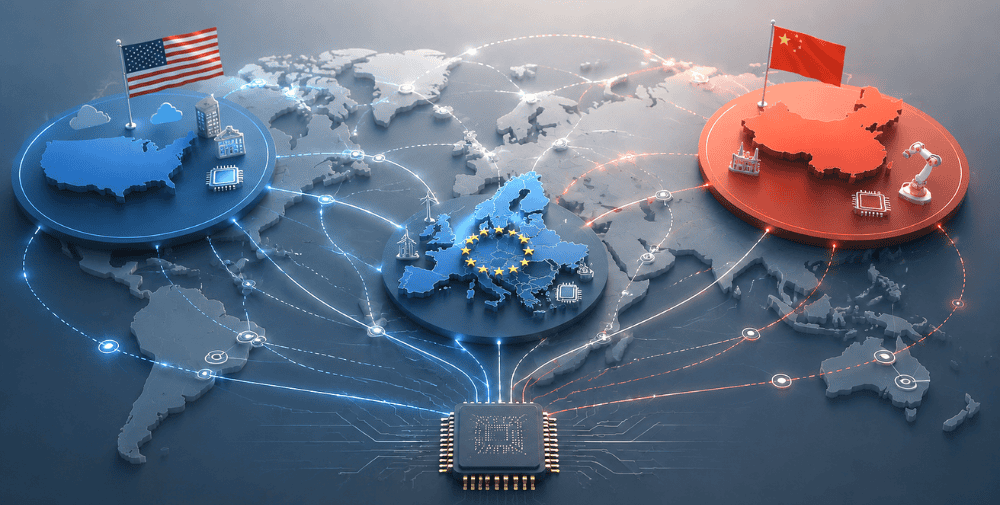
But with China’s growing power ambitions and its catch-up in nearly all sectors—as a former emerging economy—the U.S.’s return to its old great-power mentality, and Europe’s indifferent positioning between these two grinding millstones, the shared aspirations seem to have come to an end. The high-tech sector, in particular, now exemplifies the intensifying struggle among what are now three political and economic systems—America, Europe, and Asia. Or to break it down to the key technology of the high-tech sector, “The Chip War” has flared up, as Chris Miller called it in his book of the same name, or “The Game of Chips” has erupted, as Salah Nasri titled his gripping read.
An internationally well-connected industry is set to become continentally independent
A technology that had flourished in a globalized economic world suddenly became the focal point of skirmishes and petty squabbles among the world’s major powers. This increasingly reduced to absurdity the reality of global semiconductor production—and that of a thoroughly international industry—that had previously been communicated and lived out. A single microchip can cross up to 80 national borders on its journey from design to finished product. Up to 20 countries—or the international players based there—are actively involved in this process. And yet the prevailing political view, not only in Europe, is that one could become independent, sovereign, or even autonomous in the realm of this key technology. It’s as if one were deciding to go it alone when it comes to climate or weather: “You guys go ahead and have sunshine. We’d rather rely on rain.”
Yet everything is inextricably intertwined. The political attempt to make one’s own country or confederation of states more independent elicits, at best, an exasperated smile from the business and industrial sectors. Over decades, companies from a wide variety of countries have built up supply chains, partnerships, and—viewed negatively—dependencies. And suddenly, are these very same internationally active players—whether American, European, or Asian—with their subsidiaries located in nation-states, supposed to ensure the sovereignty of a single country or an economic union?
Preferential rights for products are being established, supply restrictions are being imposed, and collaborations are being regulated for those companies located within one’s own sovereign territory. The U.S. and China have recently been outdoing each other in these efforts. Raw materials (e.g., rare earths), machinery, equipment, and technologies have become political pawns. An economic nuisance for corporations accustomed to success. But even more importantly, it is sheer madness in the vast landscape of global challenges—from climate change to overpopulation.
More and more initiatives, programs, and alliances are flooding the continental markets
Hardly a week goes by now without the three global rivals launching or forging new initiatives, programs, funding pools, projects, attempts to block progress, or alliances in the field of microelectronics. Whether publicly or behind closed doors, efforts are underway in many places to break down what is essentially inseparable, rethink it, delineate it, and thereby make it more autonomous and independent for their own purposes in the long term. What sounds like diversification is more like a fragmentation of what has long been established. There are many ideas and approaches, but unfortunately, especially in Europe, there is little coordination, expertise, or transparency. Politics thus becomes a stumbling block for the economy, industry, and international cooperation. The attempt to advance one’s own territory becomes a threat to everything that has been built up over 30 years of globalization in the semiconductor industry.
Europe and Germany are pursuing unclear goals with questionable means
Europe and Germany are prime examples of diffuse and uncoordinated action in this regard. On June 27, the European Union, Germany, and other countries joined the “Pax Silica” alliance. Coordinated by the U.S. State Department, this alliance—aimed at securing AI and semiconductor supply chains—is intended to counter China’s dominance. Twenty-four countries have now joined. For example, after joining, the Netherlands openly and unequivocally announced its participation and also made clear demands of the U.S. As for Germany, aside from a brief LinkedIn post by the German Embassy in Washington, there has been no word to date regarding Germany’s accession to “Pax Silica,” its own demands, or its intentions.
At the same time, the U.S. has recently introduced a concerning framework with the MATCH Act, which, once enacted, could also have a direct impact on cooperation within Pax Silica and other international alliances. Export bans (including those on DUV lithography) targeting China, Chinese companies on restriction lists, and the requirement that allies comply with these and other guidelines within 150 days or face restrictions of their own—all of this illustrates the complex situation we are knowingly entering. Is this what sovereignty looks like, or is it a new form of dependence? It would be so important for member states in alliances like Pax Silica to take a clear stand and not submit silently. Yet the decision made by the federal government and large parts of Europe is different.
Yes, at the European and German levels, there is currently a lack of a clear plan and a transparent course of action. Want another example? On July 9, the CHIPDIPLO conference in Brussels, titled “Semiconductors Under Geopolitical Stress: From Global Shocks to the European Chips Act 2.0,” experts from business, industry, associations, politics, and beyond. On the very same day, the launch of the new EU project ICOS² (“International Cooperation on Semiconductor Innovation and Supply Resilience”) took place simultaneously at Tyndall in Ireland. Two events on the same topic took place on the very same day. Both are going their own way; they are not coordinated with one another and do not even seem to be aware that the other initiative exists.
From Saxony to Europe—too many cooks spoil the semiconductor broth
There are strategies—ranging from the Saxon strategy to the German strategy to the European semiconductor strategy. There are alliances—ranging from regional ones like the European Semiconductor Regions Alliance (ESRA) to blocs like Pax Silica. There are funding sources, ranging from local development banks like the SAB to national initiatives such as the Important Projects of Common European Interest (IPCEI) to continental initiatives like the European Chips Act 2.0. Ministries at the state level, at the national level, and even within unions of states like the European Union are advancing the same or very similar issues—with significant overlap—in parallel yet independently. It’s a jumble of opinions, possibilities, and approaches. Or as the saying goes: “Too many cooks spoil the broth.”
How can we achieve the full impact or collaborate in a targeted manner as a continent or alliance of nations in a complex field such as microelectronics? Examples such as the Organization for Economic Co-operation and Development (OECD) show that there is another way. Within this framework, over 50 economies have presented several well-researched papers (including “Vulnerabilities in the Semiconductor Supply Chain” and “Mapping the Semiconductor Value Chain”) and demonstrate on a larger scale that global cooperation remains possible. It offers an alternative to the “East versus West” or “Europe versus the U.S. versus China” bloc mentality. In a multilateral, data-driven, and open manner, they are seeking solutions that do not end at national borders or continents. However, there is a catch here as well—China is not a member of the OECD.
Our Conclusion
As a key technology, microelectronics is a foreign policy issue and must be communicated and contextualized transparently—this is something we must internalize. Here, more than anywhere else, it is crucial to take clear positions, think on a global scale, and not misjudge the realities of an entire industry. Supply chains and dependencies cannot be changed at the push of a button or by political decree. What is far more important is dialogue with partners—but also with political adversaries. Ultimately, all sides are interdependent to varying degrees or must adapt to the circumstances of a complex, interconnected industry. “More is better” is certainly not a sensible approach. As important as it is to focus on initiatives, funding, alliances, and thus collaboration, it is equally important to coordinate all of this effectively and steer it in a productive direction. Different approaches that attempt to achieve the same—or even identical—goals cannot produce the optimal result. Ultimately, microelectronics must once again be considered on a larger and more global scale. If Europe does not want to be ground down in the long term by Chinese and American interests, it must find ways to move beyond bloc thinking.
Our recommendation: The upcoming podcast “What’s chippening” with Jan-Peter Kleinhans
Silicon Saxony Managing Director Frank Bösenberg will discuss some of these initiatives in our podcast “What’s chippening” with Jan-Peter Kleinhans, a longtime microelectronics analyst at Stiftung Neue Verantwortung and interface, and current OECD expert. What Mr. Kleinhans documented five years ago in his role as an analyst—such as the geopolitical vulnerability of the semiconductor value chain and the lack of manufacturing in Europe—is now a bitter reality. You can therefore look forward to hearing what viable paths Mr. Kleinhans envisions for Europe and the world. Give it a listen. It’s worth it!
– – – – –
Related Links
Pax Silica
Official U.S. Department of State website
State Department announcement on the summit/initiative
EU/Germany Joins (Euronews)
Netherlands (contrasting example)
Press release from the Dutch government with a quote from the minister
Ratification Despite Opposition to the MATCH Act (Tom’s Hardware)
MATCH Act
Text of H.R. 4281 (Congress.gov)
Analysis of DUV Export Controls (Tom’s Hardware)
Analysis: “Industrial Policy Dressed as National Security” (R Street)
ChipDiplo Conference in Brussels
Conference “Semiconductors Under Geopolitical Stress” (CSDS): Semiconductors Under Geopolitical Stress: From Global Shocks to the European Chips Act 2.0 – CSDS
Institut Montaigne project page
EU announcement regarding the CHIPDIPLO selection
ICOS² / Tyndall
Project page (predecessor: HOME ICOS 2 – ICOS Semiconductors)
Tyndall announcement on the kickoff: ICOS² Project Launches to Strengthen Europe’s Semiconductor Resilience and Global Partnership
OECD SIEN
“Vulnerabilities in the Semiconductor Supply Chain”
“Mapping the Semiconductor Value Chain”
Common Taxonomy / Background
Kleinhans Paper 2021 (SNV / interface)
“Geopolitics of the Global Semiconductor Value Chain”
“The Lack of Semiconductor Manufacturing in Europe” (April 2021)
Podcast
“What’s Chippening”
Photo: created using artificial intelligence