Some PFAS are suspected of causing genetic mutations and promoting cancer; for many, the biological effects are still unknown. The group comprises more than 10,000 short- and long-chain industrial chemicals whose exceptional chemical resistance is due to their particularly stable carbon-fluorine bonds. PFAS enter rivers and oceans via wastewater and are spreading worldwide. High concentrations of PFAS have also recently been detected in the Elbe River—a potential health hazard for plants, animals, and humans.
Researchers at the HZDR are investigating, within the context of the National Water Strategy, how to reduce the burden on water bodies and specifically break down these “forever chemicals.” The strategy aims to secure the drinking water supply in Germany and advance water protection. In an initial study conducted starting in 2022, the research team led by postdoctoral researcher Dr. Ysabel Huaccallo-Aguilar used a process known as hydrodynamic cavitation to break down PFAS.
Cavitation breaks the stable bonds
“In hydrodynamic cavitation, we pass PFAS-enriched water through a constriction, thereby generating small vapor bubbles,” explains Dr. Sebastian Reinecke, head of the Department of Water and Environmental Technologies at HZDR. Since long-chain PFAS are surface-active, they adhere to the vapor bubbles. “When these bubbles implode—which happens when the ambient pressure in the flow behind the constriction rises—the PFAS attached to them are exposed to locally very high temperatures of several thousand degrees Celsius,” Reinecke explains. At the same time, cavitation produces highly reactive hydroxyl radicals that react nonspecifically with substances in their surroundings. “Our hypothesis is that they attack the intermediate products and thus significantly intensify PFAS degradation.”
Ysabel Huaccallo-Aguilar and her colleagues were able to demonstrate that the PFAS dissolved in tap water were broken down by the process, while organically bound fluorine was mineralized. As the treatment duration increased, the fluoride concentration in the solution rose continuously. For their experiments, the researchers used perfluorooctanesulfonic acid (PFOS), a particularly persistent and well-studied compound from the PFAS group. By the end of the experiment, they were able to degrade approximately 37 percent of the dissolved PFOS molecules at a stable degradation rate. “In follow-up experiments, we are now working to increase the degradation rate,” explains Reinecke. “Our goal is to advance the process to the point where we can degrade more than 80 percent of the PFAS in the solution and mineralize more than 50 percent of the fluorine bound in the chemicals—that is, break down the carbon-fluorine bonds typical of PFAS.”
Highly reactive plasma species can also efficiently decompose PFAS
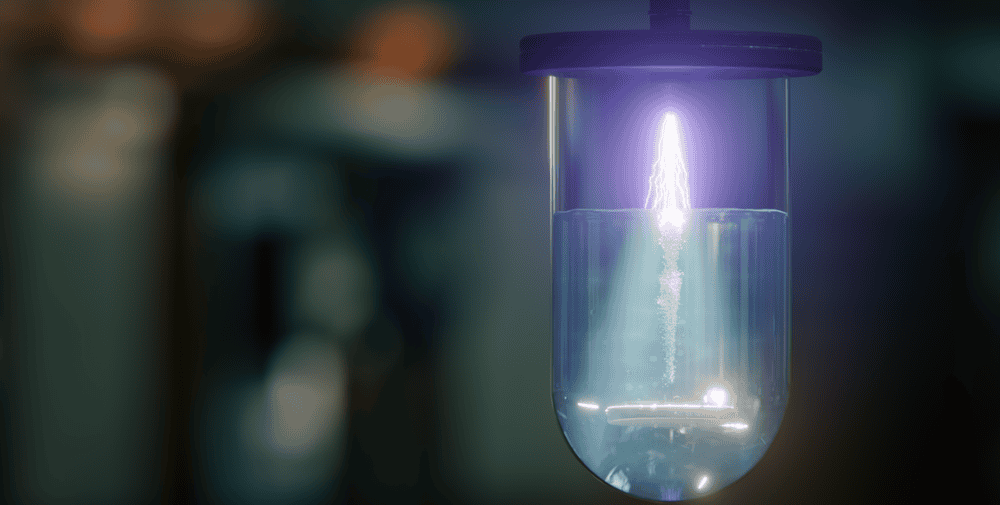
In another series of experiments, environmental engineer Dr. Amit Kumar used cold atmospheric plasma in combination with gas dispersion to degrade PFAS. The advantage: The process operates under ambient conditions and requires neither catalysts nor additional chemicals. During his doctoral research, the postdoctoral fellow had already investigated how the reactive chemical species generated in the plasma could be used to degrade micropollutants. He now applied this experience to the experiment. “We generated plasma at the water’s surface and simultaneously introduced gas into the PFAS-contaminated water,” says Sebastian Reinecke, explaining the experimental setup. “The PFAS accumulate on the surface of the gas bubbles. As these rise, the liquid is constantly circulated. This brings the PFAS to the water’s surface, where they are broken down in the plasma.”
Using this method, both long- and short-chain PFAS could be degraded almost completely. About 35 percent of the fluorine atoms bound in these “forever chemicals” were released as fluoride salts. “The reaction kinetics here are significantly faster than with cavitation, although the energy consumption per unit volume is also considerably higher,” says Reinecke, summarizing the results. “In addition, numerous transformation products are formed that we have not yet been able to investigate in detail—such as the gaseous compounds produced during the reaction.” The researchers are currently investigating in further test series whether substances of health concern are formed in the process and, if so, how this can be prevented.
Synergistic Effects from the Combination of Plasma and Cavitation
The researchers are currently working on scaling up the process for larger volumes of contaminated water. To do so, they are using multiple electrodes and a technical gas injector and gradually increasing the reaction volume from about 50 milliliters to five liters. They then plan to combine the plasma technology with cavitation. “I think we’ll achieve high degradation rates if we combine the highly reactive species from the plasma with the effects of cavitation,” says Reinecke. If they succeed in combining the advantages of both methods into a single approach, this could lead to a new technology in the long term for efficiently removing PFAS from contaminated water.
Publications
Amit Kumar, Ysabel Huaccallo-Aguilar, Holger Kryk, Uwe Hampel, Sebastian Felix Reinecke:: Enhanced degradation and defluorination of perfluorooctane sulfonate (PFOS) in tap water using gas-dispersed cold atmospheric plasma, in Scientific Reports, 2026 (DOI: 10.1038/s41598-026-57490-6).
Amit Kumar, Anett Georgi, Ysabel Huaccallo-Aguilar, Markus Meier, Holger Kryk, Sebastian Felix Reinecke, Uwe Hampel: Degradation and defluorination of perfluorooctane sulfonate (PFOS), a “forever chemical,” in water using hydrodynamic cavitation treatment, in *Chemical Engineering Journal Advances*, 2026 (DOI: 10.1016/j.ceja.2026.101046).
Funding
This research was funded by the Helmholtz Association’s Impulse and Networking Fund through the Clean Water Technology Lab (CLEWATEC), a Helmholtz Innovation Lab, under reference number HIL-A02. The projects “HyKaPro SAB-EFRE” and “Plasma4PFAS SAB-EFRE” are co-financed by the European Union and funded by tax revenues based on the budget adopted by the Saxon State Parliament.
Further Information
Dr. Sebastian Reinecke | Head of the Department of Water and Environmental Technologies
Institute of Fluid Dynamics at HZDR
Tel.: +49 351 260 2320 | Email: s.reinecke@hzdr.de
Susann Riedel | Project Manager
Institute of Fluid Dynamics at HZDR
Phone: +49 351 260 3766 | Email: s.riedel@hzdr.de
– – – – –
Related Links
👉 www.hzdr.de
Photo: B. Schröder/HZDR