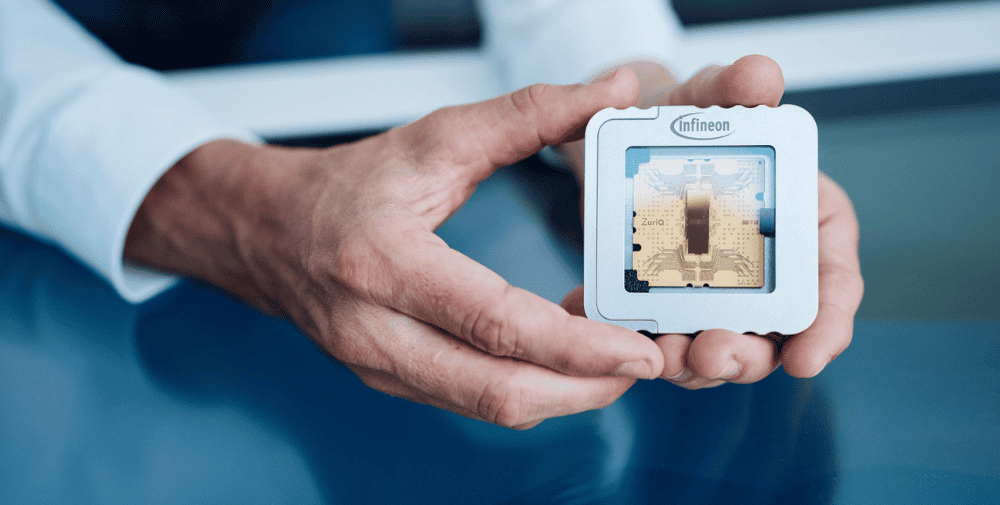
In previous development work, ZuriQ and Infineon have demonstrated the feasibility of this novel architecture. They succeeded in trapping nine individually controllable ions in a 3×3 array—the largest two-dimensional array of this kind demonstrated to date. The next step is to scale the technology to a significantly larger number of qubits. ZuriQ’s quantum computing innovations and Infineon’s industrial manufacturing expertise lay the foundation for this and drive the development of next-generation quantum computing systems.
“To further develop quantum computing into a commercially viable technology, close collaboration between quantum innovators and leading industrial companies is essential,” says Pavel Hrmo, co-founder and CEO of ZuriQ. “Together with Infineon and its extensive expertise in process development and semiconductor technology, we are making ZuriQ’s technological advances scalable and industrially viable. This brings us a decisive step closer to our goal of developing quantum computing technologies for concrete applications.”
“Advances in quantum computing require not only breakthroughs in physics but also robust manufacturing technologies for the development of future large-scale systems,” said Clemens Rössler, Senior Director and Head of Quantum Processing Units at Infineon. “With our expertise in semiconductor manufacturing, integration, and advanced packaging and interconnect technologies, we are enabling the next generation of trapped-ion quantum processor units. By combining our semiconductor expertise with ZuriQ’s design and architecture expertise, we are setting an important milestone toward the industrialization of this key technology.”
Unlike conventional quantum computers with one-dimensional ion chains, ZuriQ relies on a two-dimensional Penning microtrap architecture. Electric and magnetic fields make it possible to move the ions directly across the chip. Since the architecture does not require complex interconnect structures, larger qubit arrays can be implemented more easily. Combining this approach with Infineon’s advanced photonics and semiconductor processes is a crucial factor in accelerating the transition from laboratory demonstrations to real-world applications.
Two-dimensional ion technology offers a promising approach for precise and scalable quantum processors, enabling powerful and reliable quantum computers for real-world applications. Quantum computers have the potential to solve highly complex problems that even today’s supercomputers cannot handle.
The collaboration between an innovative quantum computing startup and a world-leading semiconductor company strengthens the European quantum ecosystem and Europe’s position in this strategically important technology field. Advances in quantum computing can accelerate innovation in fields such as medicine, logistics, materials science, and artificial intelligence, and open up new solutions for particularly complex computational problems.
About ZuriQ
Founded in 2024, ZuriQ AG is a quantum computing company based in Switzerland and a spin-off of ETH Zurich. By developing a novel architecture for trapped ions based on static electromagnetic fields, ZuriQ aims to overcome key challenges in scaling quantum computers. The company focuses on high-precision quantum operations, rapid scaling of the number of qubits, and reconfigurable quantum systems, thereby paving the way for commercially relevant quantum applications.
About Infineon
Infineon Technologies AG is a global leader in semiconductor solutions for power systems and the Internet of Things (IoT). With its products and solutions, Infineon is driving decarbonization and digitalization. The company has approximately 57,000 employees worldwide (as of the end of September 2025) and generated revenue of approximately 14.7 billion euros in fiscal year 2025 (ending in September).
– – – – –
Related Links
👉 www.infineon.com
Photo: Infineon