October 22, 2026. Germany is still not making full use of its technological strengths.
Categories

October 22, 2026. Germany is still not making full use of its technological strengths.
Categories
Tags
Contact info
Silicon Saxony
Marketing, Kommunikation und Öffentlichkeitsarbeit
Manfred-von-Ardenne-Ring 20 F
A new analysis by Anita Wölfl, a research fellow at the ifo Center for Innovation Economics and Digital Transformation, highlights Germany’s importance in global value chains while also explaining why strengthening AI, software, and domestic demand will be crucial for the EU Chips Act 2.0.
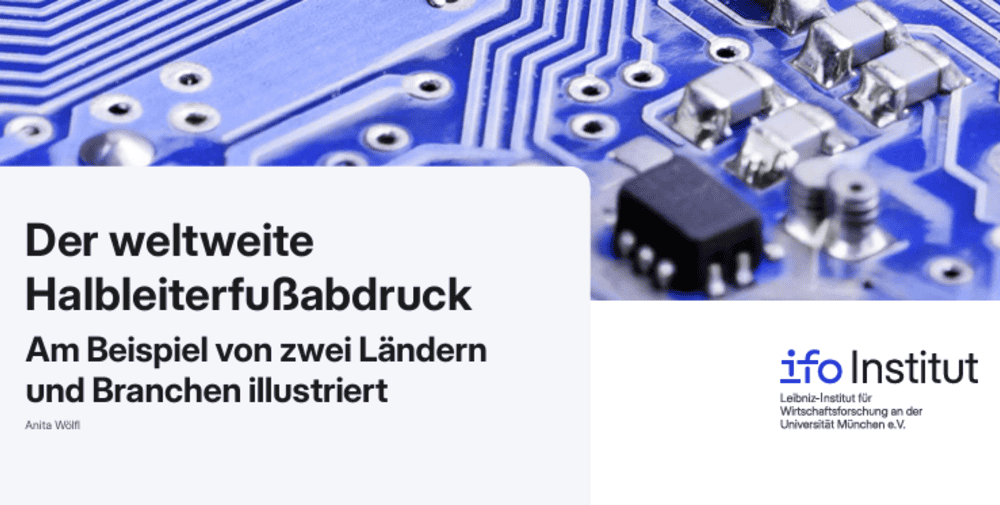
How significant is the actual economic contribution of the German semiconductor industry? And where does the value added made possible by German chips originate? A new study by the ifo Institute explores these questions. The study, “The Global Semiconductor Footprint,” published on October 14, 2026, compares Germany with the U.S. and, for the first time in this format, examines not only the direct demand for semiconductors but also their indirect significance along international production and supply chains. The result: Germany is better positioned in the global semiconductor industry than some direct market comparisons might suggest. At the same time, considerable economic potential remains untapped domestically.
Today, semiconductors are found not only in smartphones, computers, and vehicles. They enable modern industrial facilities, smart power grids, medical devices, digital services, and artificial intelligence applications. Their economic contribution therefore extends far beyond actual chip production.
This is precisely where the study comes in. It traces how semiconductors contribute to the manufacture of products and services across multiple stages of international value chains and where these products and services are ultimately in demand. For example, a chip produced in Germany can be installed in a machine that is subsequently used in the United States. Its contribution to value creation thus also occurs outside of Germany.
The so-called semiconductor footprint maps these direct and indirect connections. In doing so, the study broadens the perspective on the economic significance of the semiconductor industry and, at the same time, provides an important foundation for the further development of the European semiconductor strategy.
A key finding of the study is the strong international position of the German semiconductor industry. Its contribution to global consumer and investment demand, across all stages of the value chain, amounts to about one-seventh of the corresponding U.S. contribution.
The structures differ significantly: While the U.S. semiconductor industry benefits substantially from its own domestic market, the German industry is much more export-oriented.
This difference is particularly pronounced in the machinery and automotive sectors. In each of these sectors, the total global value-added contribution of German semiconductors is more than five times as high as the contribution to the corresponding domestic demand. A similar picture emerges in information and communication technology.
The IT services sector is particularly noteworthy. If we consider domestic demand alone, the U.S. semiconductor industry’s contribution to value added is about 23 times higher than that of Germany’s. However, when global demand is taken into account, this ratio drops to about seven to one.
The German semiconductor industry is thus internationally competitive but benefits comparatively little from the development and use of new digital technologies within its own country.
The study identifies the varying degrees of adoption of data-driven technologies as a key reason for this trend. In particular, artificial intelligence, cloud computing, and high-performance data centers are driving demand for modern semiconductors.
The U.S. has a significant lead in this regard. According to the estimates used in the study, the United States accounts for about 75 percent of global high-performance computing capacity for modern AI applications, with China accounting for another 15 percent.
In Germany, by contrast, the adoption of AI is progressing relatively slowly. According to Eurostat, just over 26 percent of German companies were using at least one AI technology in 2025. This placed Germany ninth in a European comparison.
This development has direct consequences for the semiconductor industry. New AI applications are not only driving up demand for particularly powerful processors and memory chips. Power semiconductors, sensors, communication chips, and analog and mixed-signal technologies are also needed—for example, for power supply, cooling, and control in modern data centers or industrial AI systems.
European manufacturers have particular strengths in these areas. Among other things, the study points out that European companies are global leaders in power semiconductors and will collectively achieve a market share of around 40 percent by 2024.
Based on the findings, the study identifies several areas for action to boost the adoption of modern technologies and, consequently, the demand for semiconductors.
Accelerate the Adoption of AI and Digitalization
Companies need clearer rules—with as little red tape as possible—for data protection, data availability, and the use of artificial intelligence. Public administration can also provide additional impetus by making data available and utilizing innovative technologies.
Strengthen startups and technology transfer
Young companies can develop new applications and turn research findings into marketable products more quickly. This requires better financing conditions and a more robust venture capital market.
Facilitating investments in new technologies
There is a significant need to catch up, particularly in the area of venture capital. While such investments in Germany accounted for about 0.16 percent of gross domestic product in 2025, the share in the U.S. was approximately 0.9 percent.
Strengthen the connection between the semiconductor industry and end-user sectors
New chip technologies should be developed at an early stage in collaboration with their potential customers. This will enable innovations to reach economically relevant applications more quickly.
These recommendations are also closely linked to the EU Chips Act 2.0. Unlike the first version of the European semiconductor law, the focus in the future will not be solely on creating new manufacturing capacity. Rather, the aim is to specifically strengthen demand for chips, innovative applications, and collaboration between semiconductor companies and end-user industries.
From Silicon Saxony’s perspective, the study confirms the importance of a semiconductor strategy that goes beyond the expansion of manufacturing capacity. Europe possesses internationally competitive expertise in microelectronics, software, research, and industrial applications. At the same time, the study shows that these strengths can be integrated even more closely.
In this context, it is worth taking a nuanced look at the issue of demand. Europe already makes extensive use of digital technologies, smartphones, cloud services, and computing power. However, significant portions of the technologies and infrastructure required for this are provided by non-European companies.
The challenge, therefore, is not solely to generate new demand. Europe must work harder to meet existing and future demand through its own technologies, companies, and value chains.
Industrial AI applications and so-called Physical AI, in particular, offer great opportunities in this regard. Europe has a strong industrial base—for example, in automation, mechanical engineering, mobility, and robotics—and thus also a valuable treasure trove of data. If these capabilities and data are combined with European microelectronics and software, new markets and applications can emerge.
At the same time, the European semiconductor strategy should not focus exclusively on these traditional strengths. Expanding Europe’s own AI computing capacities and digital infrastructures also opens up significant market potential. Initiatives such as the planned European AI gigafactories can generate additional demand and improve the conditions for creating more digital value in Europe.
For Silicon Saxony, this highlights a key area of focus for the EU Chips Act 2.0: A successful semiconductor strategy must consider production, chip design, software, digital infrastructure, and industrial demand as an integrated whole. Only in this way can technological strengths be translated into long-term economic growth and greater technological capacity.
The study “The Global Semiconductor Footprint—Illustrated Using Two Countries and Industries as Examples” was authored by Anita Wölfl, a research fellow at the ifo Center for Innovation Economics and Digital Transformation. It was published on October 14, 2026, in the series ifo Schnelldienst digital (Issue 20/2026).
The analysis was conducted as part of the research project “Economics of the Semiconductor Industry,” which is financially supported by Infineon Technologies. According to the publication, the author bears sole responsibility for the content; the findings do not necessarily reflect the position of Infineon.
The ifo Institute – Leibniz Institute for Economic Research at the University of Munich e. V. is one of Germany’s leading economic research institutes. It examines economic developments and policy options and makes its research findings available to the academic community, policymakers, the business sector, and the general public.
👉 To the full study: The Global Semiconductor Footprint – ifo Institute (PDF)
You need to load content from reCAPTCHA to submit the form. Please note that doing so will share data with third-party providers.
More InformationYou are currently viewing a placeholder content from Turnstile. To access the actual content, click the button below. Please note that doing so will share data with third-party providers.
More InformationYou are currently viewing a placeholder content from Facebook. To access the actual content, click the button below. Please note that doing so will share data with third-party providers.
More InformationYou are currently viewing a placeholder content from Google Maps. To access the actual content, click the button below. Please note that doing so will share data with third-party providers.
More InformationYou are currently viewing a placeholder content from OpenStreetMap. To access the actual content, click the button below. Please note that doing so will share data with third-party providers.
More InformationYou are currently viewing a placeholder content from Instagram. To access the actual content, click the button below. Please note that doing so will share data with third-party providers.
More InformationYou are currently viewing a placeholder content from X. To access the actual content, click the button below. Please note that doing so will share data with third-party providers.
More Information