Acoustic sensors are used, for example, in medical ultrasound devices, hearing aids, and industrial equipment. They detect audible and inaudible sound waves and enable the extraction of relevant information about materials, biological samples, or the condition of technical equipment. Currently, however, existing systems for mobile or continuous applications are sometimes still too large, energy-intensive, or costly.
This is where Listen2Future came in: The project developed new piezoelectric materials and used them to build innovative acoustic sensors. Combined with advanced electronics, innovative packaging solutions, and new AI-based signal processing methods, the sensors were integrated into demonstrators. These demonstrate how future acoustic sensor systems can be designed to be more compact, energy-efficient, and intelligent.
“Sensor technology is a key enabling technology and a European area of strength. Through this application-oriented research and by collaborating with the best partners from academia and industry, we are strengthening Europe’s technological expertise in highly relevant fields. It is crucial that the results make their way from the lab into practical applications, where they generate real benefits. The project has successfully achieved this. This leads to effective innovations for medicine, healthcare, energy, and industry. And it helps to further expand the market position of European companies,” says Sabine Herlitschka, Head of Strategic Funding at Infineon.
Acoustic Sensor Systems: Small, Smart, Efficient
With 14 demonstrators, Listen2Future shows how smart acoustic sensor systems open up new possibilities for diagnostic procedures, hearing aids, industrial quality control, and the monitoring of energy infrastructure. The research team developed integrated system solutions—ranging from new materials and microelectromechanical (MEMS) components to electronics, packaging, software, and algorithms—that translate acoustic signals into usable information.
Medicine: From mobile ultrasound to rapid infection detection to hearing aids
In the healthcare sector, the consortium designed compact ultrasound demonstrators and researched novel sensor technologies for future mobile ultrasound systems. A key focus was on miniaturized ultrasound transducers and the associated electronics, signal processing, and system integration.
For infection diagnostics, ultrasound demonstrators were further developed to support the rapid, simple, and noninvasive detection of serious infections. In a use case for detecting meningitis in newborns, the scan time was reduced from ten to three minutes.
Listen2Future also investigated new compact sensor solutions for future hearing aids and hearing systems. The technologies developed demonstrated promising characteristics, particularly at high sound pressure levels. At the same time, further research is needed in the areas of system integration, long-term testing, and application-oriented user testing.
Monitoring for Power Grids and Industry
For the energy sector, the project designed an AI-based acoustic sensor system to detect so-called partial discharges. These are weak electrical discharges that can indicate incipient damage to insulation. If such partial discharges are detected and localized early on, maintenance measures can be planned more effectively, and potential outages can be avoided.
The tests conducted as part of the project successfully demonstrated the potential of acoustic sensor technology for condition monitoring of power lines, substations, and transformer stations. The technology can thus contribute to predictive maintenance and the long-term reliability of the energy infrastructure.
In the field of industrial quality assurance, Listen2Future also investigated the contactless and non-destructive testing of components and materials. Compact piezoelectric, micromechanical ultrasonic transducers were used to detect material changes and small defects.
A testing system developed in the project was 80 percent lighter and 50 percent smaller than the underlying reference solution. This opens up additional possibilities for mobile and automated testing procedures, for example in industrial manufacturing, energy technology, or aviation.
System Interaction
“Listen2Future has demonstrated the potential of integrating new materials, acoustic sensors, advanced electronics, packaging technologies, and AI-based signal processing. It was particularly important that we were able to test these technologies using realistic demonstrators—ranging from medical applications to energy infrastructure. The results provide a strong and valid foundation for further research, development, and technology transfer activities in economically and socially relevant application areas,” says Andreja Rojko, Listen2Future project manager at Infineon Technologies Austria.
Results with International Visibility
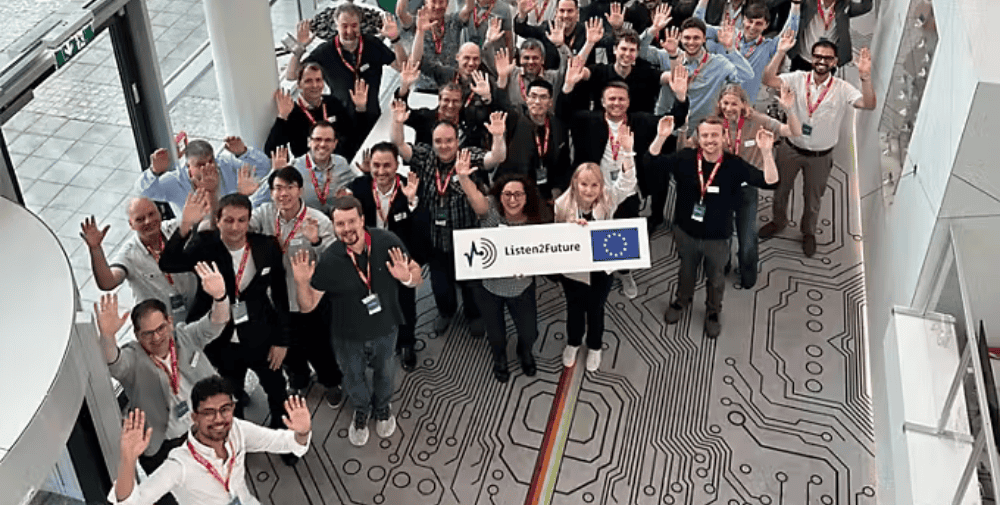
As part of Listen2Future, 14 demonstrators were developed. The consortium published 77 scientific papers, 49 of which were open-access publications. The project results were presented at 67 international conferences, workshops, and specialist events. In total, the project recorded more than 354 communication and dissemination activities, including scientific publications, conference papers, podcasts, and videos. In addition, all partners developed patents, technological roadmaps, and individual commercialization plans.
With a project budget of approximately 30 million euros, Listen2Future brought together companies, research institutions, and universities across the entire technological value chain into a research network, ranging from materials and sensor development to electronics and packaging, as well as software, algorithms, and application-specific system integration.
Project Partners
Austria: Infineon Technologies Austria AG (project lead), Silicon Austria Labs GmbH, GE Healthcare Austria GmbH & Co OG | Belgium: Pulsify Medical BV, IMEC Interuniversitair Micro-Electronica Centrum | Czech Republic: Vysoké Učeni Technické v Brně, Ústav Teorie Informace a Automatizace av cr VVI, Institut Mikroelektronických Aplikaci SRO | Germany: Hahn-Schickard-Gesellschaft für angewandte Forschung EV, Codasip GmbH, Infineon Technologies AG, Infineon Technologies Dresden GmbH & CO KG, Inoson GmbH, Path Medical GmbH, Technical University of Darmstadt, Technical University of Munich | Netherlands: Solmates BV, Sonion Nederland BV, University of Twente | Norway: Elliptic Laboratories ASA, Sintef AS, Sonitor Technologies AS | Spain: Agencia Estatal Consejo Superior de Investigaciones Científicas, Dasel SL, New Born Solutions, SMD Inductor de Analgesia SL, University of Granada
The Listen2Future project was funded under the Chips JU program with grant number 101096884. Funding was provided by the European Union and the national funding agencies of the participating countries.
Link: https://www.listen2future.eu/home
About Infineon
Infineon Technologies AG is a leading global provider of semiconductor solutions for automotive, edge systems, and power systems. With its products and solutions, Infineon is driving decarbonization and digitalization. The company has approximately 58,100 employees worldwide (as of the end of September 2026) and generated revenue of approximately 16.4 billion euros in fiscal year 2026 (ending in September).
– – – – –
Related Links
👉 www.infineon.com
Photo: Infineon