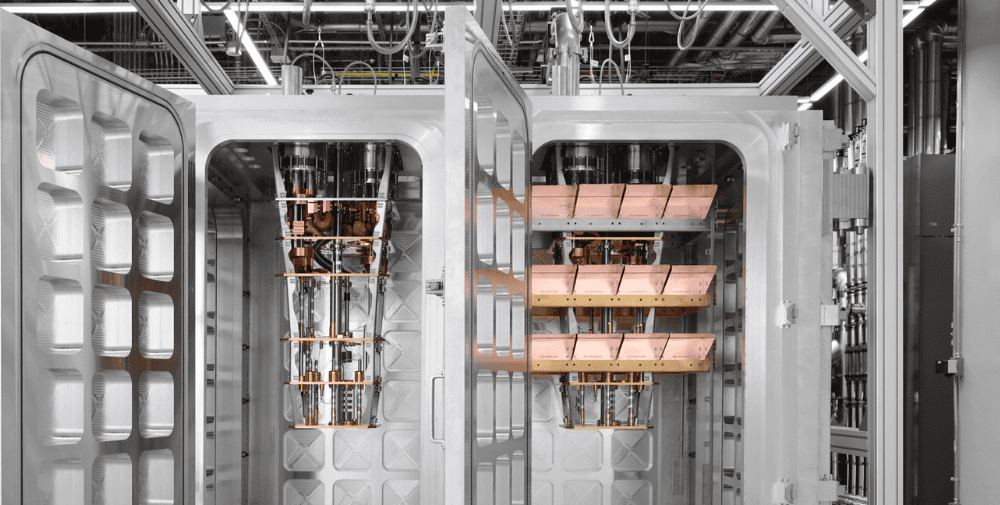
Together, the first two operational modules are more than 2.4 meters high and 2.4 meters wide. Initial tests showed that, when combined, they can be cooled to 4 Kelvin (the temperature of liquid helium) in less than five days and reach a final temperature of less than 15 millikelvin shortly thereafter. The vacuum chamber of each module offers up to twelve times more space for cabling than previous IBM quantum systems. This enables more chip-to-chip connections both within a single module and between multiple modules.
IBM’s new box-shaped design allows the modules to be arranged closely together, making use of the additional space to connect quantum processors directly using IBM’s “L-Coupler” technology. L-couplers link separate quantum chips so that they can exchange information, communicate, and work together as part of a larger quantum computer.
According to the IBM Quantum Roadmap, by 2027, L-couplers will be used to connect multiple processors into a larger quantum computer with at least 1,000 programmable qubits. Programmable qubits are qubits that can be used directly for computations. On the path to this goal, IBM will integrate IBM Quantum Nighthawk processors into the cryogenic modules later this year to further test operational performance. By the time Starling is deployed, IBM plans for each cryogenic module to house thousands of qubits.
The plans for Starling were already unveiled last year. The foundation is a new error-correction code that significantly reduces the physical resources required for fault tolerance. Since then, implementation has been proceeding according to plan, including the validation of key hardware components and significant progress in the efficient decoding of error-correction schemes.
“The development of fault-tolerant quantum computers for industrial applications depends on several fundamental technological advances,” said Jay Gambetta, Director of IBM Research and IBM Fellow. “The successful connection and operation of these cryogenic modules represent a significant step forward and will accelerate our progress, along with further innovations in quantum hardware, software, and algorithms.”
IBM expects that the scalable cryogenic modules will help shorten the development cycles of its quantum computers. For example, three key components of the IBM Quantum System Two environment are already integrated into the new architecture. However, they are now designed so that each component can be tested, improved, and further developed more quickly on its own.
The introduction of the new cryogenic quantum modules is further evidence of the consistent implementation of the IBM Quantum Roadmap and successfully addresses another key technical challenge on the path to fault-tolerant quantum computing.
About IBM
IBM is a leading provider of global hybrid cloud and AI, as well as consulting services. We help clients in more than 175 countries leverage insights from their data, optimize business processes, reduce costs, and gain a competitive edge. Thousands of governments and companies in critical infrastructure sectors such as financial services, telecommunications, and healthcare rely on IBM’s hybrid cloud platform and Red Hat OpenShift to drive their digital transformation quickly, efficiently, and securely. IBM’s groundbreaking innovations in AI, quantum computing, industry-specific cloud solutions, and consulting provide our clients with open and flexible options. All of this is based on the company’s longstanding commitment to trust, transparency, accountability, inclusion, and service.
– – – – –
Related Links
👉 www.ibm.com
Photo: IBM