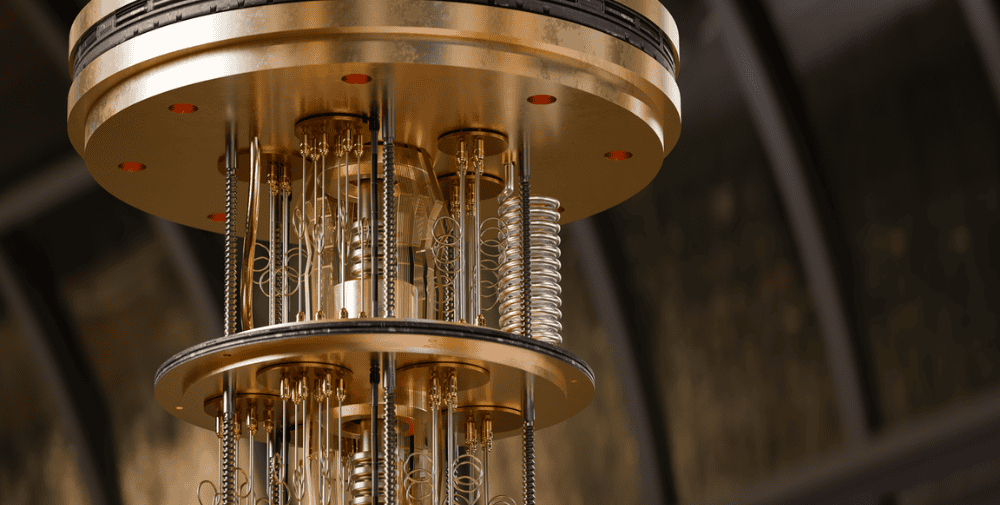
“The Quantum Zeno effect presents a previously unseen hurdle for a certain class of quantum computers,” says Dr. Gernot Schaller, head of the Quantum Information Technology Division at the HZDR Institute for Theoretical Physics. These so-called adiabatic quantum computers operate according to a special principle: Their qubits are always in the ground state—that is, the state of lowest energy. To solve a computational problem, the energy landscape of the qubits is gradually altered—so slowly that they can continuously adapt and follow the new ground state as it changes. Once the transformation is complete, the ground state immediately contains the solution to the problem.
“Adiabatic algorithms are considered robust and can be executed by quantum computers—largely independent of the hardware used,” explains Institute Director Prof. Ralf Schützhold. It therefore does not matter whether the qubits are generated using solid-state superconductors or individual ions trapped in electromagnetic traps. Both hardware variants are already being used to test adiabatic algorithms, which, from today’s perspective, can be programmed elegantly and with relative ease.
When Disturbances Become a Problem
“However, a quantum computer can only compute successfully if its qubits are not disturbed too much,” emphasizes Schützhold. Shielding against electromagnetic radiation and cooling to temperatures close to absolute zero—minus 273.15 degrees Celsius—protect the qubits from such disturbances. Only then can qubits assume all possible states between zero and one—a phenomenon known as superposition. Their quantum-physical coupling—entanglement—is also highly sensitive to external disturbances. It is the interplay of superposition and entanglement that enables the extremely fast solution of complex problems.
“But despite all these measures, the influence of the environment on the qubits can never be completely ruled out,” says Schützhold. According to the theoretical model developed by Schützhold’s team, adiabatic quantum computers become increasingly sensitive to such disturbances as they scale up—that is, as the number of qubits grows. This is because the more qubits are coupled together, the smaller the changes in the energy landscape that they must follow become. “At this point, the quantum Zeno effect kicks in,” says Schaller. Even tiny influences from the environment are then sufficient to affect the quantum states of the qubits. “Each of these disturbances acts like an unwanted measurement and halts the system’s progress,” says Schaller. “In extreme cases, a calculation could even freeze completely.”
A comparison with baking a cake illustrates the principle: For a cake to turn out right, it must rise undisturbed in the oven. If you constantly open the oven door to check whether it’s done yet, you disrupt the baking process—the cake remains flat or collapses. The situation is similar with the Quantum Zeno Effect: Every disturbance interrupts the natural evolution of the quantum state. If this happens too often, the system can no longer reach the desired final state. In extreme cases, the computational process comes to a near standstill.
However, quantum computer developers are not helplessly at the mercy of the Quantum-Zeno effect. In addition to shielding against electromagnetic radiation and heat as effectively as possible—which, in the cake analogy, would be like putting a padlock on the oven—Schützhold also proposes active protective measures. “Using the so-called spin-echo method, the coupling of the qubits to their environment could be reduced through coherent pulses.” In the cake analogy, this would be equivalent to an oven that compensates for every time the oven door is opened by briefly and rapidly heating up the interior. “Our study shows that powerful quantum computers can only be developed if the influence of the environment is taken into account from the very beginning,” Schützhold summarizes.
Publication
N. Ahmadiniaz, D. Kraft, G. Schaller, R. Schützhold: Quantum Zeno effect versus adiabatic quantum computing and quantum annealing, in New Journal of Physics (2026) (DOI: 10.1088/1367-2630/ae6e68)
Contact
Dr. Gernot Schaller | Head of Quantum Information Technology
Institute for Theoretical Physics at HZDR
Tel.: +49 351 260 3307 | Email: g.schaller@hzdr.de
Prof. Dr. Ralf Schützhold | Director
Institute for Theoretical Physics at HZDR
Phone: +49 351 260 3618 | Email: r.schuetzhold@hzdr.de
– – – – –
Further Links
👉 www.hzdr.de
Photo: B. Schröder/HZDR