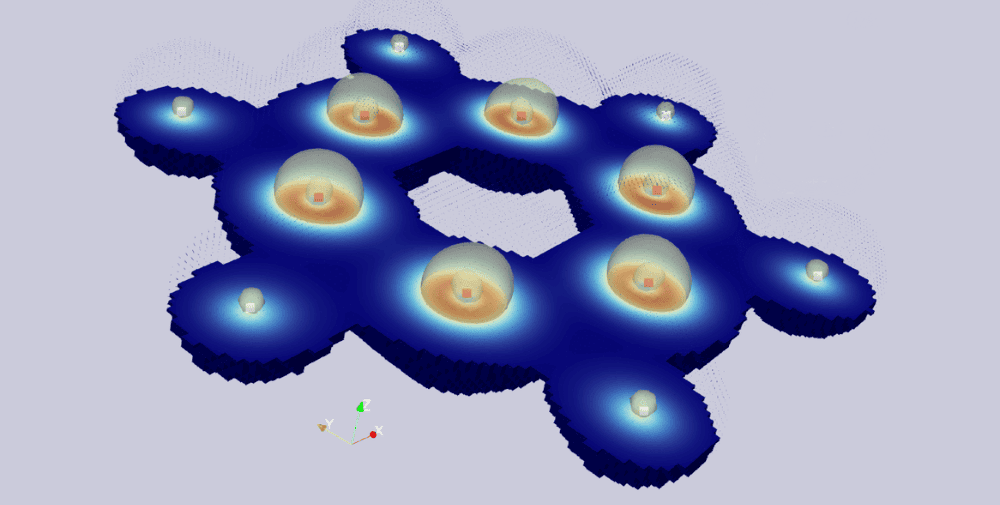

For many simulation applications, density functional theory (DFT)—which was awarded the Nobel Prize in 1998—has proven to be crucial. “The Achilles’ heel of DFT is the so-called exchange-correlation functional,” explains CASUS Director Prof. Thomas D. Kühne. In science, functionals are used to find the function best suited to a given problem. Although the exchange-correlation functionals developed for DFT in recent years have become increasingly sophisticated, the most accurate functionals require so much computation time that they can only be used for systems with a small number of particles. Skala is a new exchange-correlation functional developed by Microsoft Research AI for Science. Instead of introducing yet another layer of mathematical formulas, Microsoft took a new approach with Skala: Here, a neural network has learned how electron densities in different regions influence one another. This makes Skala one of the first AI-based exchange-correlation functionals available.
“The results presented by Microsoft Research in 2025 were impressive, particularly the combination of accuracy and computational efficiency in certain DFT calculations,” reports Kühne. “It was clear to us that we should seize the opportunity to evaluate this new approach within the framework of CP2K and explore its applicability to problems relevant to our community. Of course, we are very pleased to be the first group outside of Microsoft to confirm the benefits of Skala.” In mid-August, the scientists published the first results of their collaboration in a preprint. The results show that the chosen approach is promising. “With Skala, we achieve a noticeable leap in the accuracy of the simulations for our specific test case,” reports lead author Franz Pöschel from the CASUS “Scientific Computing Core” team.
High Interest Following the Announcement
Microsoft Research AI for Science had announced the integration of Skala into CP2K in the spring of 2026 at a conference. Since then, the community has repeatedly inquired about the status of the work. “On the one hand, we were pleased by the interest; on the other hand, we felt a certain pressure to deliver,” Pöschel continues. “I am therefore pleased to announce that Skala is now available within CP2K for simulations of molecular systems.”
Dr. Sebastian Ehlert, Senior Researcher at Microsoft Research AI for Science, explains why CP2K is so important to the Skala team: “To promote the adoption of Skala, it should be available where the community is active. CP2K has been a hub for research in computational chemistry for many years and is therefore naturally at the top of the priority list for integration.”
The CP2K ecosystem is a powerful tool for performing DFT calculations, particularly in the context of dynamic simulations of large systems over long time scales. On this open-source software platform, molecules, liquids, solids, and biological systems can be simulated using quantum mechanical methods such as density functional theory as well as classical molecular dynamics. Thanks to its efficient algorithms and the ability to execute individual computational steps in parallel on specialized computer architectures, CP2K can also compute very large systems with thousands to tens of thousands of atoms. This makes the software particularly well-suited for research into battery materials, catalysts, semiconductors, proteins, and other complex materials. CP2K was recently enhanced with features that enable the use of AI-based models. Using training data generated by CP2K, these models can predict molecular energies and forces with high accuracy. This expands the time and length scales of the simulations.
More Updates in the Works
Prior to release, the teams responsible at Microsoft Research AI for Science and CASUS extensively tested the Skala integration in CP2K. “We want to ensure that Skala delivers consistent accuracy and speed across different programs and settings,” says Ehlert. “Together with the CP2K team, we developed a series of integration tests to ensure that Skala delivers numerically correct results. We are particularly grateful for the support of the CASUS team, which has extensive experience in the numerical verification of computational methods.”
Skala is not a static solution: The AI model is constantly being improved and expanded with new capabilities. Simulations of periodic solids, such as metals and semiconductors, as well as liquids, are expected to be possible soon. CP2K can serve as a platform for rapid and widespread adoption: Thanks to the integration, users always have the latest version of Skala at their fingertips. “Microsoft Research AI for Science sets high standards for its research partners,” explains Kühne. “We are confident that this ongoing collaboration will lead to further successes following this initial one.”
Publication
F. Pöschel, J. Pototschnig, F. Stein, A. Knüpfer, T. Vogels, S. Battaglia, S. Ehlert, J. Hutter, T. D. Kühne: Molecular Implementation of the Machine-Learned Skala Exchange-Correlation Functional in CP2K through GauXC, 2026, arXiv (DOI: 10.48550/arXiv.2608.19033)
Contact
Prof. Thomas D. Kühne | Director
Center for Advanced Systems Understanding (CASUS) at HZDR
Email: t.kuehne@hzdr.de
– – – – –
Related Links
👉 www.hzdr.de
Photo: Franz Pöschel