The focus is on bismuthene, a layer of bismuth just one atomic layer thick. The material belongs to the class of so-called two-dimensional topological insulators: While its interior is electrically insulating within a certain energy range, electrons can move along its edges. These unique edge states are associated with the quantum spin Hall effect and could be significant for energy-efficient electronic components in the future.
Graphene serves as an atomically thin protective layer
One challenge is to protect such sensitive materials from environmental influences without altering their extraordinary quantum properties. The Chemnitz researchers succeeded in selectively depositing bismuthene between a silicon carbide substrate and an overlying graphene layer. This resulted in nanoscale bismuthene islands with clearly defined atomic edges.
“The particular challenge was to selectively create the bismuthene—which is only one atomic layer thick—underneath a graphene layer without impairing its extraordinary electronic properties. By combining controlled preparation with photoelectron spectroscopy, we were able to show that the two materials interact only weakly with each other. Graphene thus acts as an atomically thin protective layer,” explains Prof. Dr. Thomas Seyller from the Institute of Physics at Chemnitz University of Technology.
Theory and Experiment Confirm Extraordinary Properties
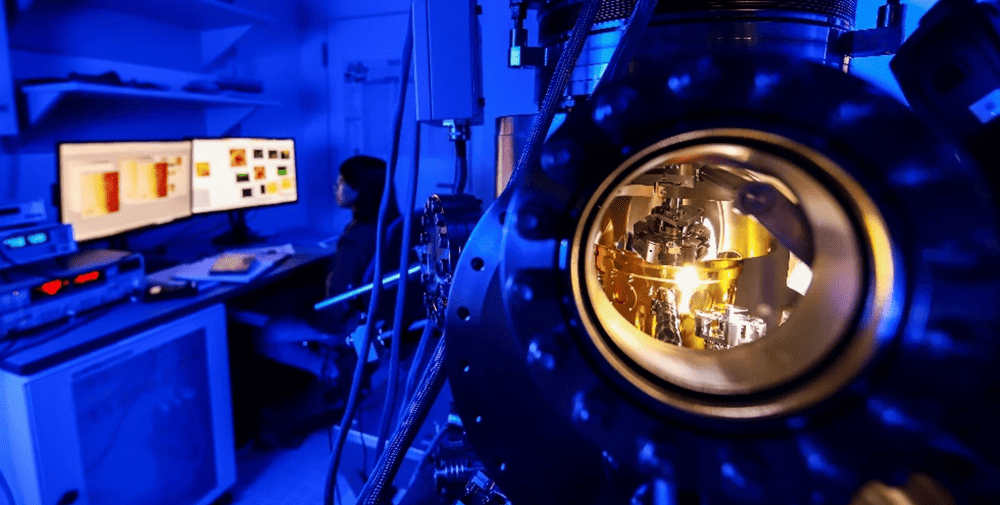
Using scanning tunneling microscopy and scanning tunneling spectroscopy, the researchers investigated the electronic properties of the bismuthene islands at temperatures as low as minus 269 degrees Celsius. This revealed a large electronic bandgap of about 0.5 electronvolts inside the islands, while characteristic metallic states were detectable at their edges. Quantum mechanical calculations based on density functional theory confirmed the experimental results and showed that the weak interaction with graphene largely preserves the electronic properties of bismuthene.
“Our quantum mechanical calculations help us understand why the unique electronic properties of bismuthene are preserved even under a layer of graphene. The key factor is the interplay between the atomic structure, the strong spin-orbit coupling in bismuth, and the comparatively weak interaction with the graphene. The good agreement between theory and experiment provides an important foundation for the targeted development of further topological materials,” explains Prof. Dr. Sibylle Gemming from the Institute of Physics and the MAIN Research Center at Chemnitz University of Technology.
Evidence of Unique Quantum Effects
In addition to the metallic edge states, the researchers found evidence of unusual behavior of the electrons along the atomically defined edges. The measurements are consistent with the model of a so-called Tomonaga-Luttinger liquid. This model describes electrons in one-dimensional systems whose behavior is largely determined by mutual interactions.
“What is particularly fascinating is that we can investigate the metallic edge states of bismuth with atomic precision through the overlying graphene layer. Our measurements not only show that these states are preserved but also provide evidence of strong interactions between the electrons along the one-dimensional edges. We have thus created a promising platform for investigating fundamental quantum phenomena. With our new 4-tip STM, we will be able to directly measure these 1D channels next year and determine any correlation effects,” says Prof. Dr. Christoph Tegenkamp of the Institute of Physics at Chemnitz University of Technology.
The results open up new possibilities for investigating topological quantum states in protected material systems. In the long term, such structures could be of interest for applications in spintronics, quantum electronics, and energy-efficient information technology. However, direct evidence of low-loss electrical transport along the protected edge channels has yet to be provided.
Contributors to the publication included Huu Thoai Ngo, Zamin Mamiyev, Niclas Tilgner, Andres David Peña Unigarro, Prof. Dr. Sibylle Gemming, Prof. Dr. Thomas Seyller, and Prof. Dr. Christoph Tegenkamp. The work was funded by the German Research Foundation (DFG) as part of Research Group FOR 5242.
Original publication: Huu Thoai Ngo et al.: “Protected Metallic Edge States in a Graphene-Capped Quantum Spin Hall System,” ACS Nano (2026) 20 (40): 27472–27481.
DOI: https://doi.org/10.1021/acsnano.6c14197
For further information, please contact the spokesperson for the DFG Research Group FOR 5242, Prof. Dr. Christoph Tegenkamp, Institute of Physics at Chemnitz University of Technology, phone +49 (0)371 531-33103, email christoph.tegenkamp@physik.tu-chemnitz.de.
(Author: Prof. Dr. Christoph Tegenkamp)
– – – – –
Related Links
👉 www.tu-chemnitz.de
Photo: Jacob Müller