Across all industries, devices are becoming smaller and more mobile and must operate on increasingly less energy. At the same time, they require reliable and low-interference data connections. Conventional wired and wireless interfaces often reach their limits in cramped installation spaces, EMC-critical environments, and situations with limited battery capacity. Li-Fi TinySpot addresses these challenges with a miniaturized optical transceiver featuring extremely low power consumption that can be integrated into sensors, wearables, and compact embedded systems. This enables manufacturers to extend the runtime of their devices, simplify the design, and ensure stable data transmission even under demanding industrial conditions.
Low power consumption and space-saving design
- Extremely low energy consumption: With a power consumption of just 5 mW, Li-Fi TinySpot extends battery life and reduces operating costs in devices where every milliwatt counts.
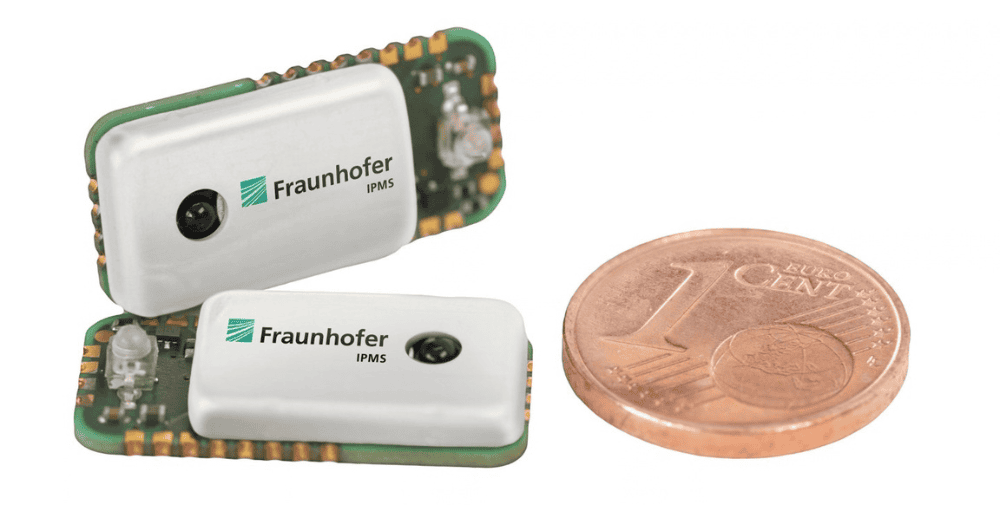
- Compact design: With dimensions of just 15 mm × 21 mm × 3.3 mm and a weight of only 1 g, Li-Fi TinySpot enables compact and highly integrated designs for sensors, handheld devices, and wearables.
- Flexible operating range: Depending on the set transmission power and field of view, the system supports distances ranging from a few centimeters to several meters.
- Safe operation: Its Laser Class 1 classification allows for operation without additional laser safety measures.
- Immunity to electromagnetic interference: Since Li-Fi uses light instead of radio waves and does not require long, wired electrical signal connections, the technology is suitable for EMC-critical environments.
- Easy integration: Standard interfaces such as UART and SPI simplify integration into microcontroller- and FPGA-based systems.
- Low latency: A low transmission latency of 170 ns supports responsive data exchange in embedded control systems and sensor applications.
- IrDA compatibility: Support for SIR, FIR, and VFIR facilitates the modernization of existing infrared interfaces without introducing wireless communication.
This makes Li-Fi TinySpot particularly attractive for battery-powered sensor systems designed for long operating times, as well as for embedded controllers and removable modules that require reliable contactless communication. Its low weight of just 1 g facilitates integration into moving, rotating, or interchangeable components. The transceiver can be mounted directly onto printed circuit boards or integrated into miniature modules and sealed enclosures—without bulky optical components or complex mechanical assemblies.
Designed for demanding embedded applications
Thanks to its contactless optical interface, Li-Fi TinySpot is suitable for applications where electrical contacts, wireless communication, or conventional cabling are impractical. These include:
- Embedded and board-to-board communication: Contactless connections between stacked printed circuit boards, sensor boards, or interchangeable modules within devices.
- Miniaturized sensor systems: Data connections for small sensor nodes in confined spaces, such as in handheld devices for logistics, laboratory equipment, precision mechanical applications, or condition and usage monitoring systems.
- Removable or rotating modules: Replacement for wear-prone microconnectors or slip rings in tool heads, small rotary tables, or compact positioning systems.
- Sealed and hygienic enclosures: Communication through small optical windows in hermetically sealed or easy-to-clean devices where exposed electrical contacts are undesirable.
- Interference-sensitive electronics: Environments with strong electromagnetic fields or densely packed electronics, where wireless technologies or long copper traces are difficult to implement.
“Li-Fi TinySpot demonstrates how optical communication can be miniaturized for compact embedded systems,” says Dr. René Kirrbach, group leader for Li-Fi at Fraunhofer IPMS. “Its contactless optical interface enables reliable data connections with low power consumption in confined spaces where conventional connectors are unsuitable due to wear, contamination, or mechanical constraints.”
For more information on Li-Fi TinySpot, visit: Li-Fi TinySpot – Fraunhofer IPMS. There you can also download the new TinySpot white paper.
Li-Fi TinySpot was developed as part of the “CommUnity” project at the Micro-Nano Competence Center.
– – – – –
Related Links
👉 www.ipms.fraunhofer.de
Photo: Fraunhofer IPMS