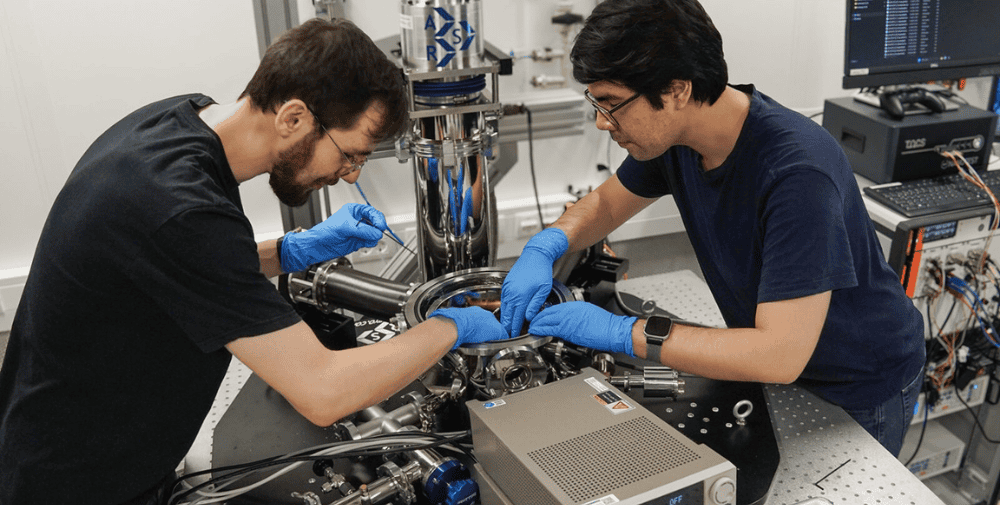
On September 2, 2026, the opening of the new laboratory was celebrated together with guests from the worlds of politics, science, and business. In attendance were Sven Schulze, Mayor of Chemnitz; Prof. Dr. Gerd Strohmeier, Rector of Chemnitz University of Technology; Robert Denk, Head of the Higher Education Division at the Saxon State Ministry of Science, Culture, and Tourism; Prof. Dr. Oliver Schmidt, Director of the Research Center for Materials, Architectures, and Integration of Nanomembranes (MAIN) at Chemnitz University of Technology; Prof. Dr. Harald Kuhn, Institute Director at Fraunhofer ENAS and Director of the Center for Micro- and Nanotechnologies (ZfM) at Chemnitz University of Technology, Prof. Dr. Bernhard Wunderle, holder of the Chair of Materials and Reliability of Microtechnical Systems at Chemnitz University of Technology, and Prof. Dr. Daniel Kriesten, Head of the European Test and Reliability Center (ETRC). CRYME provides an optimal infrastructure for researching and developing materials, components, and systems for future generations of quantum computers, as well as for evaluating their reliability.
Thanks to an investment project by Fraunhofer ENAS, funded by the Federal Ministry of Research, Technology, and Aerospace (BMFTR), state-of-the-art equipment was procured, including two specialized cooling devices—so-called cryostats—a cryogenic materials testing system for determining thermomechanical properties, and a cryogenic scanning electron microscope for material analysis at extremely low temperatures. This technology is now being operated jointly by Fraunhofer ENAS and Chemnitz University of Technology.
European Test and Reliability Center to Conduct Research at Ultra-Low Temperatures in the Future
With CRYME, the European Test and Reliability Center (ETRC)—Europe’s leading center for testing and reliability assessment of semiconductor devices—is expanding its portfolio of research services with another significant addition. Thanks to cryogenic testing methods, microelectronic components, system solutions, and new materials can in the future be comprehensively tested and evaluated in environments at extremely low temperatures of up to 4 K (-269 °C). For example, this allows for the characterization of electrical and photonic system functions, the determination of mechanical properties of materials and composites, as well as the investigation and prediction of their thermomechanical behavior.
“Today’s quantum computers require cryogenic operating conditions for their highly complex computational operations. These place the highest demands on the integrated microelectronic components and materials. It is therefore essential to test components and materials under realistic conditions to ensure their functionality, robustness, and longevity even at ultra-low temperatures. As part of the ETRC, CRYME is now creating ideal conditions for this in the heart of Chemnitz,” says Prof. Dr. Daniel Kriesten, Director of the ETRC.
At the same time, the new laboratory strengthens the close collaboration between Fraunhofer ENAS and the FMD, the Chair of Materials and Reliability of Microtechnological Systems, the Center for Micro- and Nanotechnologies (ZfM), and the Research Center for Materials, Architectures, and Integration of Nanomembranes (MAIN) at Chemnitz University of Technology, where the new laboratory is located. The new helium liquefaction plant at the neighboring Institute of Physics also plays an important role in this context, as some of CRYME’s cryostats are operated with liquid helium.
“As a key technology of the 21st century, quantum computing also stands for technological leadership, high-caliber jobs, and cutting-edge research. That is why the Chemnitz researchers involved in CRYME view the new laboratory as an essential building block for innovation, new large-scale research projects, excellent teaching, and attracting young scientists,” says Prof. Dr. Bernhard Wunderle, holder of the Chair of Materials and Reliability of Microtechnical Systems at Chemnitz University of Technology. At the same time, the collaboration taking place here is a prime example of successful cooperation on the “Smart Systems Campus” in Chemnitz—an innovative network in the fields of micro- and nanotechnology where science, applied research, and industry work closely together.
Dr. Remi Pantou, head of the “Characterization and Analytics” group at Fraunhofer ENAS and laboratory director of CRYME, adds: “CRYME’s new facilities are a key factor for collaborative projects with industry partners, as the complexity of this specialized research laboratory is unique in Germany and Europe. Several companies have expressed interest in collaborating. Specific collaborative projects have already been launched, and further initiatives are in the planning stages.”
Do you have any questions, or would you like to learn more about our research and development or new testing methods at cryogenic temperatures? Then please feel free to contact us.
– – – – –
Related Links
👉 www.enas.fraunhofer.de
Photo: Dr. Uwe Zschenderlein