EU Commission President Ursula von der Leyen said: “We cannot afford to be dependent on others for the technologies that keep our hospitals running, our energy grids stable and our services secure. It is about protecting our citizens, defending our interests and making our own decisions. Europe has the talent, the excellent research, the industrial base and the single market. Together, we must turn these strengths into technological sovereignty.”
“Chips Act 2.0”
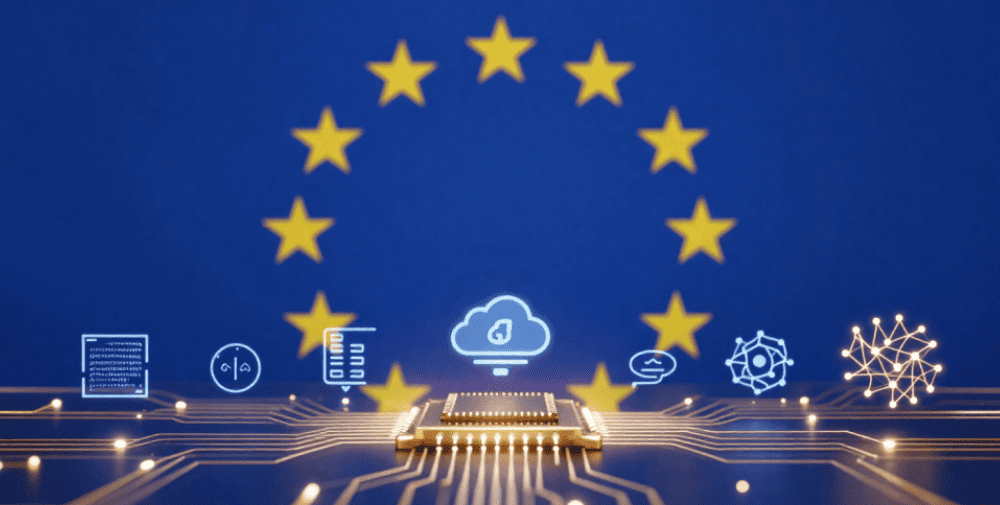
The “Chips Act 2.0” is intended to create capacities for state-of-the-art semiconductor technologies that drive AI applications. It aims to accelerate approval processes, deepen collaboration with like-minded partners and introduce a new label of excellence for Europe’s semiconductor regions. It also aims to bring European chip manufacturers closer to their customers through an ecosystem approach and build on demand from growth industries such as data centers, cloud providers and AI gigafactories. Finally, the new legislation aims to support investment and strategic projects while addressing vulnerabilities that could jeopardize supply.
Building Europe’s cloud and AI capacity
The Cloud and AI Development Act aims to promote research and innovation in cutting-edge and sustainable technologies, while aligning AI goals with climate change commitments. It aims to simplify the conditions for setting up data centers across the EU, with a focus on highly sustainable and innovative facilities on the scale needed for the transition to green and digital twins. It also aims to introduce a single EU-wide framework for assessing cloud and AI sovereignty, while leaving the majority of our market open to like-minded partners.
This should help protect critical applications and sensitive data and support the development and adoption of advanced cloud and AI technologies. The proposal also aims to support a more coordinated approach to AI adoption in the Member States, including through the AI Experience and Acceleration Hubs , which serve as local hubs to promote the integration and scaling of AI.
Strengthening digital autonomy through open source
The open source strategy aims to expand open source alternatives in priority areas such as cloud, AI, internet technologies, cybersecurity and semiconductors. It also aims to promote a stronger open source ecosystem by investing in skills, supporting open source start-ups and improving the long-term security of Europe’s open source digital infrastructure. The strategy also aims to support the increased use of open source in public administrations through procurement guidelines and best practices. It will promote the deployment of European solutions and support standards and interoperability, including through initiatives such as the Open Internet Stack.
Digitizing the European energy system while ensuring sustainable digitalization
The Strategic Roadmap for Digitalization and AI in the Energy Sector sets out how AI and other digital solutions can ensure the sustainable integration of digital infrastructure into our energy system while helping to make the European energy system more efficient.
This roadmap aims to ensure that data centers are integrated into our energy system in a sustainable and transparent way. The Commission will promote cooperation between the energy and digital sectors to ensure their efficient integration into the grid and the necessary supply of clean energy, while protecting water and energy resources. This roadmap also aims to accelerate the deployment of digital and AI solutions to improve Europe’s electricity infrastructure and make it smarter, while supporting a faster roll-out of smart meters.
In addition, it will help to develop sovereign and secure AI models for the energy sector, trained on European data and developed by European companies. By facilitating the cross-border exchange of energy data, it aims to ensure the introduction of smart energy services and flexibility that can deliver savings for millions of people across Europe.
Next steps
The legislative proposals are now being negotiated by the European Parliament and the Council of the European Union. The Commission is expected to publish a call for tenders for AI gigafactories in July. The Commission will also launch a consultation with Member States, the European Investment Bank Group and other key stakeholders to build a large-scale European equity capacity to finance Europe’s ambitions in the area of technological sovereignty.
– – – – –
Further links
👉 https://germany.representation.ec.europa.eu
👉 Chips Act 2.0
👉 Law on the development of cloud and AI
👉 Communication on the EU’s technological sovereignty and open source strategy
👉 Strategic roadmap on digitalization and AI in the energy sector
👉 Commission presents measures to digitalize the European energy system
👉 Digitalization in the energy sector
👉 Energy efficiency of data centres
Photo: Canva AI