Training Is the Treasure Trove of AI
The better an AI is trained, the greater its treasure trove of knowledge—and the more confidently it can make decisions. This determines the AI’s performance and, at the same time, poses the greatest challenge to its operational reliability. Classical AI requires large amounts of data and many training cycles. Quantum computers can accelerate and simplify this learning process—saving energy, time, data, and ultimately costs.
Quantum AI has great application potential. It can handle complex and dynamic tasks even in constantly changing environments. Potential applications exist wherever a high degree of adaptability or interaction with humans is required. Typical tasks include material handling, loading machines, grasping complex objects, using tools, assembly work, and controlling vehicles. Future applications include, in particular, humanoid robotics—ranging from caregiving and medicine to planetary missions in space exploration.
Reaping the Benefits of Future Quantum AI Today
“Quantum AI only works on quantum computers. However, there is still no universally applicable, error-free quantum computer available. Even if such computers become available in the future, not every AI-controlled device will be equipped with a quantum computer,” explains Lea Schmitz from the DLR Institute for AI Security.
To leverage the training advantages of future quantum AI on classical computers and devices with simple hardware, the institute has developed and tested a multi-stage transfer method. This method translates the training results of a quantum AI into a form that is executable and optimized for conventional hardware. This is what makes their use on small, mobile devices with simple control computers possible in the first place.
“Our goal is to be able to use quantum-trained AI independently of quantum computers in the future. We see great potential, for example, in the automation of industrial processes or in robots, whose computing power is usually significantly lower than that of a normal PC, as well as in smart devices,” says Lea Schmitz.
Robot Changes a Wheel Using Translated Quantum AI
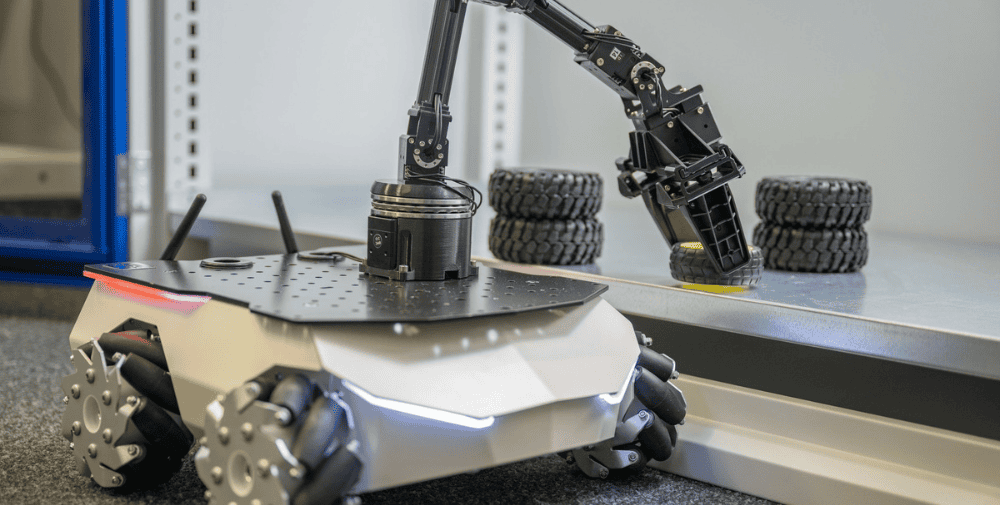
The DLR researchers have implemented the transfer concept in practice for the first time. In doing so, they have demonstrated that quantum AI can be transferred to simple and lightweight standard hardware. This is a crucial step toward harnessing the potential benefits of quantum AI in practical applications. “We demonstrate this using the example of a small mobile robot that grasps a miniature tire,” explains her colleague Lautaro Hickmann. “We trained the quantum AI in advance using a simulation of the robot. To do this, we combined the robot’s movements from a classical simulation with control by the quantum AI.”
The method is particularly well-suited for simple and lightweight hardware in mobile robots, cranes, or rovers. Another future field of application is small devices in the Internet of Things, ranging from smart, networked household devices equipped with small computers to building automation systems. The biggest challenge there is keeping the required computing power and energy consumption low. In principle, the transfer method can be applied wherever AI is used or is intended to be used.
Tensor Network Translates Quantum AI for Classical Hardware
The DLR project team first trained the quantum AI. However, the training for their robot could not yet be performed on quantum computers currently available. The motion sequences of the five-jointed gripper arm are too complex a task for that. They therefore resorted to a software simulator of a quantum computer. “When we simulate quantum physics principles such as superposition and entanglement on a classical computer, we obviously cannot achieve the same high efficiency and speed as on a real quantum computer. But we can already understand the fundamental principles,” emphasizes Lautaro Hickmann.
Using so-called tensor networks, all of the quantum AI’s training data is translated into a form that can be processed by classical computers. This consists of mathematical structures that describe geometric and physical properties. To enable the exported quantum AI to run on small devices as well, the network is further compressed and simplified. “Our method is already complete and can be used as soon as the quantum hardware for training becomes available. That’s when the process will become industrially relevant,” adds Lea Schmitz.
Quantum AI Remains Under Lock and Key
One security advantage of the transfer method is that the training of the quantum AI can take place centrally in a data center or at a company. The fully trained quantum AI remains under lock and key there. Only the training result is optimized specifically for the end devices and made available.
Furthermore, these end devices do not require a real-time connection to a quantum computer in the cloud. They can operate independently without a data connection and are thus protected against cyberattacks or data theft. This is particularly relevant for mass production. It safeguards data sovereignty and enables the widespread use of quantum AI.
This research achievement by the DLR is a key step toward making quantum AI usable in practice. The next step is to work with industry to adapt the new method to specific use cases and industrial hardware and to further develop it.
– – – – –
Related Links
👉 www.dlr.de
Photo: DLR