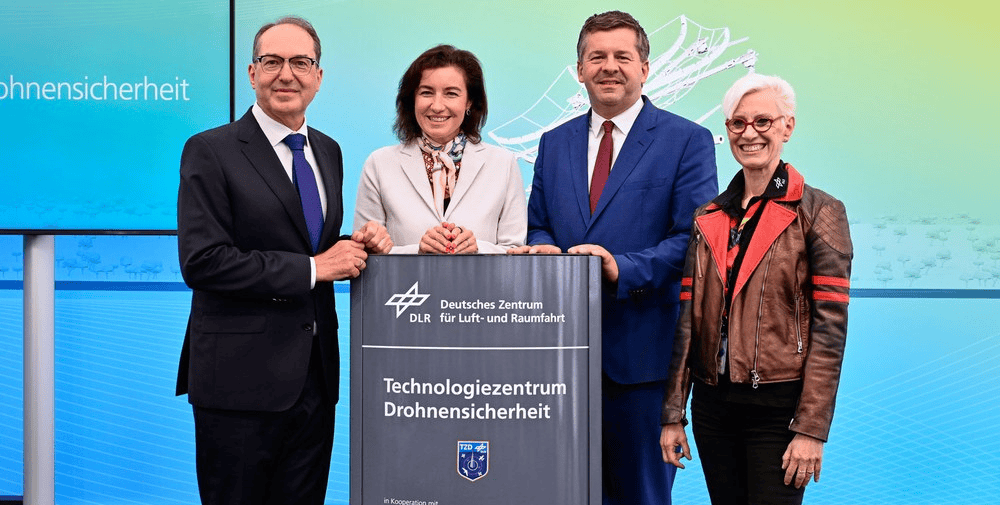
The Technology Center is primarily located at the DLR sites in Cochstedt and Braunschweig. It brings together DLR’s expertise and research infrastructure and closely links them to the practical requirements of security agencies and industry. Following the opening ceremony, DLR, together with specialized police forces, demonstrated the latest technologies and findings in drone security to guests from the worlds of politics, business, and research.
“Drones not only present enormous opportunities, they also pose a challenge. This is where the Drone Security Technology Center at the DLR sites in Cochstedt and Braunschweig will play an active role, as a logical continuation of the successful collaboration with the Federal Ministry of the Interior, federal and state police authorities, and the Federal Criminal Police Office. We need the technical expertise of research, the innovative strength and implementation skills of industry, and, above all, the perspective of those who ensure our safety in real-world operations,” explains Prof. Dr.-Ing. Anke Kaysser-Pyzalla, Chair of the DLR Executive Board. “Through technology transfer and knowledge exchange, new approaches from research can be quickly and effectively translated into practical solutions. After all, we do not develop technology for its own sake—we solve concrete problems and meet concrete needs. Research must have an impact—especially when it comes to the security of our country. The Technology Center for Drone Safety is being established at two DLR sites, which we have upgraded over the past ten years for this type of use, with funding from the BMFTR and, previously, the BMWE. The state of Saxony-Anhalt is also a strong partner for the Cochstedt site. Together, we share the vision of a technology hub. The result: unique facilities for testing and validating innovative drone security solutions under realistic conditions.”
Federal Minister of the Interior Alexander Dobrindt: “With the Drone Security Technology Center at the German Aerospace Center (DLR), we are researching, developing, and testing state-of-the-art drone defense technology under real-world conditions. Here in Cochstedt, we are researching and testing new technologies directly at an airport facility—exactly where a sensitive threat situation exists. We are pooling the expertise of academia, startups, and our security agencies to protect our country even more effectively against hybrid threats.”
Dorothee Bär, Federal Minister for Research, Technology, and Space: “The DLR site in Cochstedt is a beacon for drone research. The Federal Ministry of Research, Technology, and Space (BMFTR) supports the existing National Test Center and the Center of Excellence for Unmanned Aerial Systems. At today’s opening of the Drone Security Technology Center, the BMFTR and the Federal Ministry of the Interior (BMI) are working hand in hand. It is strikingly clear how the Federal Ministry of the Interior can build on existing expertise to decisively counter the threat posed by drones. Here, new applications and technologies are being tested—for the economy, for government agencies, and now increasingly for our security as well. We must all work together—the federal government alongside the states, the scientific community, the business sector, security agencies, and public administration—for Germany’s future: a future of freedom, security, and prosperity.”
From Research to Application
Technologies for unmanned aerial systems, as well as for their detection and defense, are developing at a rapid pace. In the future, the Drone Security Technology Center is intended to help evaluate new approaches at an early stage, further develop them, and bring them into practical use more quickly. A particularly important aspect is the use of drones in security-related situations as well as the effective defense against threats posed by drones.
The focus is on research and development geared toward specific operational requirements. The Technology Center evaluates technologies and procedures, further develops and integrates them, and tests them under realistic conditions. In doing so, it works closely with government agencies responsible for security and with private companies.
In addition, the Technology Center’s activities are integrated into the Joint Drone Defense Center (GDAZ). The Technology Center tailors its research and development work specifically to the actual needs of security agencies.
Realistic Testing and Demonstration
A key focus of the Technology Center is the realistic evaluation of existing and new technologies. Among other things, the researchers investigate methods for safe drone operation as well as technologies for detecting and countering unwanted drones. To this end, they simulate various scenarios and current and future drone systems under controlled conditions and evaluate them.
The DLR sites in Braunschweig and Cochstedt offer complementary research and testing facilities for this purpose. In this way, DLR tests and demonstrates technologies and procedures, particularly in a realistic operational environment. In doing so, researchers investigate how technical solutions function not only in the laboratory but also within the interplay of complex systems.
Bringing Innovations to Market Faster
Another key focus is technology incubation. This means that DLR works with companies to accelerate the development of innovative approaches, thereby systematically closing existing capability gaps. To this end, DLR provides extensive expertise, development environments, simulators, and laboratory and test infrastructure.
This program is aimed at companies of various sizes—from startups to established manufacturers. They can collaborate with the center to develop, test, and demonstrate technologies. At the same time, the requirements of future users are to be incorporated into the development process as early as possible.
Even outside of such incubation projects, government agencies and companies can use the Technology Center’s infrastructure for testing and demonstrations. Representatives of government agencies can also participate, for example, in projects, through internships, or as part of training programs.
With the Drone Safety Technology Center, the DLR, together with the BMI and BMFTR, is creating a platform that brings together research, development, testing, and practical requirements. The goal is to make innovative solutions for the safe use of unmanned systems and protection against the misuse of drones available more quickly.
Significant progress in a short time
In 2019, the DLR took over Magdeburg-Cochstedt Airport (CSO) to establish a drone test center there. In 2021, the DLR’s National Test Center for Unmanned Aerial Systems officially began operations. This was followed in 2022 by the official reopening of CSO Airport. Since 2021, the test center’s utilization rate has steadily increased by about 20 percent per year. In 2025, for example, this resulted in over 200 days of use, with about half of those days accounted for by external customers and collaborating users from research and industry. Now the Drone Safety Technology Center is being added and will be integrated into the activities at the DLR sites in Cochstedt and Braunschweig.
The Technology Center will be operational from day one, drawing on DLR’s existing resources, in order to address specific issues and needs as quickly as possible. At the same time, the Technology Center will be further expanded over the next few years by creating additional infrastructure and test environments and hiring additional staff. To this end, the DLR will allocate more than 10 million euros for investments and create up to 40 new positions.
– – – – –
Related Links
👉 www.izm.fraunhofer.de
Photo: DLR