The technology demonstration and subsequent panel discussion brought together around 170 high-ranking European and international representatives from politics, industry, and research. They discussed measures to develop AI-based robotics into an industrial sector in Europe within ten to fifteen years that matches the size and significance of today’s automotive industry.
Global Race
European robotics is at a turning point: Europe remains a global leader in robotics research and continues to outperform the United States and Asia in several areas. European researchers and companies have done pioneering work and achieved groundbreaking advances, particularly in collaborative robots, robotic avatars, autonomous navigation, dexterous hands, walking robots, and aerial robotics. However, the international robotics landscape is currently undergoing a fundamental transformation, and the global race is entering a new phase.
Advances in artificial intelligence are enabling robots to perceive, learn, and act in increasingly complex physical environments. Robotics is evolving from a specialized industrial market into a mass market that, in terms of scale and economic significance, has the potential to rival the automotive, computer, and telecommunications industries. Europe now faces a strategic decision—to help shape this emerging economy or to be dependent on technologies developed and manufactured in another part of the world.
15 Robots, Three Societal Challenges
The goal is to secure Europe’s competitiveness and technological sovereignty while addressing societal challenges such as demographic change, security, sustainability, healthcare, and industrial productivity. The event was initiated by the European Robotics Excellence Network euROBIN (European Excellence Network on AI-based Robotics), which is coordinated by the DLR. At the European Parliament, the network partners addressed these strategic issues using their technological expertise. A total of 15 robotic systems presented three thematic scenarios of particular economic and societal relevance:
Robot-Assisted Disassembly of Laptops and Vacuum Cleaners
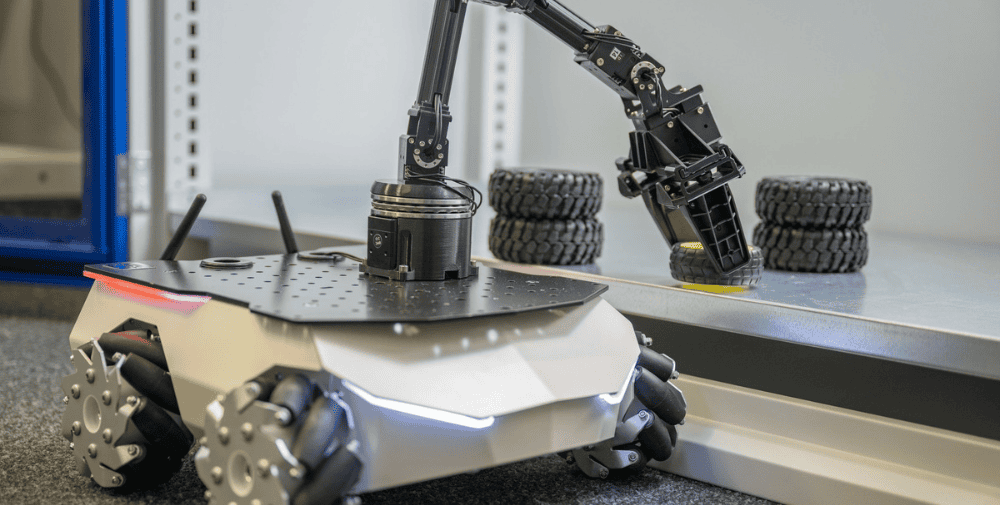
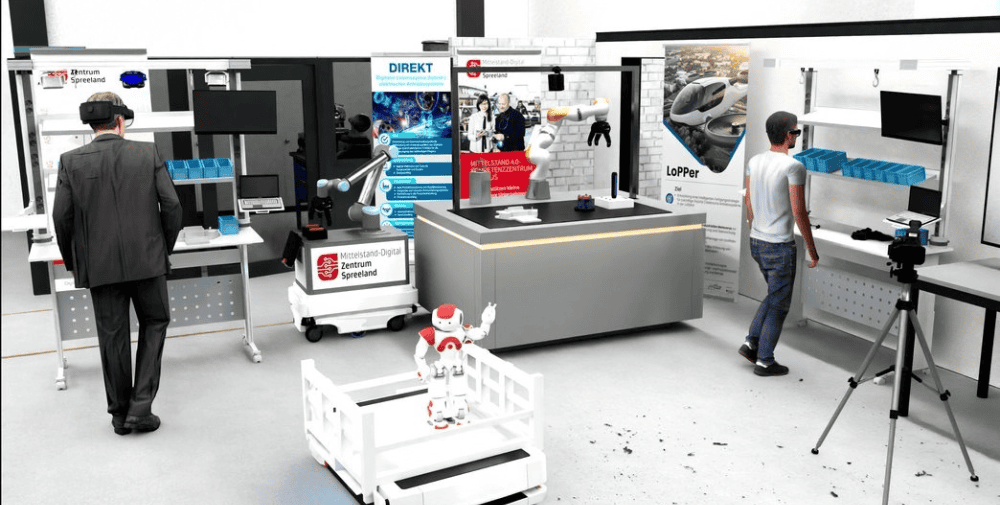
In the scenario “Robot-Assisted Manufacturing for a Circular Economy,” five different teams demonstrated application examples in manufacturing and resource efficiency: Technologies for refurbishing and disassembling laptops, for taking apart a robotic vacuum cleaner, for advanced robotic manipulation, for a mobile disassembly system, and for the virtual environment of a building.
Robotic household helpers clear the breakfast table
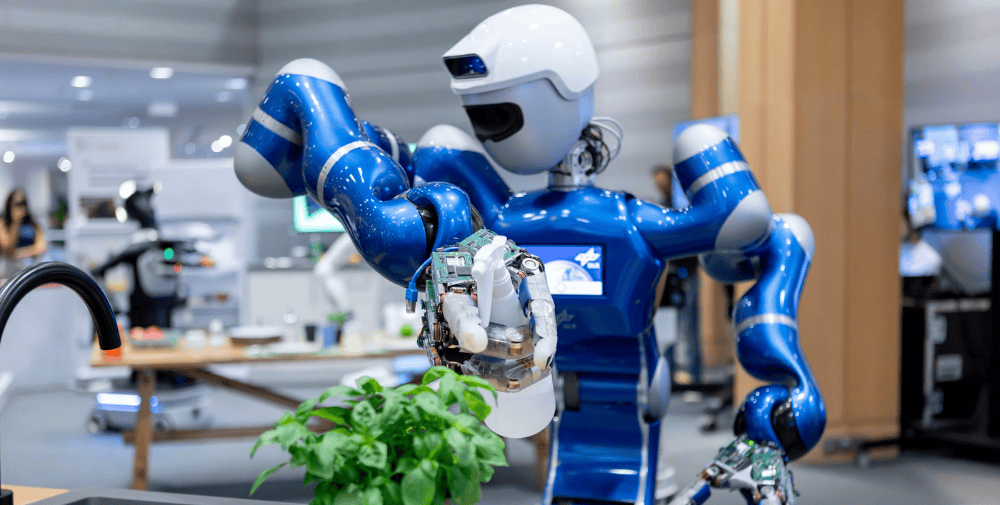
“Personal robots for a better quality of life and well-being” demonstrated how they assist people in everyday environments. As kitchen assistants, a total of four systems demonstrated their capabilities in the areas of human-robot interaction, handling, and autonomous assistance, one of which was the DLR humanoid robot “Rollin’ Justin.” The four robots operated autonomously and worked together collaboratively to clear the breakfast table: They independently recognized the various, randomly distributed items on the table, handled plates just as delicately as the cereal box, safely placed everything in the dishwasher, cabinet, and refrigerator, and disposed of the trash.
Package Delivery with Robots
In the “Outdoor Robots for Sustainable Communities” setting, various robot technologies for outdoor applications and logistics were put to use. The development teams demonstrated autonomous package delivery using agile robots such as a centaur robot, a four-legged robot on wheels, and a drone equipped with arms. They presented systems designed for use in challenging outdoor environments.
An additional exhibition featuring demonstrations of leg-based humanoid robots by industry partners underscored Europe’s expertise in this field as well. euROBIN brings together Europe’s leading robotics and AI research laboratories. Under the leadership of the DLR, the network of excellence in Brussels highlighted the breadth of the European robotics ecosystem.
From Cutting-Edge Research to Industry Leadership
Europe has spent decades building an exceptional scientific and technological foundation in robotics. “The challenge now is to translate this strength into industrial-scale production, widespread deployment, and European technological sovereignty. AI-based robotics offers us the opportunity to combine European excellence in robotics with the extraordinary advances that have taken place in the field of AI in recent years,” explains Prof. Alin Albu-Schäffer, Director of the DLR Institute of Robotics and Mechatronics and coordinator of euROBIN.
The live demonstration and closed-door roundtable discussion with leading figures from politics, industry, and research therefore also provided impetus for setting the course for the future. Axel Voss, Member of the European Parliament and host of the euROBIN demonstration at the European Parliament, affirmed: “Europe is capable of robotics—we’re demonstrating that impressively here. Now we must ensure that Europe’s cutting-edge research also produces European market leaders. If AI and robotics are shaping the next great industrial revolution, we must not allow a repeat of the situation where the key technologies are developed here but made big elsewhere. We need fewer barriers, more speed, and better conditions for investment and scaling.”
About euROBIN
The euROBIN (European Excellence Network on AI-based Robotics) brings together European research expertise in the fields of robotics and artificial intelligence. A central goal of the network is to achieve significant scientific progress in key areas of artificial intelligence and robotics. The scientific focus is on AI-based transferability across robots, tasks, and environments. In addition, the integrative research platform is intended to strengthen the robotics research community in Europe. euROBIN is funded by the European Union’s “Horizon Europe” framework program and coordinated by the DLR Institute of Robotics and Mechatronics. The core consortium consists of 31 partners from 14 countries in 26 European cities, supplemented by an additional 38 partners funded through cascade financing.
– – – – –
Related Links
👉 www.dlr.de
👉 www.eurobin-project.eu
Photo: DLR