A navigation system recalculates the route as soon as a road is closed—completely automatically, without any manual intervention. Researchers at the Brandenburg University of Technology Cottbus-Senftenberg (BTU) now want to test this very principle in a factory hall.
The idea was developed by BTU researchers Annamria Arnouk and Martin Behm (Department of Communication Technology) as well as Christian Borck (Department of AI-Supported Automation Technology) in collaboration with a team from the East Bavarian University of Applied Sciences in Regensburg (OTH Regensburg).
If a workbench breaks down, the factory reschedules on its own
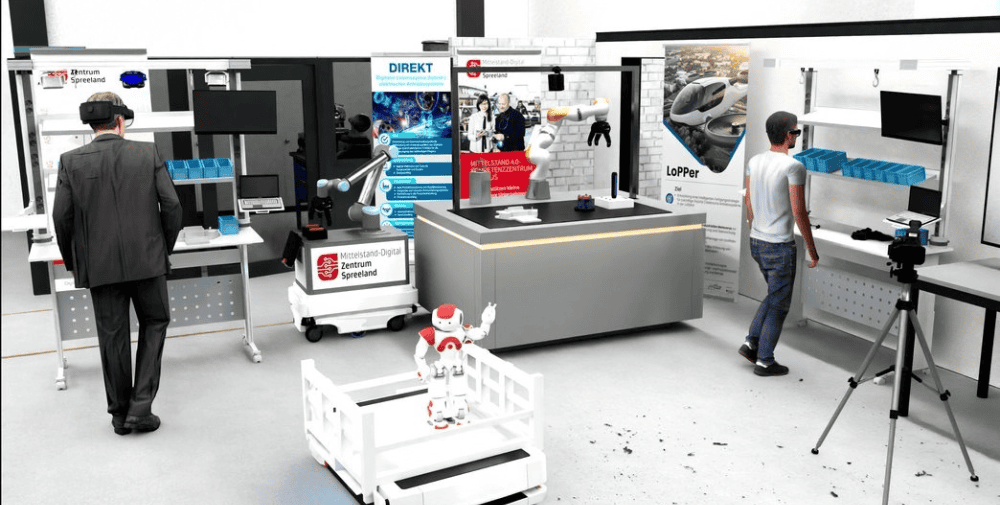
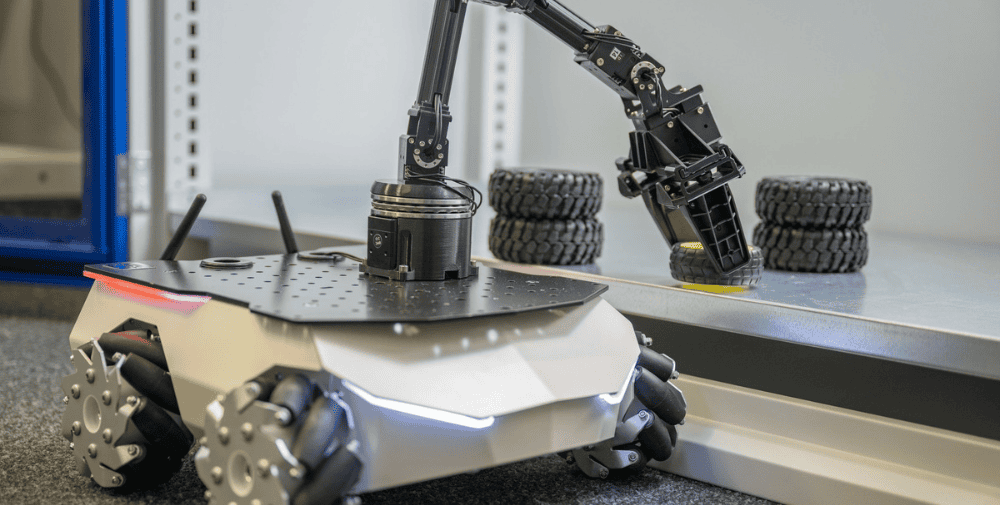
In many factories, small, driverless transport carts move autonomously through the hall, carrying components from one station to the next—much like a robot moving packages through a warehouse. If something breaks at a station, the vehicle must be rerouted. Until now, this usually meant that a technician had to reprogram the robot manually. That takes time and is cumbersome.
The research team wants to change that: In the future, the robots should find the new route on their own—just like a GPS that automatically recalculates the route when there’s a detour.
The factory’s blueprint becomes a map for the robots
Almost every building has a digital blueprint. The researchers’ program reads this blueprint like a map and automatically generates a complete route for the robots. What used to have to be painstakingly set up by hand is now handled by the computer in a single step.
At the same time, a second system uses a camera to constantly monitor whether everything is in order at a workstation. It also supports on-site employees in their work via smart glasses or a tablet. If it detects a problem, it alerts the relevant parties.
What’s new about this is that both components are now directly connected to each other. If the monitoring system reports a problem, it immediately requests a new route from the mapping service. The affected robots then automatically take a different route—without any human intervention. The researchers tested this on a production line where electric drives for aircraft are assembled.
A Digital Twin for Assembly
This second system was developed at BTU Cottbus-Senftenberg. It comes into play exactly where the robots deliver their components: at the workbench, where employees assemble the parts by hand—that is, the point at which machines and humans finally swap tasks.
The workbench has a digital replica
At the heart of the system is a digital twin of the workstation: Every component and every assembly step exists again in 3D on the computer—like a virtual replica of the workbench that moves in real time along with the actual workstation. When an employee reaches for a screw, her digital counterpart does the same on the computer at the same time. If something changes at the real workstation, the digital replica automatically updates—the two worlds run in sync.
AI provides support just like a good coworker
This is made possible by artificial intelligence that analyzes the camera images from the workbench: It recognizes the workers’ hand movements and detects which component they are currently picking up—much like an attentive colleague who closely follows what’s happening at the next workstation without intervening. As a result, the system always knows which step is currently being worked on and alerts the user as soon as something is assembled in the wrong order or in the wrong position. A silent observer thus becomes a kind of early-warning system that intercepts errors before they become permanent in the finished assembly.
A Risk-Free Training Environment
The digital twin serves not only for monitoring but also for training: New employees can first go through complicated assembly steps virtually before working on the actual component—similar to a flight simulator, where aspiring pilots practice their first maneuvers safely. A wrong move in the simulation environment costs nothing more than another try; on the actual component, the same mistake could be costly or delay production. Mistakes there therefore have no consequences, and the training process is noticeably faster—an advantage that pays off especially with complex, rare assembly steps for which a long learning phase on the actual workpiece would otherwise be almost unavoidable.
It is only through the interaction of both systems that the true value of the research becomes apparent: While the navigation system ensures that components reliably reach the correct station despite disruptions, the assembly assistance system ensures that they are also installed correctly there—and reports findings back to the factory as soon as something doesn’t fit.
A system that grows with every factory
To ensure the solution works not just in a single factory, the researchers are relying on technology that is universally understood—similar to a map format that any navigation system can read, rather than one specific brand. If a production hall is remodeled, all that will be needed in the future is to update the digital blueprint. The new route instructions for the robots will then be generated automatically—without anyone having to manually readjust the system.
What’s Next
So far, the idea is a well-thought-out concept. Next, the researchers want to test it in practice—at the chesco research factory at the BTU in Cottbus. The goal: Ultimately, no one should have to initiate anything manually. If a station fails, the factory—just like a navigation system—should reorient itself entirely on its own.
Publication
A. Arnouk, M. Behm, C. Borck, T. Hoffmann, F. Dietrich, M. Melzer, J. Dünnweber: “Automated Mission Planning for Mobile Robots Using Building Information Modeling (BIM) and Digital Twins.” Published in: *Sensors & Transducers*, Vol. 273, Issue 2, June 2026, pp. 39–49.
– – – – –
Further Links
👉 www.b-tu.de
Photo: BTU