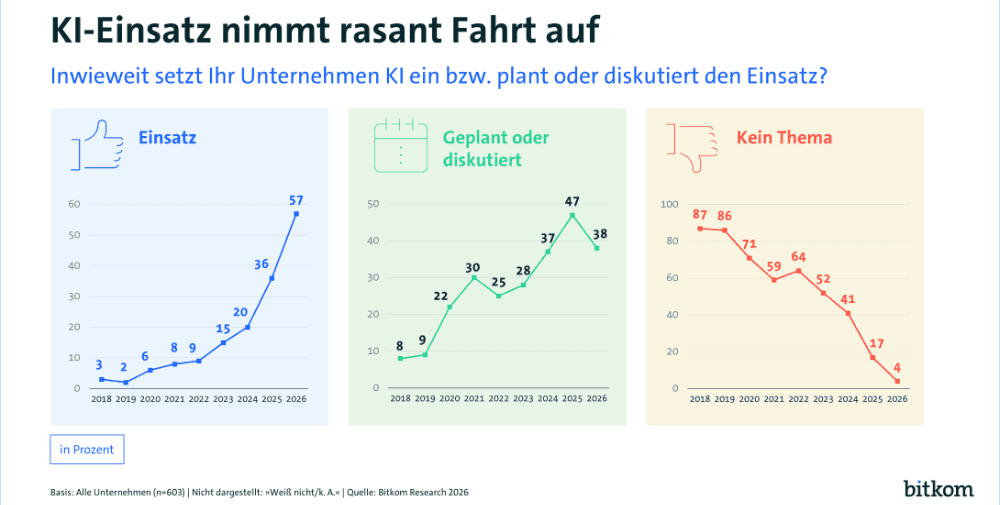
At the same time, most companies still consider themselves to be in the very early stages of AI adoption. No company currently using AI reports fully leveraging its potential; just 3 percent believe they are making fairly strong use of it. By contrast, 28 percent believe they are making little use of AI’s capabilities, and 59 percent believe they are not making any use of it at all. “Artificial intelligence is not just the domain of a few pioneers; it has taken hold across the entire economy. And it has done so at a pace we’ve never seen with any other technology. For most, however, this is just the beginning; the real work starts now,” says Bitkom President Dr. Ralf Wintergerst. “For policymakers, any remaining doubts should be dispelled: the requirements of AI as a key technology must be prioritized. This ranges from infrastructure—including sufficient data centers—to regulations that support rather than hinder companies.”
Conviction and uncertainty lie close together
There are hardly any fundamental doubts about the technology left in the business world. 91 percent of companies consider AI to be the most important technology of the future, up from 81 percent last year and 73 percent in 2024. Only 8 percent still view it as hype that is massively overrated—in 2024, that figure was 26 percent, or about one in four companies. When it comes to their own companies, 80 percent view AI primarily as an opportunity, while 18 percent see it more as a risk. Not a single company considers AI to be overwhelmingly risky, and likewise, none still believes that AI has no impact on their own business.
At the same time, the survey reveals significant uncertainty surrounding AI. 61 percent believe that companies that do not use AI have no future (2025: 51 percent). 56 percent believe that Germany has fallen behind in AI. 34 percent are concerned that AI threatens the survival of their company—up from 23 percent last year. 31 percent expect AI to change their business model (2025: 24 percent). And among companies that already use AI, one-third (33 percent) openly admit that they do so primarily out of fear of falling behind otherwise. “We see a lot of optimism surrounding AI, but also uncertainty,” says Wintergerst. “The very same companies that recognize AI as the defining technology of the coming years also fear that it will threaten their very existence.”
From Customer Interaction to the Heart of the Company
AI continues to be used most frequently in customer-facing roles, such as handling inquiries (72 percent), as well as in marketing and communications (54 percent). However, areas that played only a minor role last year have seen significant growth: internal knowledge management at 22 percent (2025: 11 percent), AI in the company’s own products and services at 20 percent (12 percent), AI in sales—14 percent (5 percent)—and in the IT department—9 percent (2 percent). Its use has also risen in controlling and accounting, from 17 to 25 percent. In production processes, 22 percent use AI; in research and development, 16 percent; in the legal or tax department, 8 percent; and in management, 7 percent.
AI agents are currently coming into focus. Unlike a chatbot, which answers questions, an agent acts independently—for example, by conducting price comparisons, soliciting quotes, and developing decision options. For only 24 percent of companies that use AI or are planning or discussing its use is this not currently an issue. Eleven percent are already using such agents, 29 percent are planning to use them, and 31 percent are discussing their use. “AI agents are today roughly where artificial intelligence as a whole was three years ago. But they will spread just as quickly,” says Wintergerst. “Companies should prepare for this. An agent that acts independently needs reliable data, connected systems, and rules governing what it is allowed to do and what it must avoid.”
AI Delivers Measurable Returns
Two-thirds of companies using AI have improved their competitive position as a result (66 percent). 48 percent were able to significantly speed up their internal processes through AI, and 45 percent see a measurable contribution to the company’s success. For 40 percent, the quality of their products or services has improved, and 36 percent have even developed new products or services using AI.
From the companies’ perspective, however, much more is still possible. No company believes it is fully tapping into the potential of AI; only 3 percent do so to a significant extent. In contrast, 28 percent say they make relatively little use of AI’s potential, and 59 percent say they make no use of it at all. This percentage is nearly identical across all company sizes, from businesses with 20 employees to large corporations. “The good news is: When it comes to AI, no one needs to feel left behind. Almost all of them still have the decisive steps ahead of them,” says Wintergerst.
Nearly half of companies are spending more on AI
Looking at the budget, companies are continuing to drive the use of AI forward. In 2026, 45 percent of all companies will spend more on AI than in the previous year—13 percent will spend significantly more, and 32 percent will spend somewhat more. Half are keeping spending unchanged; only 3 percent plan to reduce it somewhat, and no company is cutting it significantly. 2 percent have never invested in AI and do not plan to do so.
The sources of these costs, however, contradict a common perception. Fifty-one percent of AI users cite infrastructure—such as the cloud and computing power—as a major cost driver, 50 percent cite data processing, and 41 percent cite integration into existing systems. Subscriptions and licenses for AI software are a major cost factor for only 21 percent, putting them on par with spending on external consulting. Employee training generates high costs for 19 percent. The use of tokens for AI is the least significant cost factor: For 8 percent, it is a major cost factor, while for 11 percent, it is a minor one. “With AI, it’s not primarily about the model used. Preparing data, connecting systems, and providing computing capacity require the most effort. Anyone who merely purchases a license has bought AI, but hasn’t changed anything yet,” says Wintergerst.
What’s Holding Back AI Adoption
Those who haven’t adopted AI yet do so primarily because they lack the technical know-how to implement it—that’s what 85 percent of companies without AI say. They continue to feel deterred from using AI by unsettling legal hurdles and ambiguities (66 percent), costs that are difficult to estimate (63 percent), and a lack of personnel resources (51 percent). Forty percent lack the necessary data, and 30 percent see no use cases.
Even companies that are already using AI face obstacles. At the top of the list are data protection requirements (66 percent), followed by legal uncertainty (56 percent), costs that are difficult to estimate (54 percent), and concerns that company data might fall into the wrong hands (45 percent). For 42 percent, a lack of employee acceptance is a barrier. Only 26 percent cite poor-quality results, 25 percent point to a lack of traceability, and 11 percent cite a lack of use cases. “Before getting started, the technology itself is the main problem; those who already have AI in-house are grappling with data protection and the question of what is permitted,” says Wintergerst.
Expertise is lacking, but the number of training sessions is rising significantly
Sixty-six percent of companies rate their employees’ AI skills as low, while only 28 percent rate them as high. This is where users and non-users clearly diverge: Among companies using AI, 40 percent consider their employees’ relevant skills to be high, while only 14 percent of companies not using AI do so. Companies are taking steps to improve their workforce’s AI skills and, in many cases, offer training programs focused on AI. 70 percent of all companies now train their employees in the use of AI—11 percent train all employees, 22 percent train the majority, and 37 percent train selected employees. However, at 25 percent, one in four companies offers no training at all; last year, that figure was 43 percent. Among companies that use AI, 91 percent provide training, while only 4 percent do nothing. “Competence develops through the use of AI, but it doesn’t happen on its own. The fact that seven out of ten companies now offer training is real progress,” says Wintergerst.
Experience Eases Concerns About Jobs
For the next two years, 45 percent of companies expect a slight decline and 12 percent a significant decline in their total number of employees due to AI. In contrast, 14 percent anticipate a slight increase, while no company expects a significant one. At the same time, 29 percent are unable or unwilling to provide a response. Only 9 percent of companies already using AI expect a significant decline in jobs—a much lower figure than among companies not using AI, where 15 percent anticipate such a decline. At the same time, companies that already use AI are twice as likely—18 percent versus 9 percent—to expect an increase in the number of employees due to AI. Wintergerst: “AI will change jobs; some job roles will disappear, while others will emerge. For an aging economy with a severe shortage of skilled workers and productivity that has been stagnant for years, this is not a threat, but an opportunity.”
More companies see themselves as affected by the AI Act—and criticism is growing
The AI Act has made its mark on the business world this year. 37 percent of companies expect to be affected by the AI Act as users, up from 23 percent last year. Thirty-four percent are currently assessing the situation, 18 percent do not believe they are affected, and 8 percent have not yet addressed the AI Act. Among the companies that are affected or are assessing the situation, 89 percent expect a high implementation burden, and 51 percent even expect a very high one. And 66 percent of all companies believe that the AI Act creates more disadvantages than advantages for German companies; last year, that figure was 56 percent. Affected companies estimate, on average, that they have 2.1 high-risk AI systems in use, up from 1.5 last year. Twenty-five percent expect to have one high-risk system, 30 percent expect to have two such systems, and 16 percent expect to have three or more. Eight percent do not expect to have any high-risk systems, and 22 percent are unable to provide any information on this. “The AI Act was intended to build trust, but it is instead creating widespread uncertainty. The more closely companies examine the issue, the more this uncertainty grows,” says Wintergerst. “We need binding and prompt legal clarity on the implementation of the AI Act, as well as practical standards,” Wintergerst adds. “We also need support programs for companies so they can use artificial intelligence in compliance with the AI Act.”
Bitkom Invites You to AIDAQ in Berlin
The use of AI is also the focus of Bitkom’s AI, Data & Quantum Summit (AIDAQ) hosted by Bitkom on September 22 and 23 at the bcc in Berlin. More than 2,500 participants and over 200 speakers from business, politics, and research are expected to attend 140 sessions. The Federal Ministry of Research, Technology, and Space has assumed patronage of the event. Among those attending are Dr. Karsten Wildberger, Federal Minister for Digitalization and State Modernization; Thomas Jarzombek, Parliamentary State Secretary at the Federal Ministry for Digitalization and State Modernization; Dr. Thomas Steffen, State Secretary at the Federal Ministry for Economic Affairs and Energy; Dr. Daniela Brönstrup, Vice President of the Federal Network Agency; Michael Vetter, CIO at the Federal Ministry of Defense; Dr. Tina Klüwer, Executive Director of AI NATION; Tom Becker, VP DACH at Mistral; Sarah Engel, Head of AI at Trumpf, Jasper Krauser, Head of Quantum Technologies at Airbus, and Prof. Dr. Volker Gruhn, Chairman of the Supervisory Board at adesso. All information about the program is available online here: aidaq.berlin.
– – – – –
Related Links
👉 www.bitkom.org
Graphic: Bitkom