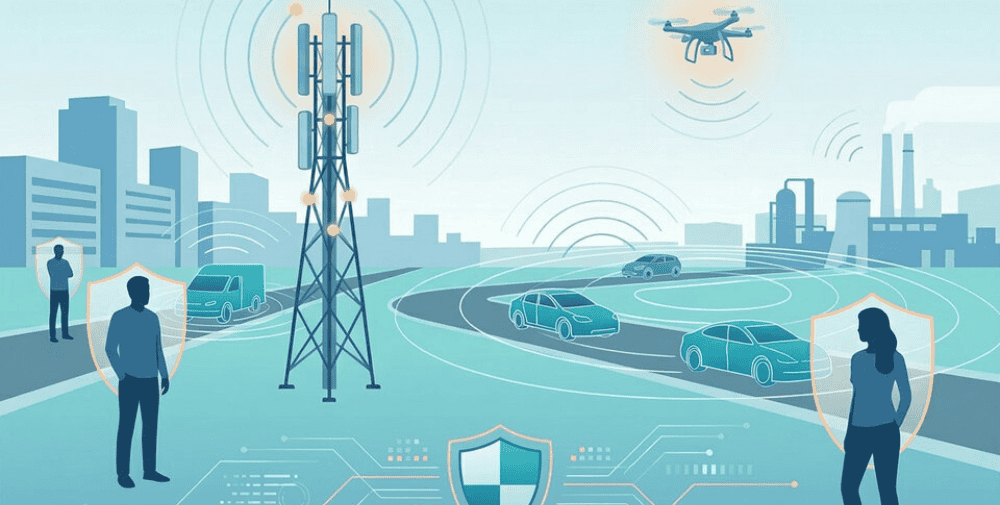
ISAC is considered one of the key technologies of 6G. In this context, cellular networks no longer serve exclusively for communication but can simultaneously monitor their surroundings. This makes it possible, for example, to detect vehicles, locate drones, monitor production facilities, or support rescue operations—all without requiring additional technical effort.
However, these new possibilities also bring new challenges. Unlike today’s mobile applications, future networks could track movements or collect other information about individuals without them actively using a device. The latest resolution from the Conference of Independent Federal and State Data Protection Supervisory Authorities therefore calls for data protection and the protection of fundamental rights to be taken into account right from the technology’s development stage.
This is precisely what researchers at the Barkhausen Institute have been working on for years. They are developing technical methods to control, secure, and ensure transparency in the sensor functions of ISACs within communication networks. The goal is not to add data protection as an afterthought, but to integrate it into the technical foundations of future mobile networks from the very beginning. This approach is also known as “Privacy by Design.”
Initial concepts have already emerged from this research. For example, the researchers developed an on/off switch that smartphone manufacturers could integrate into their devices in the future. This would allow the smartphone’s sensor function to be completely deactivated while still enabling communication. In addition, a prototype app was created that informs users whether sensing is taking place at their current location. Furthermore, the Barkhausen Institute is developing concepts and recommendations for the design of future cellular networks to ensure that ISAC can be implemented in a manner that complies with data protection regulations. This involves, for example, processing only the data that is actually necessary and ensuring that only authorized entities can access it.
“ISAC offers enormous potential—from smart mobility to industrial automation. Our goal is to design this new technology in such a way that its benefits can be harnessed without creating new risks to data protection and privacy,” says Dr. Stefan Köpsell, a data protection expert at the Barkhausen Institute.
The Dresden researchers are also contributing their findings to international standardization bodies. Together with partners, they are participating, among other things, in the work of the European Telecommunications Standards Institute (ETSI), which is currently developing the foundations for the future 6G standard. In September 2026, international experts will meet at the Barkhausen Institute to further develop the topics of data protection, security, and trustworthiness for ISAC.
The Barkhausen Institute was founded in 2017 with the mission of researching trustworthiness in a connected world. The current debate on data protection in 6G demonstrates just how relevant this long-term research approach is today. To ensure this does not pose a risk to fundamental rights, research is needed that considers technical innovation and data protection together.
– – – – –
Further Links
👉 www.barkhauseninstitut.org
Photo: Barkhausen Institute (AI-generated)