AI is spreading rapidly among German companies. According to Bitkom, active AI usage has risen from 17 to 41 percent within a year. At the same time, AI investments by small and medium-sized enterprises (SMEs) declined slightly in 2025, according to a Horváth study.
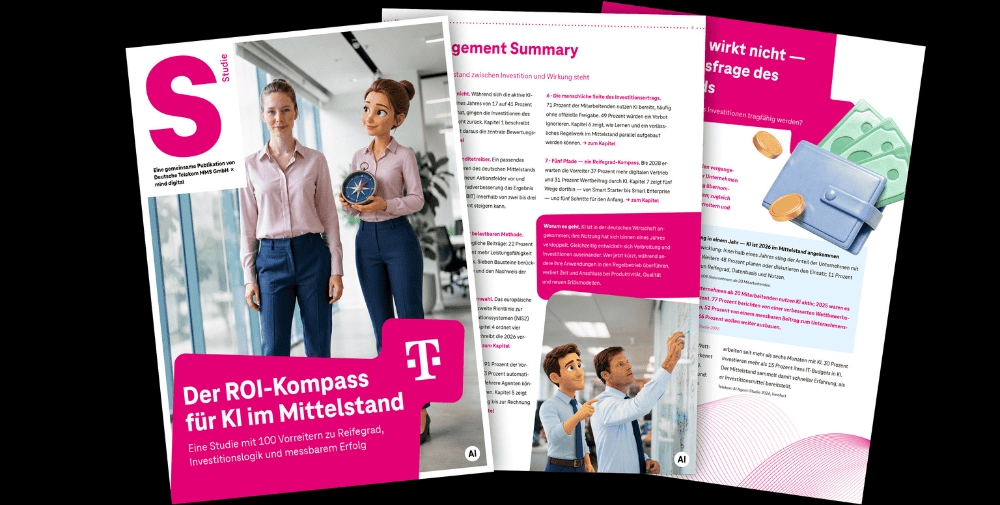
The new “ROI Compass for AI in SMEs” combines insights from years of “Zukunftsmacher” research involving more than 100 pioneers, current market research among 123 decision-makers, practical projects by Telekom MMS, and findings from 32 external studies.
The focus is on one question: How can companies successfully make the transition from AI implementation to a measurable return on investment (ROI)?
As AI maturity grows, cost-effectiveness comes into focus
The Telekom AI Agent Study 2026 provides a current look at an already advanced market segment. In April 2026, Innofact surveyed a total of 123 decision-makers with budget responsibility for AI and digitalization from German companies with 10 to 999 employees. At least 60 percent hold executive-level positions.
The sample deliberately represents companies with a higher affinity for AI and should therefore not be understood as a representative cross-section of German small and medium-sized enterprises.
In this segment in particular, AI has already become deeply integrated into everyday business operations:
- 70 percent classify themselves as advanced or experts in AI implementation.
- 68 percent have been working with AI for more than six months.
- 30 percent invest more than 15 percent of their IT budget in AI.
As usage grows, the question of where and how AI investments actually pay off becomes increasingly important.
The key finding of the ROI Compass: It is not the size of the AI budget that determines economic success, but rather how strategically companies invest and whether the conditions for productive use have been established.
ROI starts with the business process—not with the AI tool
The ROI Compass distinguishes three economic levers of AI: efficiency, performance, and growth. The analyzed studies show potential contributions of a 22 percent increase in productivity, a 20 percent increase in performance, and a 10 percent impact on earnings through new revenue models and digital services. However, simply looking at license or usage costs is not enough to make a sound investment decision. Costs associated with data, integration, operations, security, governance, and organizational changes must also be weighed against the expected benefits.
This shifts the initial question: Not “Which AI should we use?”, but “In which business process can AI create measurable value?”&
The Telekom AI Agent Study also highlights just how important this perspective is. It examines 13 specific use cases for AI agents and evaluates them based on criteria such as business value, willingness to pay, and feasibility. Eight use cases were prioritized for short- or medium-term implementation—including order processing, quote generation, invoice processing, email service, purchasing and procurement, and IT support.
Processes that link multiple work steps and enterprise systems are particularly interesting. This is evident, for example, in quotations, orders, and invoices: AI agents can consolidate information from various systems and handle defined process steps. These three use cases are among the prioritized areas of application.
Productive Benefits Require Data, Integration, and Governance
As AI is integrated into business processes, the requirements also increase. Companies need not only an AI model but also an environment in which agents can collaborate across systems—in a controlled and secure manner—with existing applications, data, and processes.
Data protection and digital sovereignty thus also become part of the investment decision. 55 percent of the AI-savvy companies surveyed rate the origin of an AI solution—whether from Germany or Europe—as important or very important. 86 percent would be willing to pay a premium for a solution running on German infrastructure with proven compliance with the General Data Protection Regulation and the European AI Act.&
The ROI Compass therefore recommends clarifying data, protection needs, and governance requirements early on and deriving the requirements for architecture and technical implementation from them. To this end, the study classifies different cloud architectures and their potential applications.
Furthermore, concrete real-world examples demonstrate that economic benefits do not arise from AI as an isolated technology. It arises when data is available, processes are adapted, and applications are integrated into routine operations.
RENOLIT demonstrates just how important these fundamentals are for scaling: Together with Telekom MMS, the company first developed a data strategy and launched the initiative at two plants. Today, a central data platform consolidates production data from nine locations, thereby laying the groundwork for AI applications.
Start with one process—and scale successful AI
Companies do not have to implement AI as a large-scale, company-wide program right from the start. The ROI Compass describes five development paths that take into account different levels of maturity and business objectives—from the “Smart Starter” with manageable applications to the “Smart Enterprise” with company-wide coordinated AI agents.
The first steps can therefore intentionally start small: with a specific use case or a clearly defined workflow. The key is to define goals and metrics, measure the impact during routine operations, and then extend successful approaches to other processes, data sources, and business units.
This results in a clear sequence: Determine business benefits, create the necessary conditions, implement productively, and then scale.
From the ROI Compass to Implementation: Deploying AI Agents Productively
Telekom Business supports companies on this journey:
- Recognize potential: Identify suitable business processes, define goals and metrics, and evaluate the expected economic benefits.
- Create the necessary conditions: Review data, systems, and processes, and clarify requirements for security, governance, and operations.
- Deploying AI agents productively: With the T-AI Agent Platform, individual business processes can be specifically supported and automated using AI agents and connected to existing applications and data. Governance, monitoring, and defined approvals support controlled, productive operations. The technological foundation is n8n; consulting, integration, and operations are provided from a single source.
This allows you to start with a specific process and then scale it step by step. Market research also supports this process logic: The prioritized agent use cases are precisely where multiple steps and systems are interconnected.
The “ROI Compass for AI in SMEs”—a study featuring 100 pioneers on maturity levels, investment logic, and measurable success—is now available for free download.
– – – – –
Related Links
👉 www.smwk.sachsen.de
👉 Go to the “ROI Compass for AI in SMEs”
Photo: Telekom MMS