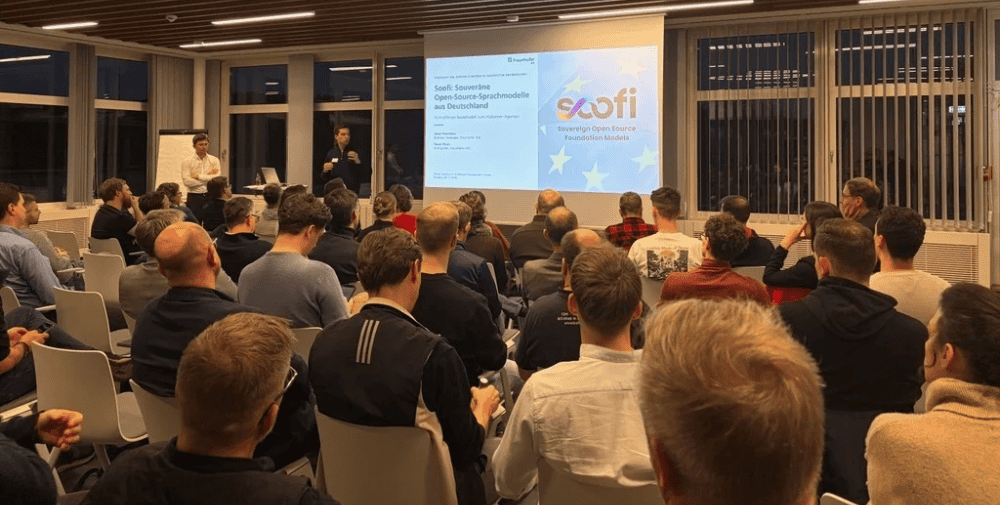
That was exactly what the evening was all about: Four presentations from industry, research, and IT services shed light on the topic from different perspectives. The room was packed, and the discussion was lively. There were deliberately no ready-made blueprints—instead, there were honest real-world experiences and thought-provoking questions.
Following the kickoff in August at Dresden University of Applied Sciences, this was already the second “Spotlight” event organized by the Software Strategy Group. While the first event focused primarily on how AI is changing work in development teams, this time the focus was on a sober assessment: What are we investing—and what are we getting in return?
Keynote 1: Beyond Tokens—Strategic Cost Management for Enterprise AI
David Kaminsky set the tone for the evening with a clear guiding principle: It’s not about using less AI, but about wasting less AI. His benchmark: more impact per token.
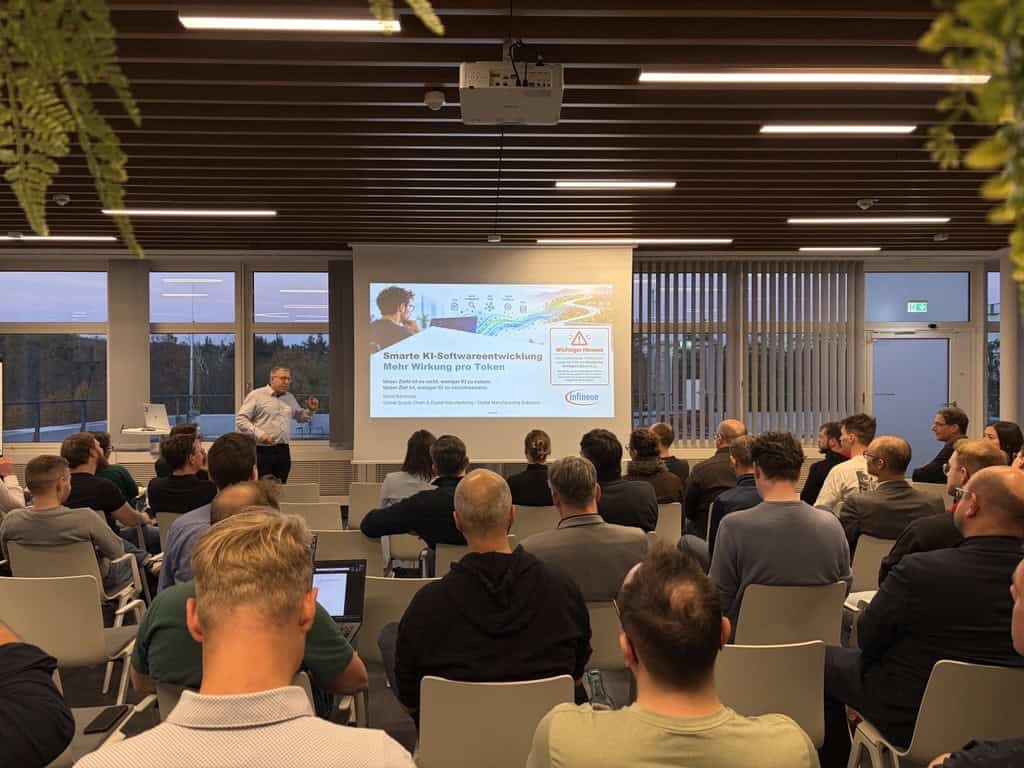
Using a simple example, he demonstrated where waste occurs. If a developer asks the AI to create a REST service without following standards, the AI has to figure out a lot on its own:
- What architecture, what logging, what error handling?
- What security patterns, what testing strategy?
- Which libraries and coding guidelines?
The result is back-and-forth communication and correction loops—each of which costs time and tokens. With predefined engineering skills, however, the AI follows the organization’s defined path and directly delivers a suitable implementation.
His key point: Any correction that has been recorded once in a skill does not need to be re-explained to the AI a thousand times. Skills are therefore not just a quality issue, but also a means of cost optimization.
It was remarkable how consistently Kaminsky shifted the focus on costs from the technology to the organization. Those who thoroughly document standards, architectural principles, and approved libraries not only save tokens but also achieve more consistent results. The real investment, then, lies not in the model itself, but in maintaining one’s own knowledge. With a wink, he pointed out, by the way, that his presentation, too, was largely created using AI—along with a note to please verify important information for yourself.
Insight 2: Soofi – Sovereign Open-Source Language Models from Germany
When discussing AI costs, one must also address dependencies. The team from Fraunhofer IAIS introduced Soofi—Sovereign Open Source Foundation Models—and the path from an open base model to a semiconductor agent.
They identified three key reasons why sovereignty matters particularly in industry:
- Price: Companies are dependent on the providers’ pricing and licensing models. Agent-based AI frequently invokes a model for each task—and costs rise accordingly.
- Availability: Anthropic’s Fable 5 was unavailable for nearly three weeks in June 2026 due to U.S. export controls. The provider decides on model changes and terms of use.
- Data sovereignty: Wafer maps, recipes, and yield data are core IP. When using APIs, prompts and context leave the company.
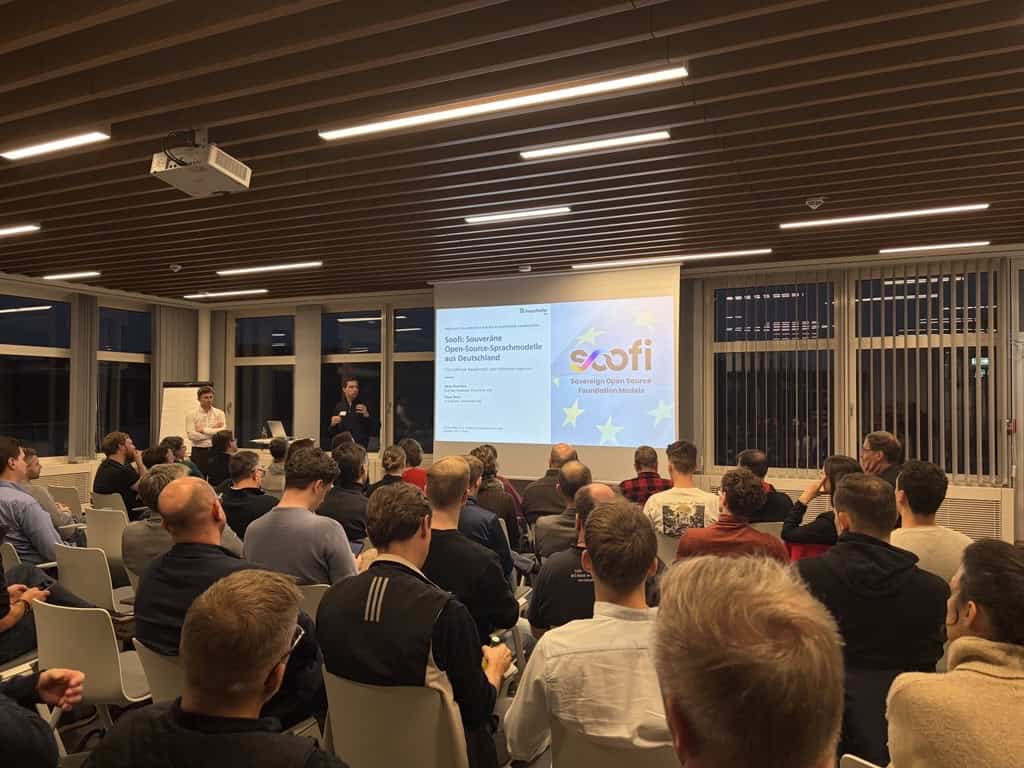
The alternative: a powerful model that you can operate, test, and customize yourself. The computation time demonstrates that this is also economically feasible. This is an interesting prospect for Saxony’s semiconductor industry. The expertise contained in the fabs’ process documentation and defect catalogs can be transferred to a proprietary model with relatively little effort—without sensitive data ever leaving the company. Behind Soofi stands a broad consortium of research institutions and partners, including Fraunhofer, DFKI, and the German AI Association.
Insight 3: AI tools are up and running, productivity feels better—but no one knows if it’s worth it
“Is it worth it?”—Stefan Hennig opened with this question and shared candid insights from the day-to-day operations of an IT service provider.
First, he highlighted the tension development teams are currently facing. On one hand, there’s identity: A lead developer says that code crafting—the reason he became a developer—is something AI can now do better. On the other hand, there’s necessity: A development manager is convinced that a team that’s still writing code itself next year has a serious problem.
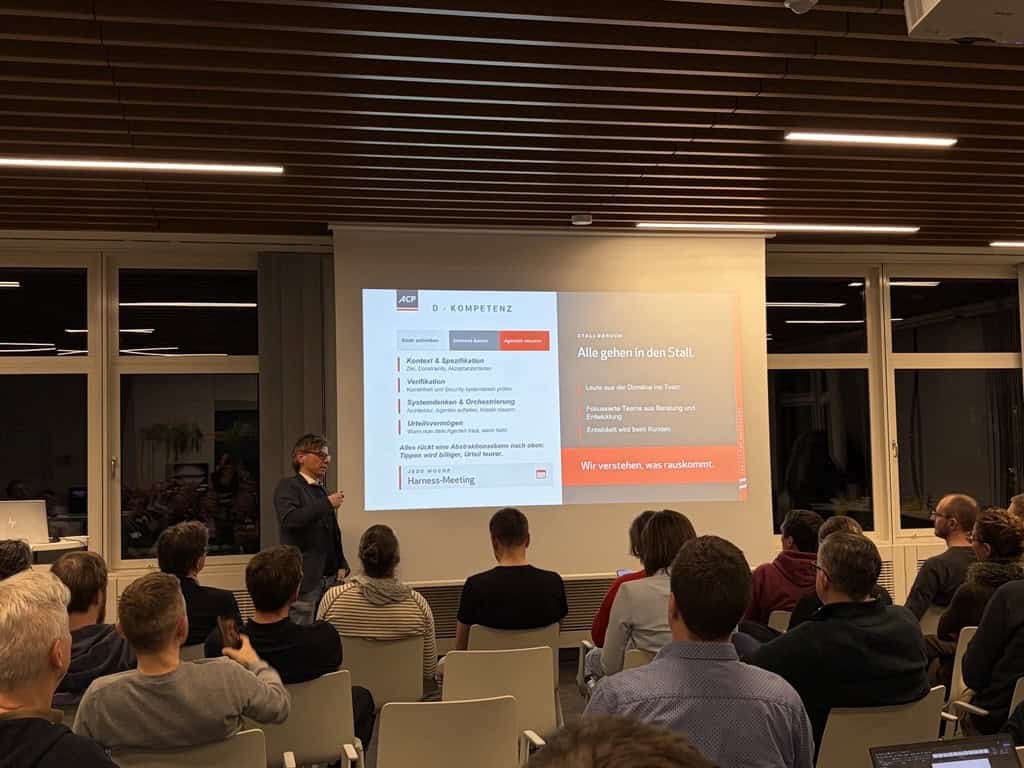
ACP started with the bottlenecks: In product management, prototypes are tested quickly; development focuses on crafting; and in review and QA, AI finds more bugs. Otherwise, development would have waited for requirements—and QA would have been overwhelmed by the code.
Then came the cost model, and it didn’t add up. Token costs initially skyrocketed; today, they’re the smallest expense. The real cost lies in the surrounding infrastructure: maintaining our own data center infrastructure, developing and maintaining the harness, and building expertise. If you divide these costs by the hourly rate, you get the number of hours the AI would have to save each month—more than can realistically be saved.
The consequence lies in expertise. The role is shifting from “writing code” to “building harnesses” to “controlling agents.” What’s needed:
- Context and specifications: goals, constraints, acceptance criteria
- Verification: systematically checking correctness and security
- Systems thinking and orchestration: Architecture, dividing up agents, managing costs
- Judgment: knowing when to trust the agent and when not to
Everything moves up one level of abstraction: coding becomes cheaper, judgment becomes more expensive. At ACP, there’s a weekly “harness” meeting for this. And the “insider perspective” principle: bringing domain experts into the team, forming focused teams from consulting and development, and developing the system on-site at the client’s location. The goal: to understand what the end result will be.
This part in particular sparked a palpable response in the room. Hennig openly articulated what many are experiencing: Productivity feels better, but reliable figures are often lacking. His response to this is not to back down, but rather a deliberate restructuring of roles and work methods—with people serving as the final authority at the end of the chain.
Insight 4: AI Is Getting More Expensive, but the Impact Is Lacking—What Software Teams Need to Change Now
Ilja Bauer described a pattern he has observed in about 90 percent of companies. It unfolds in three steps:
- AI adoption is low—so everyone gets a Claude Code license.
- Usage and satisfaction vary widely—so boot camps and training programs follow.
- AI costs rise—so limits and subscriptions are introduced.
In the end, the result is the same: the AI has no impact on the company.
A key cost driver: AI isn’t being used to address the bottleneck. The software product development pipeline includes Discovery, Forming, and Shipping. Those who only accelerate Shipping produce faster—but not necessarily the right thing.
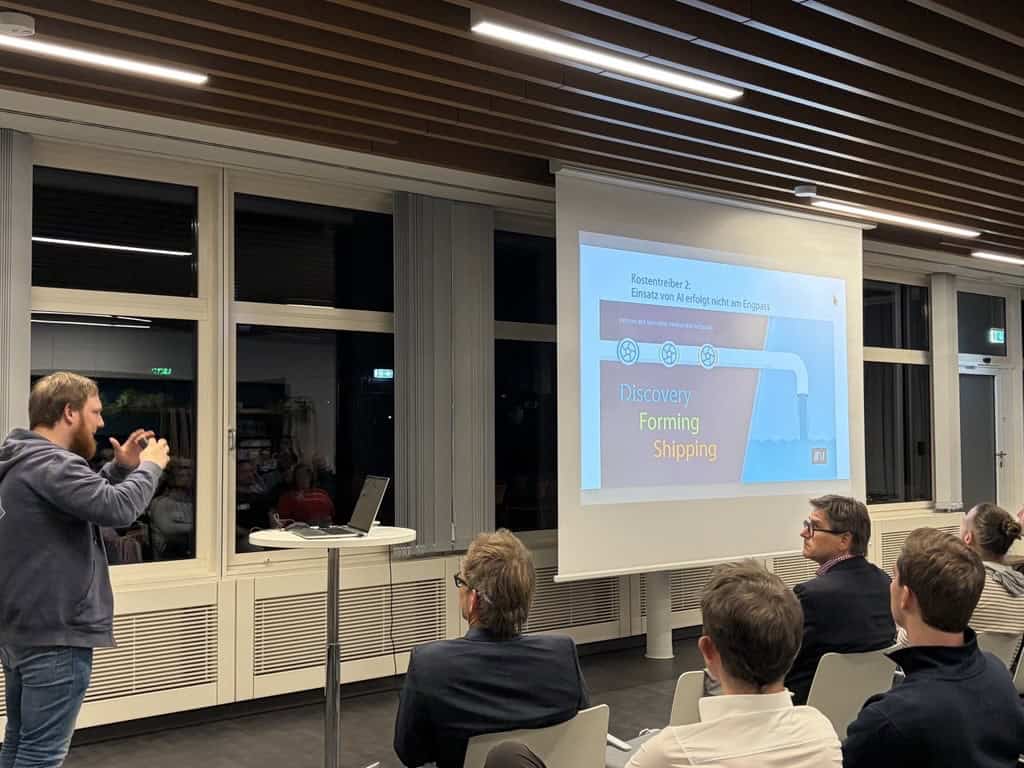
His approach: Every increment—whether a feature, bug fix, or modernization—needs an impact hypothesis. Productivity alone isn’t enough. Only when linked to measurable impact—such as revenue, profit, retention, or time to hire—does the benefit become visible. This creates a learning cycle from hypothesis to release.
With that, Bauer brought the discussion full circle back to the beginning of the evening. Licenses, training, and budget constraints are reactions to symptoms. If you want to make the benefits visible, you must first define what impact an increment is supposed to achieve—and then verify afterward whether it actually occurred. This transforms perceived productivity into a verifiable statement.
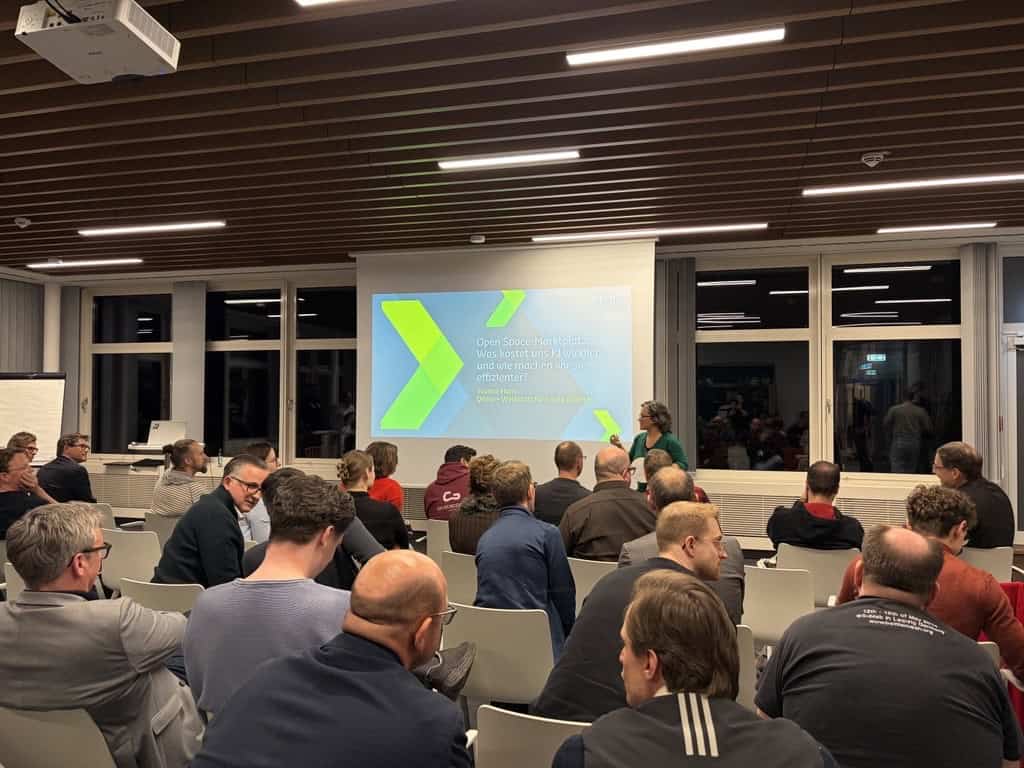
Open Space: What Does AI Really Cost Us—and How Can We Make It More Efficient?
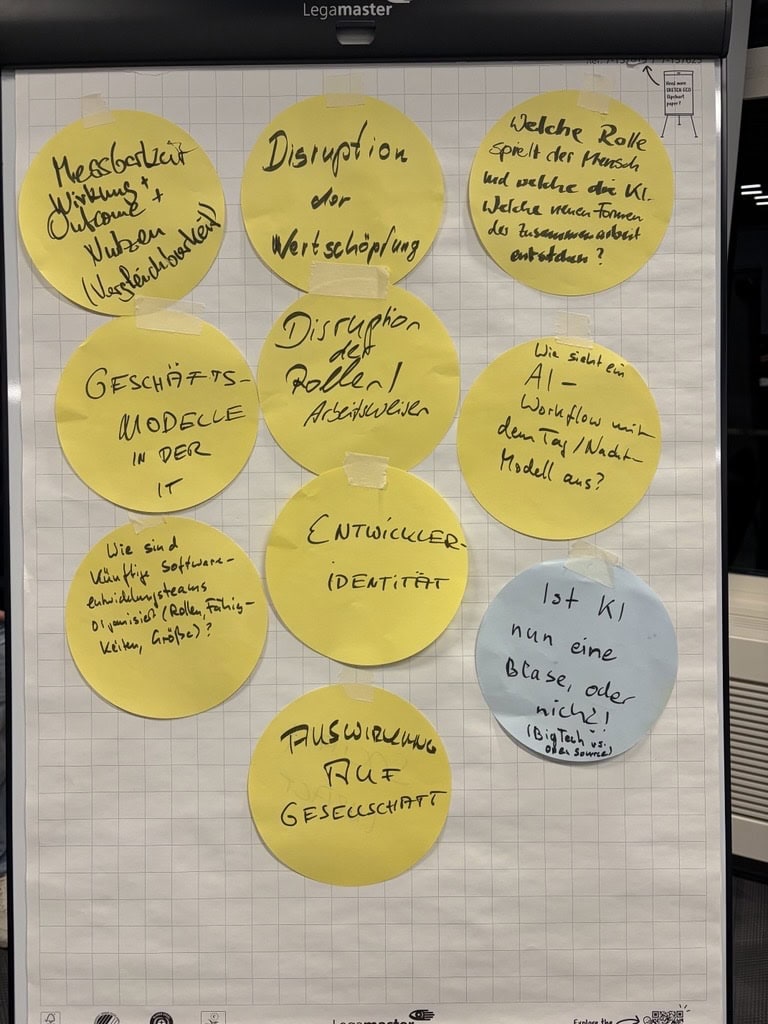
Afterward, Yvonne Horn from Qilmo—Workshop for New Ways of Working—took over as moderator of the Open Space marketplace. The participants contributed their own questions, which clearly demonstrate how far the topic extends beyond costs:
- Measurability of impact, outcomes, and benefits—and their comparability
- Disruption of value creation
- Disruption of roles and work practices
- What role do humans play, what role does AI play—and what new forms of collaboration are emerging?
- How will future software development teams be organized (roles, skills, size)?
- Developer identity
- Business models in IT
- What does an AI workflow with a day-night model look like?
- Impact on society
- Is AI a bubble or not? (Big Tech vs. Open Source)
It quickly became clear: Behind the question of costs lie fundamental questions about value creation, collaboration, and identity. In small groups, the participants continued their discussions, shared experiences from their companies, and made new connections.
Conclusion: Impact isn’t driven by licenses
Four perspectives, one common finding: Whether AI-driven development pays off isn’t determined by the token price.
- Avoid waste: Capture knowledge as a skill once and for all instead of having to explain it to the AI over and over again.
- Manage dependencies: Sovereign, self-operated models ensure price, availability, and data sovereignty.
- Calculate total costs honestly: Infrastructure, harness, and expertise cost more than the tokens.
- Make impact measurable: Use AI where the bottleneck lies—and tie every increment to an impact hypothesis.
Many thanks to all the speakers, to Infineon for their hospitality at the Development Center, and to all participants for the engaging discussion.
What’s next: a new working group for the software and IT community
Two spotlight sessions, two packed rooms, and a wealth of questions: The community’s interest is high, and many topics deserve more than just one evening. That’s why a new working group is now being formed at Silicon Saxony based on this foundation.
In this group, we aim to build on the diverse range of topics covered in the past two Spotlight events and further develop them into concrete formats—from measuring impact to new roles and team structures, all the way to robust models and business models in IT. The working group is aimed at the entire software and IT community in Silicon Saxony: developers, executives, researchers, and service providers.
Anyone who would like to help shape the group, suggest topics, or contribute a format is warmly invited to contact us.
– – – – –
Related Links
👉 About the Software & IT Division
Photos: Silicon Saxony