1. When Suddenly Nothing Works Anymore
Our world is digitally connected like never before. Banks process billions electronically, airlines coordinate their operations via complex IT systems, and government agencies exchange highly sensitive information over secure networks. Digital infrastructure has long since become the foundation of the economy, public administration, communication, and national security. But this foundation is less stable than it appears at first glance.
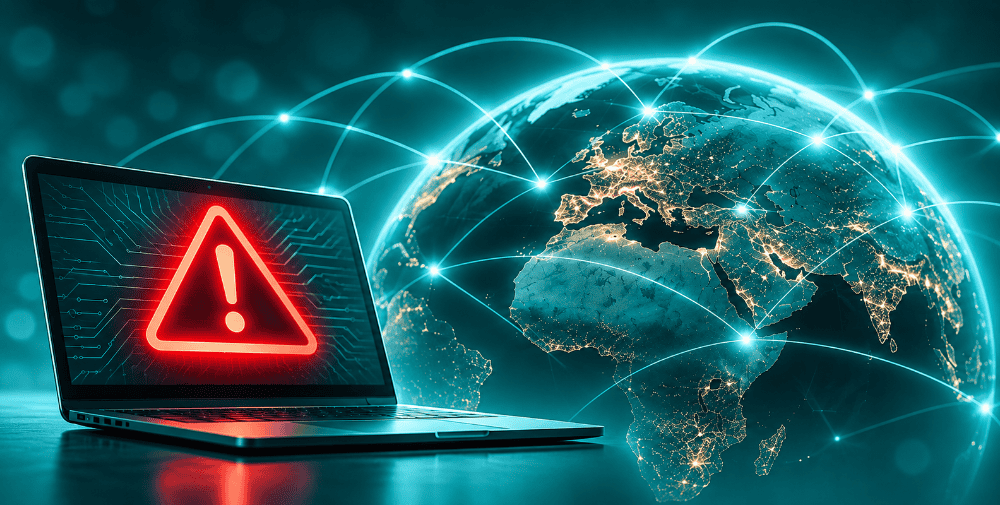
Recent reports of disruptions at Microsoft, Apple, the U.S. Federal Aviation Administration (FAA), the National Security Agency (NSA), JPMorgan Chase, and other companies deserve special attention. Between November 12 and 17, 2026, cloud services, payment systems, air traffic control, corporate communications, and government networks, among others, were affected. The proximity of these events in time is striking. However, it does not yet prove a common cause.
The crucial question, therefore, is: Are we merely experiencing a cluster of technical glitches—or are these incidents revealing fundamental weaknesses in a global digital infrastructure whose complexity and interconnectedness are increasingly becoming a security risk?
2. The Incidents and Their Official Explanations
The outages affected various industries and technical systems. No clear common pattern has yet been identified. Here is a list of the most prominent companies that have recently struggled with outages and disruptions to their digital infrastructures:
Microsoft: A major outage in Microsoft 365 affected Outlook, Teams, and other enterprise services, among others. Microsoft cited a long-standing software bug that, under certain network and load conditions, led to resource bottlenecks and the spread of the outage. The company stated that it had ruled out a cyberattack.
U.S. Federal Aviation Administration (FAA): The U.S. Federal Aviation Administration was forced to order a nationwide ground stop on November 13. According to the agency, 17 of 22 control centers were affected by network issues. Particularly notable was an unusually high number of connection attempts. The FAA cited problems with older telecommunications infrastructure and a previously installed router. The exact cause was under further investigation.
United Airlines: Technical issues with internal communication and data systems led to flight delays. Among other things, critical information needed for flight preparation was temporarily unavailable.
JPMorgan Chase: A software error slowed down transaction processing. Customers of other banks also experienced delays as a result.
U.S. National Security Agency (NSA): The U.S. intelligence agency’s internal classified communications network was temporarily disrupted. The NSA attributed this to scheduled maintenance and stated that mission-critical capabilities remained intact.
Apple: Several services, including the App Store, Apple Pay, Apple Music, and iCloud, were temporarily unavailable following an internal update. Apple confirmed the connection to the update and denied that a cyberattack had occurred.
In this context, the U.S. government stated that there was no evidence of a coordinated attack or a common perpetrator. These statements are relevant but do not replace an independent technical investigation. Questions remain, particularly regarding the FAA and the NSA, about the full cause and actual scope of the disruptions. Another important question is why the U.S. and its companies, in particular, were at the center of this unusual wave of outages.
3. Artificial Intelligence: Progress and a New Security Risk
The possible connection between the outages and the rapid development of artificial intelligence deserves special attention. AI systems are now capable of analyzing large amounts of program code, identifying security vulnerabilities, and providing recommendations for addressing them. Tasks that used to take weeks or months can now be completed significantly faster in some cases. This is fundamentally a step forward. At the same time, however, a new risk is emerging. Companies must respond ever more quickly to discovered vulnerabilities and adapt their systems accordingly.
This can lead to a problematic trend:
• AI finds more security vulnerabilities.
• Companies release updates and security patches more frequently.
• Automated processes alter complex IT systems.
• Insufficiently tested changes can cause new errors.
• In the worst-case scenario, this could affect numerous interconnected systems.
AI could thus indirectly serve as a catalyst for increasing vulnerability to errors. Cybercriminals and state actors can also use AI to find vulnerabilities, tailor malware, automate phishing attacks, and launch more targeted attacks on networks. AI thus enhances both defensive capabilities and the capabilities of potential attackers. However, there is no conclusive evidence that AI-generated attacks were the cause of the November outages discussed here.
4. Cyberattacks, Overload, or Targeted Sabotage?
The disruption at the FAA is particularly interesting. The agency reported approximately 1,000 connection attempts every four to five seconds. Such a traffic pattern may outwardly resemble a so-called DDoS attack. In distributed denial-of-service attacks, attackers attempt to overload networks or applications with a large number of requests.
However, comparable effects can also result from technical errors, such as misconfigured routers, communication loops, or faulty software. Manipulated updates, compromised service providers, or attacks on shared network components would also be conceivable attack scenarios.
So-called supply-chain attacks are particularly relevant. In such attacks, not every company is targeted individually. Instead, attackers compromise a shared software provider, IT service provider, or technical supplier. A compromised component can then affect numerous organizations simultaneously.
However, there is no concrete evidence of such a coordinated attack to date. The temporal clustering of the outages warrants a thorough investigation but should not be confused with proof of sabotage.
5. The Invisible Connection: Dependence on a Few IT Providers
Perhaps the most important insight lies not in the individual disruptions, but in the structure of the digital infrastructure. A large portion of the global economy and public administration depends on a relatively small number of technology companies and infrastructure operators.
Microsoft, Amazon Web Services, and Google operate central cloud platforms. Apple controls significant portions of its device, account, and service infrastructure. Banks use shared payment networks, software components, and technical service providers.
This creates dependencies that are not immediately apparent. A company can operate its own applications yet still rely on external identity services, cloud platforms, or network components. In IT, particularly critical components are referred to as a “single point of failure.” If a central component fails, numerous other systems can be affected.
The Microsoft incident also shows that even security mechanisms such as automatic failover systems can, under certain conditions, exacerbate a disruption.
The crucial question, therefore, is not only whether individual systems function reliably, but whether the entire technical architecture remains stable even under exceptional conditions.
6. The Geopolitical Dimension
Digital infrastructures have long been an integral part of geopolitical power. State actors invest considerable resources in cyber reconnaissance, espionage, and the preparation of potential attacks on foreign infrastructures. An attack does not necessarily have to aim to destroy systems. Simply disrupting communication channels, manipulating information, or interfering with economic processes can have significant consequences. Of particular relevance are cyberespionage, targeted sabotage, and the covert infiltration of critical systems to gain access to them at a later date.
However, it would be irresponsible to conclude that a specific state or organization was involved based solely on the temporal clustering of the November events. The information released so far provides no conclusive evidence to support such a conclusion. Regardless, it is clear that the more the economy, government, and security depend on digital systems, the greater their strategic importance becomes.
7. How Vulnerable Is Our Digital Infrastructure?
Current events make it clear that technical performance does not automatically equate to stability. Many IT systems have evolved over decades. New software, modern cloud services, and automated processes have been built on top of existing infrastructures. This has resulted in complex architectures whose behavior is difficult to predict under exceptional conditions. Increasing automation and the use of AI can further accelerate this trend.
The following are therefore necessary:
• Redundant and, as far as possible, independent systems
• Comprehensive testing prior to the deployment of software updates
• Controlled automation and rapid fallback options
• Robust emergency and recovery plans
• Less dependence on individual vendors
• Greater transparency and international cooperation
Especially for critical infrastructure, it must be ensured that essential functions can continue to operate even if central digital services fail.
8. Conclusion: Coincidence, System Failure, or a New Threat Landscape?
The cluster of IT disruptions in November 2026 is remarkable. The information released so far points to several different technical causes. There is no evidence to date of a coordinated cyberattack or a state-sponsored act of sabotage. Nevertheless, it would be too simplistic to dismiss the events merely as random technical glitches. They demonstrate just how vulnerable a digital infrastructure can be when complex systems, older hardware, centralized platforms, external service providers, and automated processes are all intertwined.
The role of artificial intelligence is also particularly interesting in this context. It can uncover security vulnerabilities more quickly, accelerate software development, and open up new opportunities for attackers. At the same time, however, it also increases the pressure on companies to adapt their systems ever more rapidly. This creates a new challenge: the speed of technological change must keep pace with the ability to control its consequences.
Perhaps the greatest danger, therefore, does not lie solely in the fact that attackers could deliberately shut down our digital world. Rather, it lies in the fact that a global information and communication system has been created whose complexity, interconnectedness, and pace of change can hardly be fully controlled anymore.
After all, a highly developed digital world is only beneficial if it continues to function reliably even when individual components fail. This is a fact that, in light of the recent—and perhaps ongoing—wave of outages and disruptions, should become the focus of all discussions.
________________________________________
Sources and Further Information
• Federal Aviation Administration (FAA): Information on the Ground Stop, November 2026
• Microsoft: Technical Investigation Report on the Microsoft 365 Outage
• Reuters: JPMorgan and the Transaction Processing Disruption
• Reuters: Apple and the Impact of an Internal Update
• CBS News: Disruption of the NSA’s internal network
• Associated Press: United Airlines and technical flight disruptions
• ENISA: Threat Landscape 2025
Editor’s Note: The events refer to publicly documented information as of November 18, 2026. Preliminary statements regarding causes should be understood as such. The temporal proximity of the incidents does not constitute evidence of a common technical or criminal origin.
Photo: generated using AI (ChatGPT)