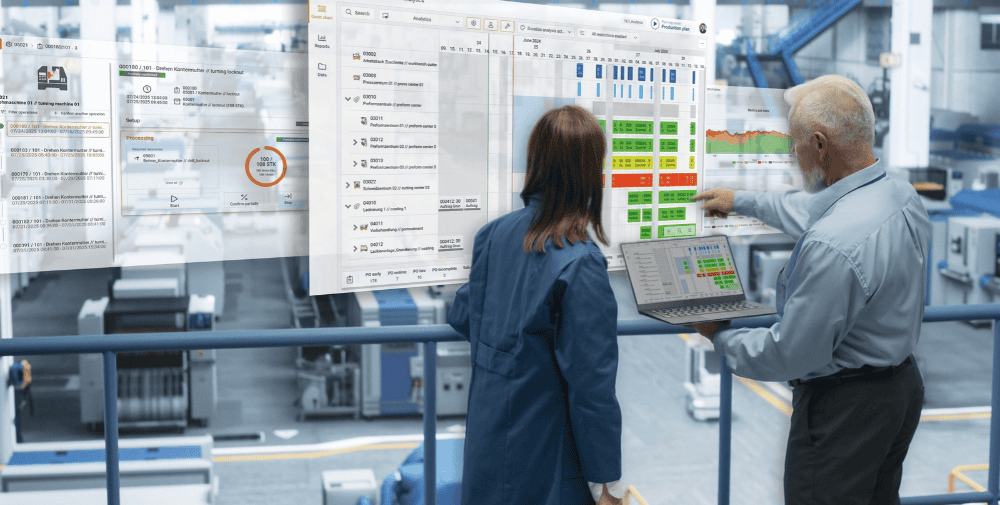
An international manufacturing company that wants to decide how to redirect its inventory in the event of supply chain disruptions needs more than just a simple, AI-generated answer. It needs to be able to search for alternative suppliers, monitor stock availability, view customer commitments and weigh up financial trade-offs. And to forecast liquidity risks in volatile markets, CFOs need context that a simple chatbot cannot provide. All of these activities involve intertwined operational decisions that incorporate dependencies, preferences, approvals, financial implications and trade-offs that directly impact overall business operations.
In countless conversations I’ve had with executives over the past year, the discussion has consistently shifted from AI capabilities to day-to-day feasibility. While AI models are evolving rapidly, the real question is whether AI understands the business context in which it is being used.
Too often, the discourse around AI assumes that better models will automatically lead to better business outcomes. This is not the case. Companies are increasingly finding that intelligent functions without an operational context – the processes, data, rules and policies used to manage and protect businesses – can trigger processes but enable little progress. On the contrary, in some cases this can even lead to more fragmentation and more risk.
An AI-generated recommendation may seem convincing, but it may ignore important dependencies in other parts of the system. And an AI agent can efficiently automate one workflow, but at the same time confuse the planning assumptions in another step. Companies do not lack AI output, but rather AI systems that are able to understand the impact on operations.
This is where the real challenge for enterprise AI currently lies. And to solve this problem, simply controlling processes is not enough. Context is needed.
Business software has formed the backbone of the global economy for decades. Financial systems, supply chains, procurement networks, workforce planning platforms, manufacturing workflows and order fulfillment processes all run on networked systems that capture not only information but also the logic behind business processes. These systems include process knowledge and data, governance structures, authorizations, policies and economic relationships that have been collected over many years and inform every decision a company makes. They are the brains of any organization.
In the AI age, this business context is especially valuable. Without this data, AI outputs remain educated guesses instead of well-informed judgments.
But when AI is embedded directly into operational processes, it can draw logical conclusions across all aspects of the business. This changes the role of software in companies, as enterprise systems are increasingly directly involved in the actual execution.
AI can identify risks earlier, coordinate responses across functions, recommend actions in real time and automate the execution of routine activities within defined frameworks. This does not take the form of isolated agents that work separately from each other, but via intelligent functions that are linked to the economic and operational structure of the company itself.
Autonomy in the company does not mean that people are excluded from the decision-making process. Rather, autonomy means reducing the fragmentation and administrative effort that prevent companies from working quickly, uniformly and comprehensively. It is still people who set priorities, make important decisions and bear responsibility. However, AI can help coordinate and execute the operational processes associated with these decisions.
As an example, consider a supplier failure that impacts a critical manufacturing component. Most modern AI systems can summarize the problem or predict the likely delay based on learned patterns. However, AI embedded in processes not only provides insights, but can coordinate and initiate actions. It can identify affected production plans, analyze global inventory positions, evaluate alternative sourcing options, estimate the financial burden, highlight delivery risks for customers and simultaneously suggest measures for procurement, logistics, finance and customer operations.
In this way, AI not only automates workflows, but also offers completely new possibilities in the interaction between humans and company systems. But that’s not all.
The more action-oriented AI becomes, the more crucial the systems that connect it to day-to-day operations and processes become. Systems that can understand permissions, policies, dependencies, processes, financial implications and organizational responsibilities at the enterprise level will become more important than ever.
This development also has an impact on how leaders should approach the topic of transformation.
So far, most companies have been experimenting with AI assistants, rolling out pilot projects and automating isolated tasks. Few of them have been able to actually increase productivity, and even fewer have been able to fundamentally realign their operations.
The companies that can establish themselves as pioneers in the next phase will take a different approach to artificial intelligence. They will connect intelligent functions directly to operational systems where decisions have real business consequences. They will recognize that trustworthy, productive AI is based on context, data quality and process integrity, as well as extensive process knowledge.
Most importantly, these companies will understand that the successful use of AI is not just a technological shift, but a change management challenge. Real added value can only be achieved when AI agents, processes and people work hand in hand.
The future belongs to the companies that find this balance: People set priorities and take responsibility, while intelligent systems coordinate processes and execute actions with precision. This enables companies to work more resiliently, productively and intelligently in an increasingly complex world.
– – – – – –
Further links
👉 www.sap.com
Photo: pixabay