Practical application remains the biggest challenge
Twenty-six second-year mechatronics apprentices participated in the first two of a total of three surveys. The focus was on key aspects of semiconductor manufacturing, such as vacuum technology, LPCVD systems, and structured troubleshooting (8D).
The results paint a clear picture:
- 62% still feel unfamiliar with the theoretical fundamentals of LPCVD systems.
- 77% rate their practical handling of the systems as uncertain.
- 88% rarely or never have the opportunity to analyze real-world malfunctions on their own.
- Also, 88% feel inadequately prepared when it comes to understanding process interdependencies.
The trainees cite the lack of access to real systems, too few practical error scenarios, and a lack of time in their daily training as the biggest challenges. Understanding complex processes and systematic troubleshooting, in particular, can often only be taught to a limited extent under real production conditions.
Valuable Insights for Member Companies
The survey not only provides an overview of the current situation but also offers Silicon Saxony’s member companies important guidance for further developing their training strategies.
The results illustrate that modern training is increasingly facing new challenges: production facilities are operating at high capacity, safety requirements are rising, and opportunities for hands-on practice are limited. Digital learning formats can effectively bridge this gap by enabling practical training without interfering with ongoing production processes.
In the long term, companies benefit from better-prepared skilled workers, greater confidence in performing daily tasks, and shorter onboarding periods. At the same time, the results underscore the need to integrate innovative training formats into corporate training programs at an early stage.
High Acceptance of Digital Learning Technologies
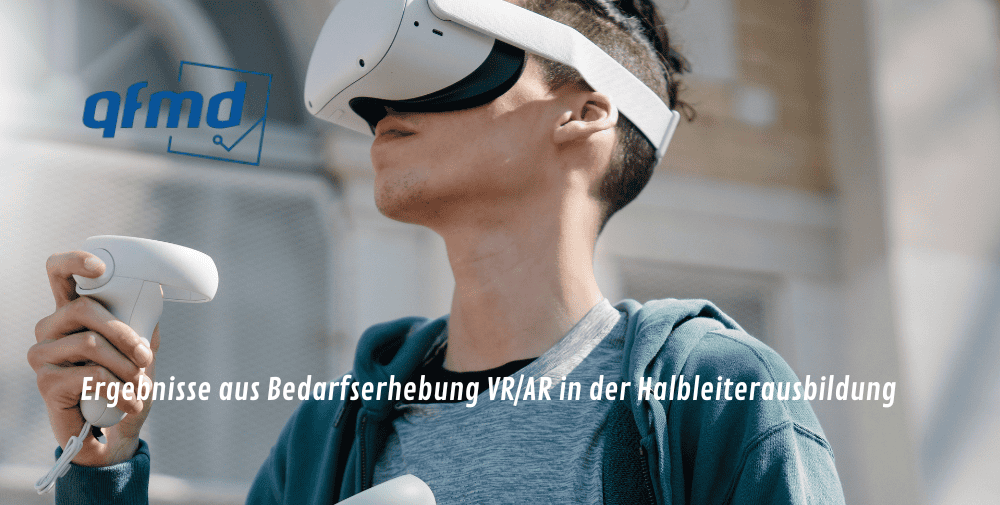
The survey also shows that digital learning offerings are already met with great openness among trainees: 96% have already gained experience with virtual reality, simulations, or digital learning games.
However, the feedback makes it clear that virtual learning environments are not seen as a replacement, but rather as a valuable supplement to hands-on training. VR applications can provide significant added value, particularly in situations where real-world equipment is not always available or where complex failure scenarios occur only rarely.
Developing New Educational Formats Together
This is precisely where the VIP project—Virtual Internship in Vacuum Technology—comes in. qfmd GmbH and Silicon Saxony are jointly developing immersive VR/XR learning scenarios that allow for realistic training in typical process flows, maintenance tasks, and fault scenarios.
The project is designed as a joint innovation initiative to secure a skilled workforce in the European semiconductor industry. It not only creates new learning formats for trainees but also provides data-driven insights that help companies further develop their training and continuing education programs to meet future needs.
Through projects like VIP, Silicon Saxony, together with its partners, strengthens the innovative capacity of Saxony as a semiconductor hub and makes an important contribution to training the skilled workers of tomorrow.
👉 more information: https://www.qfmd.de/vip-projekt/
_______
👉 this text is a automatic translation