Managers, in particular, see AI as an opportunity to move more quickly into more challenging roles:
- 39.5 percent of employees surveyed somewhat or strongly agree with the statement that “AI gives entry-level employees the opportunity to take on more challenging tasks more quickly.”
- Among managers, the level of agreement—at 47.9 percent—is significantly higher than among employees without managerial responsibilities (36.8 percent).
AI Is Changing Traditional Entry-Level Roles
The results also reveal a downside:
- 41.3 percent of employees somewhat or strongly agree with the statement that “AI is taking over tasks that were typically performed by entry-level employees in the past.”
- Managers are more likely to share this view (47.9 percent) than employees without managerial responsibilities (39.1 percent).
“It’s paradoxical. AI can both accelerate and hinder career entry. On the one hand, it helps young employees take on more challenging tasks more quickly. On the other hand, AI is eliminating precisely those routine tasks through which many gained their initial professional experience—such as research or presentations as part of consulting assignments. This makes it all the more important not to lose sight of those just starting their careers. They need the opportunity to gain practical experience while simultaneously building AI skills. This is also an investment in the next generation of skilled professionals,” says Prof. Dr. Anne Gfrerer, Professor of Business Informatics at IU International University and a scientific expert on the study, as she interprets the results.
AI Competence Is Becoming a Basic Requirement
When it comes to AI competencies, a slim majority of respondents is certain: “For entry-level professionals, AI skills are becoming a basic requirement in many occupational fields.” Overall, 54.9 percent of employees agree with this statement to some extent or completely. At 65.6 percent, managers share this assessment significantly more often than employees without managerial responsibilities (51.5 percent).
Overall, 41.3 percent of employees expect that skills such as prompting or the critical evaluation of AI results will become more important in the future. There are clear differences between managers and employees without managerial responsibilities:
- For example, 51.2 percent of managers expect prompting to become more important in the future, compared to 38.1 percent of employees without managerial responsibilities.
A similar pattern emerges regarding the critical evaluation of AI results:
- Here, 49.6 percent of managers anticipate an increase in importance, compared to 38.6 percent of employees without managerial responsibilities.
- At the same time, employees without managerial responsibilities are significantly more likely than managers to be unable to assess the future importance of these skills.
“The fact that many employees are not yet able to properly assess the importance of these skills shows that: Companies need to communicate more clearly which skills and work methods will be in demand in the future. Only then can employees prepare specifically for the changes ahead,” explains Prof. Dr. Philipp Diebold, who contributed his expertise to the study as a professor of business informatics at IU International University.
Hardly Any Time for AI Training
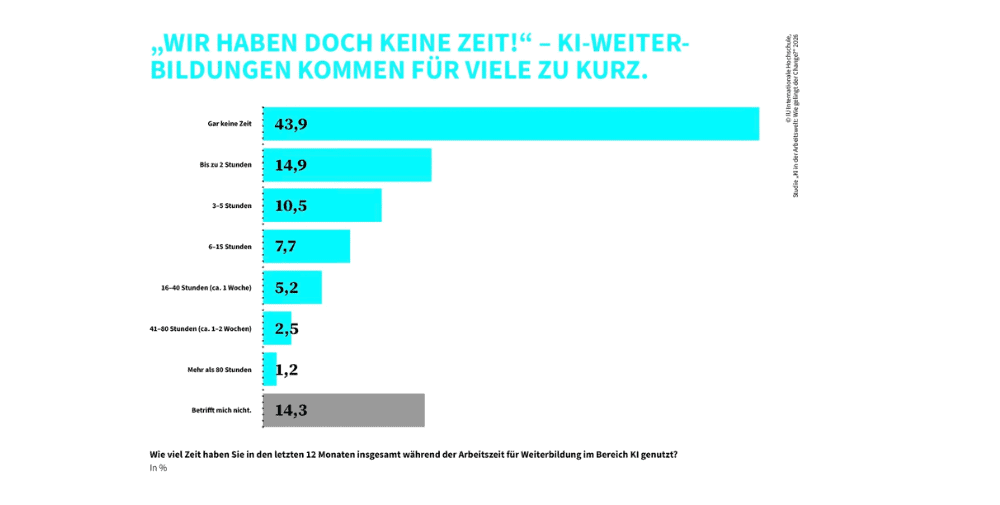
Yet it is precisely this communication that is lacking in many places: 43.9 percent of employees in Germany have not used any work time for AI training in the past 12 months (at the time of the survey).
- Nearly half (47.4 percent) of them cite the fact that AI training is not necessary as the reason.
- Just under a quarter (24.0 percent) cite that their company does not want them to pursue such training, while one-fifth (20.6 percent) cite a lack of time as the reason.
A gap is also evident when it comes to corporate support:
- According to employees, companies most frequently provide very strong or somewhat strong support for training in technical skills (51.6 percent) and communication skills (46.0 percent).
- Critical thinking—which experts view as an important skill for the future—is, by contrast, supported significantly less often (33.6 percent, “very strongly” or “somewhat strongly”).
“The current expectation in companies is to use AI in a way that adds value. However, the results reveal a contradiction: Many employees lack the time to engage with it, yet at the same time, AI is often not yet considered relevant or necessary. AI is actually supposed to reduce workload, increase efficiency, and save time. Instead, it initially ties up resources—especially when it’s simply added “on top” of existing workflows rather than adapting them to accommodate it. This raises the question of whether the current approach is the right one or whether a targeted change in work practices is needed to create the conditions for truly productive AI use,” says Diebold.
Despite the gaps in continuing education, employees remain confident: 81.6 percent are confident in their ability to acquire new skills on their own.
About the Study
The study “AI in the Workplace: How Can We Make the Transition?” by IU International University examines how artificial intelligence is transforming the world of work in Germany and what role leadership and change management play in this process. For the study, 2,000 employees in Germany aged 16 to 65 were surveyed. The sample is representative of the German labor market in terms of age and gender. The survey was conducted from March 31 to April 14, 2026 (panel: Horizoom).
The full study is available at: www.iu.de/forschung/studien/ki-und-arbeitswelt/
AI and Job Readiness at IU
With the Job Readiness Framework (JRF), IU International University has developed its own orientation framework to specifically prepare future career starters for the AI-driven job market. The framework combines subject matter expertise, professional competence, and the reflective use of artificial intelligence. Through a five-level competency model, AI competencies are made systematically measurable for the first time. Graduates can thus demonstrate that they use AI in a work context confidently, strategically, and responsibly—not merely as tool users, but as active shapers of work processes.
ABOUT IU INTERNATIONAL UNIVERSITY
With approximately 130,000 students, IU International University (IU) is Germany’s largest university. This private, state-recognized educational institution, headquartered in Erfurt, began offering courses in 2000 and is now represented at 37 locations. IU stands for maximum flexibility in higher education: whether through dual study programs, distance learning, or on-campus study—students from over 160 countries tailor their educational paths individually to their personal life situations. With more than 200 degree programs at the bachelor’s, master’s, and MBA levels, IU imparts practical skills. Innovative learning concepts foster targeted, future-ready skills for an increasingly AI-driven workplace. A modern, digitally supported learning environment and the use of artificial intelligence enable effective, personalized learning. As a pioneer in this field, IU has developed its own digital learning assistant, “Syntea,” which has been in use since 2023. A network of over 15,000 companies—including Motel One, Vodafone, the AWO, and Deutsche Bahn—makes IU a strong partner in training skilled professionals and consistently bridges the gap between academic teaching and real-world practice.
Related Links
👉 www.iu.de
Graphic: IU