For decades, progress in electronics has been shaped by Moore’s Law: Ever smaller transistors enable higher performance at lower costs. However, traditional scaling is increasingly reaching its physical and economic limits. Moore4Power is countering this development with a fundamental change of perspective – away from the optimization of individual components and towards innovations at system level. Significant advances in efficiency, reliability and power density can be achieved through the intelligent, application-oriented interaction of technologies, materials and functions.
“Power electronics is a decisive lever for energy efficiency and sustainability. With Moore4Power, we are taking intelligent integration to the next level to achieve significantly higher energy and resource efficiency,” says Jochen Koszescha, Head of Coordination of the Moore4Power project at Infineon. “We are proud to make a decisive contribution to Europe’s Clean Industrial Deal together with an outstanding consortium of science, research and industry.”
Intelligent integration beyond traditional scaling
The focus of Moore4Power is on heterogeneous integration: different semiconductor technologies – such as silicon (Si), silicon carbide (SiC) and gallium nitride (GaN) – are brought together with sensor, control and communication functions to form tightly integrated systems. Each technology is used precisely where it can best exploit its specific strengths. The result is greater efficiency, improved reliability and more compact designs. Power chiplet technology also enables scalable architectures and more flexible product variants with globally competitive cost structures. This modular approach paves the way for next-generation solutions in a variety of highly relevant fields of application. The foundation for this was already laid in the predecessor project PowerizeD, a major project funded by the Chips JU, which ended in 2025 and achieved outstanding progress in efficiency and reliability.
More power for energy, mobility and industry
Moore4Power focuses on key industries in which energy conversion has a significant impact on costs, CO₂ reduction and reliability. For example, advanced power electronics can improve energy conversion directly in wind turbines and increase the energy yield from wind power. In e-mobility, the new generation of power electronics should enable efficiencies of up to 99% with virtually loss-free, bidirectional charging. In the rail sector, the aim is to reduce drive losses by at least 30 percent and thus significantly increase energy efficiency.
Faster development through digital intelligence
KI-supported models, digital twins and automated processes are set to radically shorten development cycles. Hardware and software are developed in parallel to reduce simulation times and increase accuracy at the same time. This should reduce the time from the first fab samples to the release of a validated data sheet to just one week, compared to several weeks today. This acceleration reduces costs, increases industrial implementation and strengthens the competitiveness of European industry. The first scalable demonstrators are also being tested under real operating conditions.
Sustainability integrated right from the start
A central element is the Digital Product Passport (DPP), which is to be anchored directly in the power modules with wireless access. The DPP will then provide relevant data over the entire life cycle, such as operating conditions, status information and remaining service life. This transparency improves predictive maintenance, extends product life and improves reusability, thereby also reducing the consumption of raw materials. All of this has a direct impact on CO₂ savings and is a concrete contribution to the circular economy and Europe’s climate goals.
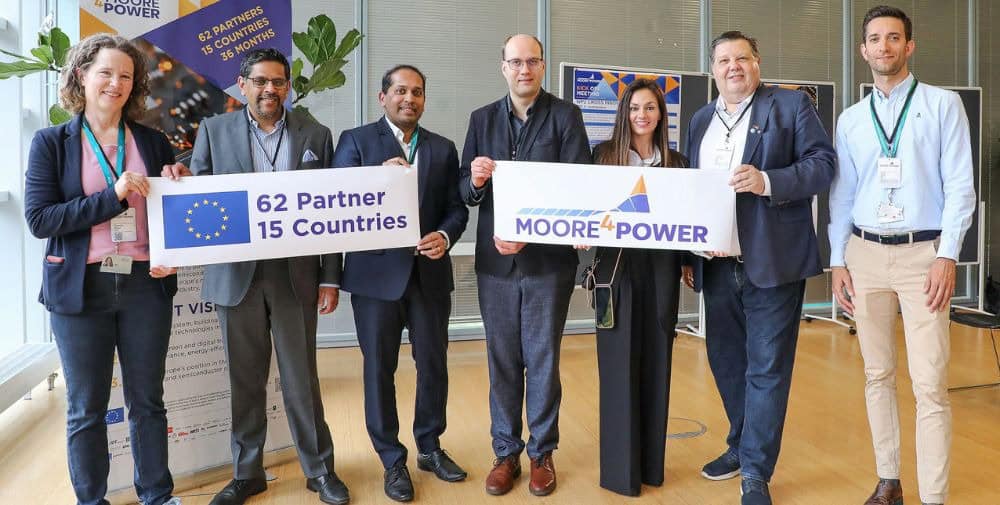
EU top-level research: 62 partners from 15 countries
The European project Moore4Power (More than Moore for Disruptive Innovations in Power Electronics) will run for a total of three years. It is co-financed by funding from the participating countries and the Horizon Europe – Chips Joint Undertaking program (innovation measure). The consortium in detail:
Belgium: Interuniversitair Micro-Electronica Centrum VZW (IMEC) | Materialise NV (MATE) | Sadechaf BV (SADE); Germany: Ansys Germany GmbH (ANSYS) | Airbus Operations GmbH (A-D) | Finepower GmbH (FPG) | Fraunhofer ENAS (FHG) | Hella GmbH & Co KGaA (HELLA) | Infineon Technologies Germany AG (IFAG) | Infineon Technologies Dresden AG & Co. KG (IFD) | Nano-Join GmbH (NANO) | Ostbayerische Technische Hochschule Amberg-Weiden (OTH) | Technical University of Dortmund (TUDO) | University of Bremen (UBRE); Finland: Aalto-korkeakoulusäätiö sr (AALTO) | ABB Oy (ABB) | Kempower Oy (KEMP) | Lappeenrannan-Lahden teknillinen yliopisto (LUT) | MSc electronics Oy (MSC) | Vensum Power Oy (VENS); France: Ampère SAS (AMP) | Commissariat à l’Énergie Atomique et aux Énergies Alternatives (CEA) | Institut VEDECOM (VEDE) | SASU Rayione (RAY) | Trialog SAS (TRIA); Greece: Innovation Dis.co Idiotiki Kefalaiouchiki Etaireia (DISCO); Italy: Infineon Technologies Italia SRL (IFI) | Università degli Studi di Milano-Bicocca (UMIB) | Università degli Studi di Padova (UNIPD); Latvia: Elektronikas un Datorzinātņu Institūts (EDI); Netherlands: Prodrive Technologies Innovation Services B.V. (PTIS) | Signify Netherlands B.V. (SIGN) | Technische Universiteit Delft (TUDE) | Technische Universiteit Eindhoven (TUE) | Universiteit Twente (UTWEN) | VSL B.V. (VSL); Austria: Austrian Institute of Technology GmbH | EV Group E. Thallner GmbH | Hellpower Energy e.U. (HEPO) | Infineon Technologies Austria AG (IFAT) | Kompetenzzentrum Automobil- und Industrieelektronik GmbH (KAI) | Silicon Austria Labs GmbH (SAL); Romania: Infineon Technologies Romania & Co. SCS (IFRO), Universitatea Tehnică din Cluj-Napoca (UTCN); Sweden: Alstom Rail Sweden AB (ALST), Kungliga Tekniska högskolan (KTH), Rise Research Institutes of Sweden AB (RISE); Switzerland: ABB Schweiz AG (ABBCH), Eidgenössische Technische Hochschule Zürich (ETHZ), Plexim GmbH (PLEXIM). Spain: Consejo Superior De Investigaciones Científicas (CSIC), Fagor Automation S. Coop. (FAGOR), Frenetic Electronics, S.L. (FREN), Ingeteam Power Technology S.A. (IPT), Ingeteam Research Institute S.L. (IRI), Power Smart Control S.L. (PSC), Universidad de Oviedo (UNOVI); Czech Republic: i46 s.r.o. (i46) | Vysoké učení technické v Brně (BUT); Hungary: Budapesti Műszaki és Gazdaságtudományi Egyetem (BME) | HUN-REN Energiatudományi Kutatóközpont (HUNREN) | Infineon Technologies Cegléd (IFCE) | Spinsplit Műszaki Kutató Fejlesztő Kft. (SPIN)
About Infineon
Infineon Technologies AG is a leading global provider of semiconductor solutions for power systems and the Internet of Things (IoT). With its products and solutions, Infineon is driving decarbonization and digitalization. The company has around 57,000 employees worldwide (end of September 2025) and generated sales of around 14.7 billion euros in the 2025 financial year (end of September).
– – – – –
Further links
👉 www.infineon.com
Photo: Infineon