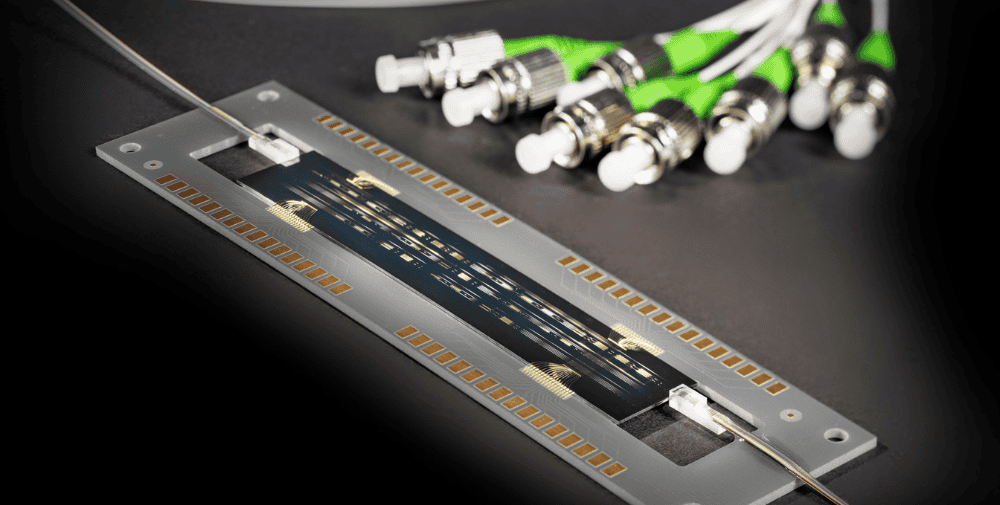


To this end, the six members of the Thuringian photonics network OptoNet e.V. aim to develop small modules suitable for standard network hardware at reduced costs, which can be easily installed at security-relevant locations. To achieve this, photonic and microelectronic functions are combined on a single silicon chip: a polarization analysis module for measuring the quantum states of photons, single-photon detectors for highly sensitive signal conversion, and electronics for high-resolution timestamping and evaluation of the detections.
Cybersecurity for Future Communication Infrastructures
Even today, protecting sensitive information from cyber threats is a top priority and requires ever-new and more robust security measures to ensure confidentiality and prevent unauthorized access. “It is foreseeable that quantum computers will be able to break traditional encryption methods in the coming years, thereby jeopardizing the security of information,” explains Dr. Kevin Füchsel, Managing Director of Quantum Optics Jena GmbH, which is leading the overall project.
According to Füchsel, entanglement-based quantum key distribution is considered a promising technology for securing future communication infrastructures: “It is possible to generate and distribute cryptographic keys with physically guaranteed security, regardless of an attacker’s computing power.” In quantum communication, it is not electrical signals that are transmitted, but photons—individual particles of light—that are entangled in their quantum states. Information is encoded via the polarization of a single photon. Like any other form of manipulation, eavesdropping alters the state of the photons. This makes attacks detectable and enables targeted protective measures. According to Füchsel, three components are required for quantum key distribution: polarization analysis to detect the state of a photon, single-photon detectors to ensure that the individual light particles are actually measured, and timestamping to synchronize the sender and receiver and filter out noise.
Quantum Key Distribution – So Far, Large Hardware for Small Photons
To practically implement all these theoretical advantages of quantum key distribution for broad application in the IT networks of the future, the six partners are working on a miniaturized technology platform. “Just a glance at the multitude of opto-mechanical components currently used in laboratory setups for quantum communication makes it clear that the miniaturization and photonic integration of quantum key distribution presents significant challenges but also opportunities,” says Prof. Dr. Andreas Tünnermann, director of Fraunhofer IOF and the Institute of Applied Physics at Friedrich Schiller University in Jena, describing the project. He is confident that Thuringia can take a leading role in this field: “We have expertise built up over many years in both optics and photonics on the one hand, and in microelectronics and sensor technology on the other. By joining forces, we will succeed.”
Dr. Andreas Fischer, Managing Director of AIM Micro Systems GmbH, adds: “We are working toward a highly integrated solution that can be easily and modularly deployed in network devices, much like a small SFP module.” To this end, all partners will contribute to the development of more compact, standardized, and industry-ready components. The challenges for assembly and interconnection technology lie in the photonic and electrical connection to the overall system, Fischer continues.
Silicon chip will combine all functions within a few millimeters
The project will implement a complete analysis unit as a monolithically integrated chip that combines the photonic and electronic functional units on a single chip measuring just a few millimeters.
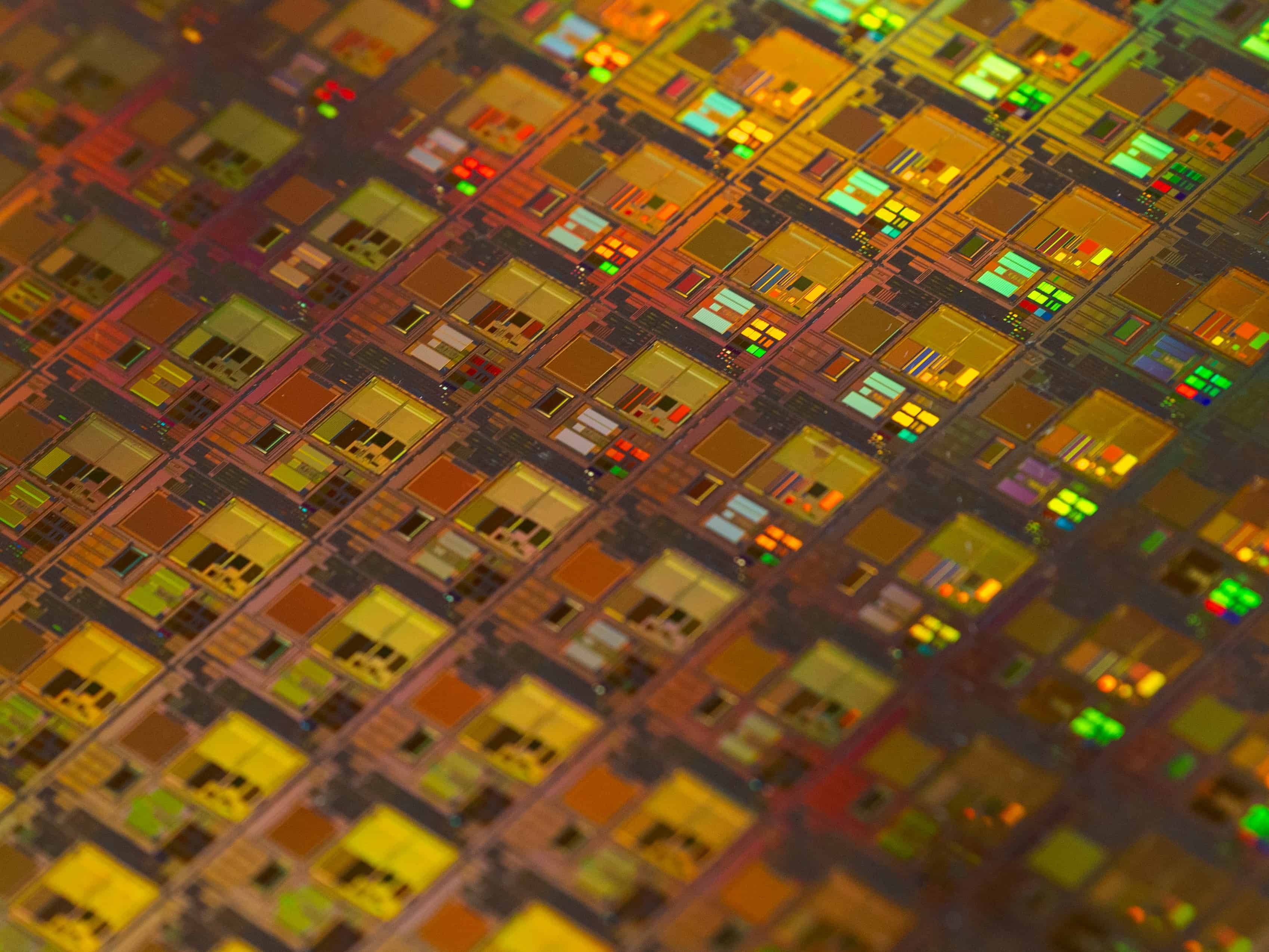
“We will further develop our technologies specifically for quantum key distribution and continue to adapt our CMOS processes for the fabrication of photonic-integrated chips,” explains Dr. Gabriel Kittler, CEO of X-FAB Global Services GmbH. This would enable photonic and electronic component layers to be processed on a single wafer in the future. The IMMS and Fraunhofer IOF will use this X-FAB technology platform to develop subsystems for the joint chip.
Fraunhofer IOF will implement all solutions for the chip’s photonic silicon nitride-based components of the chip, such as the micro-optical modules, the light processing in the polarization analysis unit including the beam splitter, as well as the couplers for connecting photonics and electronics and for fiber coupling from the chip to the outside. The test setups for characterizing all photonic modules will be implemented at FSU Jena.
“Everything that is supposed to happen in the electronic layer of the chip will be developed at IMMS, integrating as many functions as possible—today’s many individual components are to be incorporated into tomorrow’s chip,” explains Martin Eberhardt, Managing Director of IMMS. One focus will be on SPAD-based single-photon detectors, which, like the previous discrete sensors, handle the highly sensitive signal conversion but would be located directly on the chip. These highly sensitive single-photon avalanche photodiodes (SPADs) will, for the first time, be expanded to include the timestamp electronics to be newly developed at PIC-PAM. Eberhardt adds that the transfer of IMMS’s existing SPAD-based solutions to quantum applications with integrated photonics, in collaboration with Fraunhofer IOF, will be particularly exciting.
Small module for easy use in network devices
To ensure that the novel chips can ultimately operate in a small, SFP-like module within network devices, AIM Micro Systems will implement the precise assembly and interconnection technology: AIM will assemble the chips, provide them with housings, and implement suitable connections for light and electronics with a focus on industrial suitability and manufacturing technologies.
At Quantum Optics Jena, work is underway to develop a photon source that enables quantum key distribution even using photons visible to SPADs. In addition, the company will build the overall demonstrator for the project based on the developments of all partners to make the functionality of the results tangible.
Innovation made in Thuringia
“Thuringia is one of the leading locations for microelectronics and photonics in Germany. We are pleased that six highly innovative Thuringian photonics players from our membership are working on this significant innovation step in the combination of integrated photonics and quantum communication,” says Anke Siegmeier, Managing Director of OptoNet e.V. Furthermore, the close collaboration with X-FAB as a regional semiconductor manufacturing partner and the involvement of local research institutions will generate significant benefits for Thuringia. The state will benefit from the transfer of technology and know-how to regional suppliers and startups, from the strengthening of the value chain, and from the transferability of the results to cross-industry applications—even beyond Thuringia.
Funding
The collaborative project “Photonically Integrated Polarization Analysis Unit with Single-Photon Processing” (PIC-PAM) is funded through the Free State of Thuringia’s funding program for the promotion of research, technology, and innovation (FTI) as a Thuringia Collaborative Research and Development Project under project number 1006811 and is co-financed by the European Union. The topic “Design of a Time-Tagging ASIC with a Photonically Integrated Polarization Analysis Unit” by IMMS under project number 2026 VFE 0051.
Quantum Optics Jena GmbH
Today’s information security is based on complex cryptography. Quantum computers will challenge these methods in the future. Quantum Optics Jena GmbH is developing quantum key distribution (QKD) based on entangled photons to enable secure communication on a physical basis. The company covers the entire process chain—from sources through analysis to key management. Solutions are available for fiber-optic networks as well as for future QKD satellite systems. https://qo-jena.com/
AIM Micro Systems GmbH
AIM Micro Systems GmbH, headquartered in Triptis, specializes in the development and manufacture of high-precision micro-optical and optoelectronic systems. As a technology-oriented partner, the company supports customers in demanding industries such as medical technology and sensor technology along the entire process chain—from concept through industrialization to series production. The company possesses particular expertise in the integration of complex optoelectronic and photonic components under cleanroom conditions, as well as in the implementation of customer-specific solutions with a high degree of vertical integration. https://www.aim-micro-systems.de
X-FAB Global Services GmbH
X-FAB is a global foundry group that enables its customers to develop world-leading semiconductor products with a comprehensive range of specialized technologies and design IP. These are manufactured in X-FAB’s six wafer fabs in Malaysia, Germany, France, and the U.S. With many years of expertise in the fields of analog/mixed-signal technologies, microsystems/MEMS, and silicon carbide (SiC), X-FAB is the development and manufacturing partner for its customers, who primarily serve the automotive, industrial, and medical end markets. X-FAB employs approximately 4,300 people and has been listed on Euronext Paris (XFAB) since April 2017. https://www.xfab.com/
Fraunhofer Institute for Applied Optics and Precision Engineering IOF
The Fraunhofer Institute for Applied Optics and Precision Engineering IOF in Jena conducts application-oriented research in the field of photonics and develops innovative optical systems for controlling light—from its generation and manipulation to its application. The institute’s range of services covers the entire photonic process chain, from opto-mechanical and opto-electronic system design to the production of custom solutions and prototypes. At Fraunhofer IOF, approximately 500 employees generate an annual research volume of 40 million euros. https://www.iof.fraunhofer.de
Friedrich Schiller University Jena, Institute of Applied Physics
The Institute of Applied Physics (IAP) at Friedrich Schiller University Jena has a long-standing tradition and expertise in the design, fabrication, and application of active and passive optical and photonic elements. In addition, it is particularly well-known for its developments in the field of ultrashort-pulse laser development and application as well as quantum optics. Collaborative projects with companies ensure practical relevance and feasibility. In the Experimental Quantum Information research group, the focus is on the development and experimental implementation of innovative methods for the generation, manipulation, and detection of complex quantum states of light. https://www.physik.uni-jena.de/iap/16984/Institute for Applied Physics
IMMS Institute for Microelectronics and Mechatronics Systems, non-profit GmbH (IMMS GmbH)
IMMS supports companies in launching internationally successful innovations for health, the environment, and industry, and accompanies them from the feasibility study through to series production. It helps companies advance through application-oriented research and development in microelectronics, systems engineering, and mechatronics, and transfers the results of basic research into practical applications. IMMS was founded in 1995 as a state-owned enterprise of the Free State of Thuringia and is an affiliated institute of the Technical University of Ilmenau. It operates with a team of approximately 90 people at its headquarters in Ilmenau and at its branch in Erfurt. https://www.imms.de
– – – – –
Further Links
👉 www.imms.de
👉 www.xfab.com
👉 www.iof.fraunhofer.de
Photo: Fraunhofer IOF