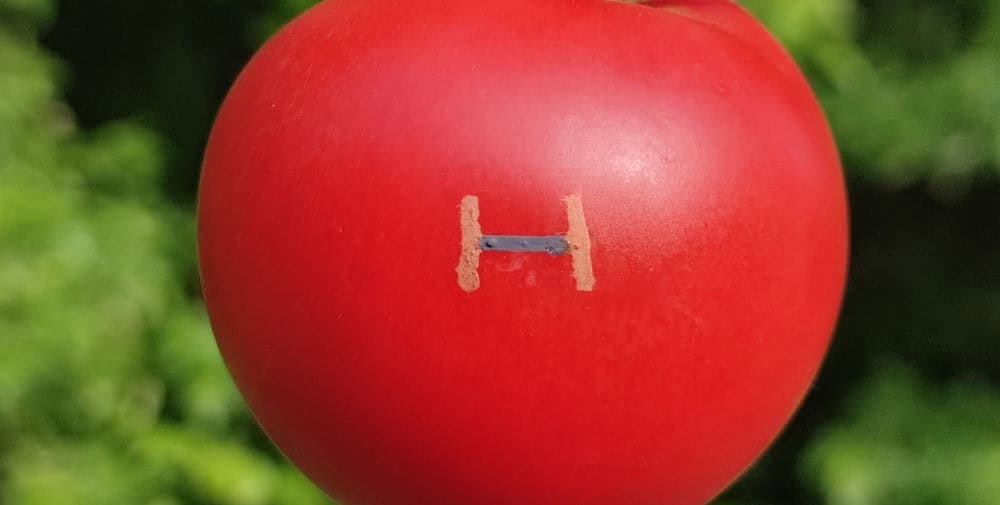
Iron, cellulose and beeswax: an international research team at the HZDR shows that these environmentally friendly ingredients are completely sufficient to create new types of magnetic field sensors. Instead of using traditional manufacturing processes, the team is relying on bio-based inks and industrial printing technologies.
Magnetic field sensors are now among the invisible mass products of the electronics industry. They measure movements, positions or distances and are found in window contacts, steering wheels, hard disks, packaging and smartphones. Billions of these components are produced every year. “Many of these sensors contain materials such as nickel or cobalt,” says Dr. Denys Makarov, Head of the Intelligent Materials and Functional Elements Department at the Institute of Ion Beam Physics and Materials Research at the HZDR. “These are substances that can be problematic for the environment and health if they are not disposed of properly.” At the same time, their production often requires energy-intensive processes and complex manufacturing steps.
The development of sustainable sensors is technically challenging. Although iron is considered readily available and biocompatible, it does not achieve the sensitivity of many of today’s magnetic field sensors on its own. The research team therefore combined iron with iron oxide and developed special core-shell particles in which an iron core is surrounded by a thin oxide layer.
“Humankind has known iron or cellulose for centuries,” says Lin Guo, who is working on the project as part of his doctoral thesis: “The challenge is to develop a sensor with usable performance from these sustainable materials.” The precise composition and processing of the particles was crucial here. According to the team, the printed sensors achieve sensitivities that are comparable to current commercial solutions in certain areas of application.
The sensors are produced using screen printing, a process that is more familiar from the textile industry. Instead of removing materials in areas that are not required, the sensor layer is applied in a targeted manner. “We only print sensors where we need them,” explains Makarov. This not only saves material, but also energy.
When sensors can disappear
The end of life of the sensors also played an important role in the development. Conventional electronics are usually used until they break down and have to be disposed of. The aim of the current study, however, is to develop materials that can be degraded or recycled in a controlled manner. The iron-iron oxide sensor layer was therefore embedded in a matrix of biocompatible materials such as cellulose or starch. A layer of biocompatible polymers or natural materials such as beeswax protects the sensors from moisture and also determines their service life. “We can use the encapsulation to control how long a sensor remains stable,” says Guo. The service life can be specifically adapted for different applications. If the biological matrix in the water dissolves later, oxidized iron particles in particular remain behind. “This is basically rust,” says Denys Makarov. Potentially toxic substances such as certain nickel or cobalt compounds are deliberately not used in the concept.
The technology for producing printed magnetic field sensors has already been licensed. The team is now working on specific applications. The researchers are particularly interested in areas where electronic components are only needed for a limited time, such as in intelligent packaging, disposable medical products or special sensor systems for agriculture. In these areas, sustainable magnetic field sensors could help to manufacture electronics in a more resource-efficient way in the future.
At the same time, the team is already working on other concepts. Future projects include more durable encapsulations, new biocompatible materials and the integration of sensors into flexible electronic systems.
Publication
L. Guo, R. Xu, P. T. Das, E. S. Oliveros-Mata, X. Peng, O. V. Pylypovskyi, R. Hübner, F. Ganss, X. Wang, Y. Li, S. Gepp, Y. Zabila, X. Bao, S. Li, Q. Zhang, I. Veremchuk, Ž. Janićijević, L. Baraban, C. Voigt, S. Mosch, O. Gutfleisch, R.-W. Li, D. Makarov: Eco-sustainable magnetoresistive sensors towards disposable magnetoelectronics, in Nature Communications, 2026 (DOI: 10.1038/s41467-026-71077-9)
Contact
Dr. Denys Makarov I Department of Smart Materials and Functional Elements
Institute of Ion Beam Physics and Materials Research at HZDR
Tel. +49 351 260 3273 | E-Mail: d.makarov@hzdr.de
– – – – – –
Further links
👉 www.hzdr.de
Photo: Lin Guo