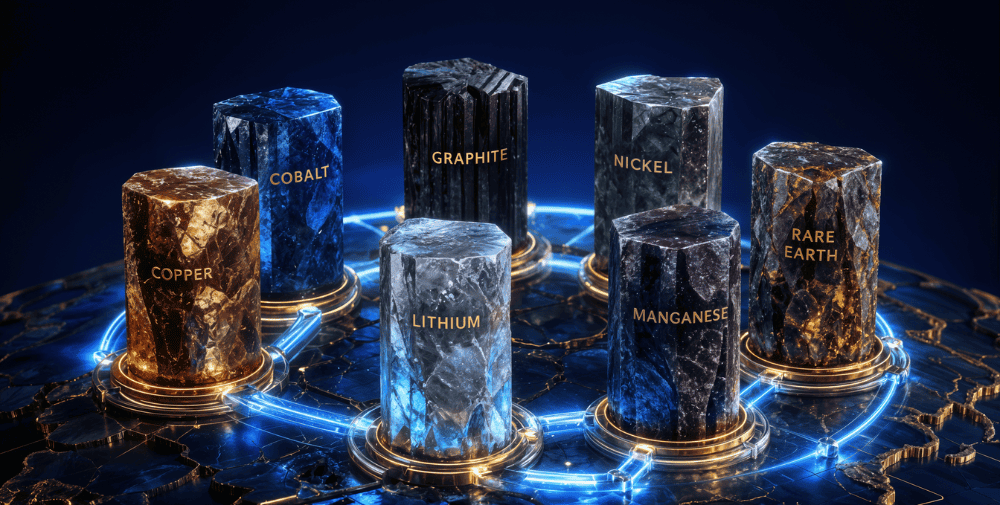
Whether electric cars, solar panels, or smartphones—many technologies that shape our daily lives could not be produced at all without certain raw materials. However, many of these materials are scarce, their extraction is problematic, and their supply is uncertain. To minimize these supply risks and strengthen sovereignty, the European Union has adopted the Critical Raw Materials Act (CRMA).
Funding Measures
To implement the CRMA objectives, Germany has established the funding measures EGARoh and EGARoh_Junior. Both are part of the FONA strategy of the Federal Ministry of Research, Technology, and Space (BMFTR), which aims to promote research for sustainability. EGARoh stands for “New Approaches to the Exploration, Extraction, and Processing of Primary Raw Materials in the Context of National and European Cooperation” and aims to research and develop technological innovations for the exploration, extraction, and processing of primary mineral raw materials. The goal is to achieve progress through strategic partnerships between science and industry that can be put into practice within three to five years.
With the EGARoh_Junior funding initiative “Support for International Junior Research Groups to Address the Need for Skilled Workers in the Exploration, Extraction, and Processing of Primary Raw Materials,” the BMFTR is addressing the need to secure a skilled workforce in the raw materials sector. With the cessation of ore mining in Germany in the early 1990s, career prospects in research and industry were lost. To reposition itself more effectively in this field and accelerate networking with stakeholders in the raw materials sector, the Ministry is supporting outstanding young scientists by enabling them to establish a junior research group. This is intended to improve the knowledge base in Germany and support the skilled workforce market.
The two funding initiatives, EGARoh and EGARoh_Junior, have the clear goal of increasing the supply of critical raw materials and thereby strengthening the industrial base for Germany as a high-tech hub—as a contribution to the BMFTR’s High-Tech Agenda for Germany.
EGARoh Projects at the HZDR
The HZDR has secured a total of five projects under the EGARoh funding measure, all of which are based at the Helmholtz Institute Freiberg for Resource Technology (HIF). These include the networking and transfer project EGARoh-Connect, which, in collaboration with the Federal Institute for Geosciences and Natural Resources (BGR) and RWTH (RWTH) Aachen, aims to transfer results to industry, raw materials initiatives, as well as science and politics. “In the EGARoh-Connect project, we compile all results from the individual projects and junior research groups to make them accessible and understandable to the public. Furthermore, we identify industry- and technology-specific cross-cutting issues, analyze the achievement of objectives for the funding measures, and derive corresponding recommendations for action for policy makers,” says project coordinator Dr. Nicole Körtge from the HIF, summarizing the scope of the project.
The DigIT Project – Digitalization and Geomodeling for Intelligent Exploration Technologies (Project Leader Dr. Samuel Thomas Thiele)
The project aims to develop digital technologies that can be used to quickly and precisely capture geological information, as well as data from abandoned mines, and make it usable for near-deposit exploration. Data integration and digitization are currently two major challenges for mineral resource exploration in Europe. The reason for this is that mining is a traditionally data-intensive industry with complex information flows. Exploration and mining companies must continuously generate and process geological information from the subsurface. However, a large portion of this information is already lost during sampling and mapping work on the exposed mine walls. Through digital mapping of mining areas, self-updating geological models, simulation of ore formation processes, and the improvement of data standards, mining data is utilized more effectively and exploration targets are predicted with precision.
In the PARFEKD project—resource- and energy-efficient, continuous agitator grinding and flotation with innovative inline particle analysis for sustainable ore processing (Project Leader Dr. Martin Rudolph)
This project focuses on new approaches to raw material processing. The researchers aim to develop energy- and resource-efficient technologies up to the pilot scale. A key focus is on the digitalization of these processes. Using modern inline measurement systems, particles and bubbles are analyzed in real time to continuously improve grinding and flotation.
STREAM – Structure-Oriented Development of Energy-Efficient Processes for Resource-Conserving Primary Raw Material Extraction through New Processing and Modeling Approaches (Project Leader Dr. Lucas Pereira)
Since ores often differ significantly in structure and composition, and this microstructure is usually not taken into account in conventional processing methods, this results in higher energy consumption and lower yields. The project therefore combines materials science, process modeling, and process engineering to develop selective comminution and flotation technologies specifically tailored to the properties of the ores. With the help of soft sensors, data analysis, and machine learning, processes are continuously monitored and optimized—for greater energy efficiency and higher material recovery rates, particularly for lithium and rare earth elements.
NahGOLD – Sustainable and innovative extraction of GOLD and strategic metals from polymetallic ores (Project Leader Dr. Ajay Bhagwan Patil)
The project is developing innovative and sustainable processes for the extraction of gold and strategic metals from polymetallic ores in Europe. In addition to gold, polymetallic gold ores also contain important metals such as zinc, bismuth, tellurium, and selenium. The high zinc content has posed a technical hurdle to date. NahGOLD addresses this challenge with novel processing technologies and metallurgical methods that enable the targeted separation and recovery of zinc. The developed processes are being tested on a pilot scale and demonstrated at European deposits.
The projects are funded with a total of 6.8 million euros and have a duration of three years; only the Connect project spans the entire 6.5-year funding period.
EGARoh_Junior Early-Career Research Groups at HZDR
HZDR was able to secure funding for a total of three early-career research groups under the EGARoh_Junior funding program. All junior research groups have a duration of five years and are funded with a total of ten million euros. With the exception of the ECuFlot group, which is based at the Institute of Fluid Dynamics, all junior research groups are affiliated with the HIF. In particular, project partners from resource-rich countries that have strategic raw material partnerships with the EU and Germany are involved. The cooperation partners outside Europe include countries ranging from North and South America to Africa and Australia.
REEHydroMin – Extraction of rare earth elements from primary resources using sustainable hydrometallurgy
The project focuses on the development of a scalable, sustainable, and competitive method for extracting critical rare earth elements from complex primary raw materials. It employs innovative techniques for processing and metallurgical procedures to extract complex rare earth resources from deposits in Europe, Canada (with Brazil), and South Africa. REEHydroMin will also develop an academic program focusing on rare and less-studied metals that are significant for the semiconductor industry in Germany and train the next generation of professionals for this field.
PURE – Particle-based approach for the sustainable processing of critical raw materials to realize the energy transition: Ore microstructure-driven simulation of processing plants (led by Dr. Lucas Pereira)
Raw materials for renewable energy plants are extracted from complex ores. The complexity of the ores poses a challenge, as most ore bodies currently available for extraction are of low quality, exhibit highly variable spatial architecture, and are characterized by complex mineral associations and microstructures. PURE will develop technologies to improve resource efficiency, minimize waste, and enable real-time process optimization based on ore microstructures.
ECuFlot – Efficient copper flotation in water-scarce regions through innovative use of process water (Principal Investigator Dr. Milad Eftekhari)
The ECuFlot early-career research group will develop more efficient and water-saving flotation strategies for copper extraction. The focus is on the recovery of very fine copper particles, particularly those smaller than 20 micrometers, from low-grade primary copper ores as well as from secondary copper smelter slags. The background is that many copper deposits are located in regions with water scarcity, while copper flotation traditionally requires large amounts of water. Mines are therefore increasingly using recycled water. However, changes in water chemistry caused by water recycling—particularly in salinity and specific ion composition—can significantly affect flotation performance. ECuFlot investigates how this water chemistry ultimately impacts copper recovery. The goal is to develop transferable strategies for ion-sensitive and salt-tolerant flotation that can be reliably operated with recycled process water.
Approval for another junior research group at the HIF is still pending.
Contact
Dr. Nicole Körtge | Processing Department
Helmholtz Institute Freiberg for Resource Technology at the HZDR
Tel.: +49 351 260 4407 | Email: n.koertge@hzdr.de
– – – – –
Further Links
👉 www.hzdr.de
Photo: Adobe Stock (AI-generated)