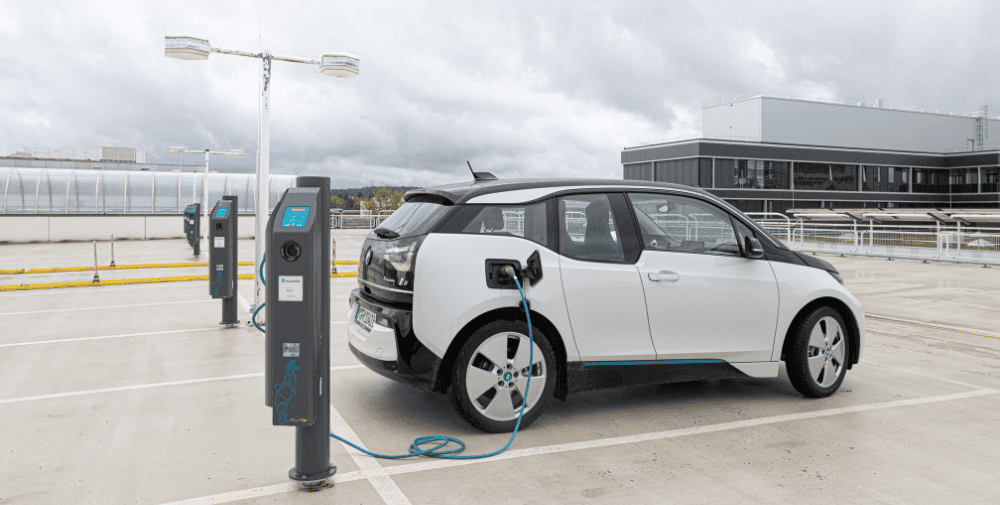
A key application is the “DC Innovation Hub” at the Weidmüller Academy in Detmold. There, a direct current (DC) grid is in operation where electricity from renewable sources is efficiently integrated into the DC network and can now also be stored and used with electric vehicles. “Direct-current grids offer real gains in efficiency and flexibility here, which we have consistently leveraged in the project,” says Isabella Bianchini, research team leader at the Fraunhofer Institute for Manufacturing Engineering and Automation IPA.
In collaboration with the Ostwestfalen-Lippe University of Applied Sciences (TH OWL), the Fraunhofer Institute for Integrated Systems and Device Technology IISB, and the industry partners Ambibox, Eaton, and Weidmüller, flexible solutions for bidirectional charging in industrial DC grids were developed. The project was successfully completed in April 2026.
Increasing Energy Efficiency with Direct Current
The project began with the question of how charging infrastructure could be efficiently integrated into industrial direct current (DC) grids to reduce energy costs and avoid costly grid expansion. In conventional scenarios, charging stations are powered via the AC grid, and each conversion step results in losses. “If we connect the charging infrastructure directly to the company’s internal DC grid, we avoid these detours,” explains Dietmar Hölderle, a research associate in the Industrial Microgrids research team at Fraunhofer IPA. “At the same time, we can integrate the storage capacity of the vehicle batteries as a virtual battery and smooth out consumption peaks.”
To this end, the project partners have developed a detailed electrical model of the DC grid and the charging infrastructure, as well as a software-based energy management system. In addition to generation and consumption, it also takes operational constraints into account, such as minimum state-of-charge levels. Simulations showed that secondary control in the DC grid keeps the voltage stable, while the vehicles can simultaneously be used as flexible batteries—for example, to supply energy from the vehicle batteries when electricity prices are high or to reduce load peaks.
Converters for Greater Efficiency
To ensure that energy from the DC grid can flow into the batteries as needed and flow back when required, power electronic converters form the heart of the infrastructure. Researchers at Fraunhofer IISB have developed galvanically isolated DC/DC converters that adapt the voltage from the industrial DC grid to the level of the vehicle batteries. Unlike what is typical in the current state of the art, a single-stage system was implemented here. A single converter stage thus ensures galvanic isolation while simultaneously regulating the grid voltage to the voltage required by the vehicle. To achieve these hardware cost savings, researchers at Fraunhofer IISB developed and implemented a clever control strategy that operates stably even with different vehicle classes and thus across a very wide voltage range.
The project partners built the DC/DC converters, measured them in the laboratory, and subsequently tested them in an industrial DC power grid. During these tests, efficiency, thermal behavior, and control quality were examined. The result: The converters operated with high dynamics and stability, achieved high efficiency levels, and ensured a safe electrical isolation between the corporate grid and the vehicle battery while simultaneously reducing the number of components required. They thus form a practical foundation for a flexible DC charging infrastructure.
Virtual Batteries
At the system level, the Fraunhofer IPA developed an energy management system and a simulation model that maps the electrical components of the DC grid and enables energy-flexible operating strategies. In particular, the study examined how charging and discharging strategies affect grid stability and voltage regulation.
Fraunhofer IPA and TH OWL validated the model in the laboratory: Various scenarios were simulated in a test grid. The DC grid model showed a high degree of agreement with the measurement data from the laboratory and was successfully validated. This provides a robust simulation model that can be used for the design, analysis, and further development of future DC grids. At the same time, the energy management system was integrated. It automatically controls the charging and discharging processes of the connected electric vehicles and takes technical and operational requirements into account. “We were able to demonstrate that the batteries can be specifically used for applications such as dynamic electricity rates—for example, by supplying energy from the vehicles when electricity prices are high, without limiting the vehicles’ availability,” Hölderle summarizes.
With the successful completion of DCI4Charge, a field-tested comprehensive concept is now available—ranging from the power electronics connection to the simulation model and the energy management system. It demonstrates how companies can integrate DC grids, charging infrastructure, and electric vehicles into a unified energy system.
– – – – –
Related Links
👉 www.ipa.fraunhofer.de
Photo: Fraunhofer IPA/Photo: Rainer Bez