Open-source hardware offers companies a wide range of opportunities: development expertise can be shared, products can be further developed collaboratively, and new innovation and business models can be explored. At the same time, this open approach raises many questions, especially for companies that have had little exposure to it so far. What does “open” mean for their own product? What knowledge can be shared? What role do communities play? And at what points in the product lifecycle can open-source hardware actually add value?
This is exactly where the workshop series “How To: Open Source Hardware,” developed by the OSHOP – Open Source Hardware Innovation Platform, comes in. The goal is not only to provide companies with foundational knowledge but also to jointly develop a concrete open-source hardware use case and explore its potential for their own operations.
Tackling Complex Questions in a Playful Way
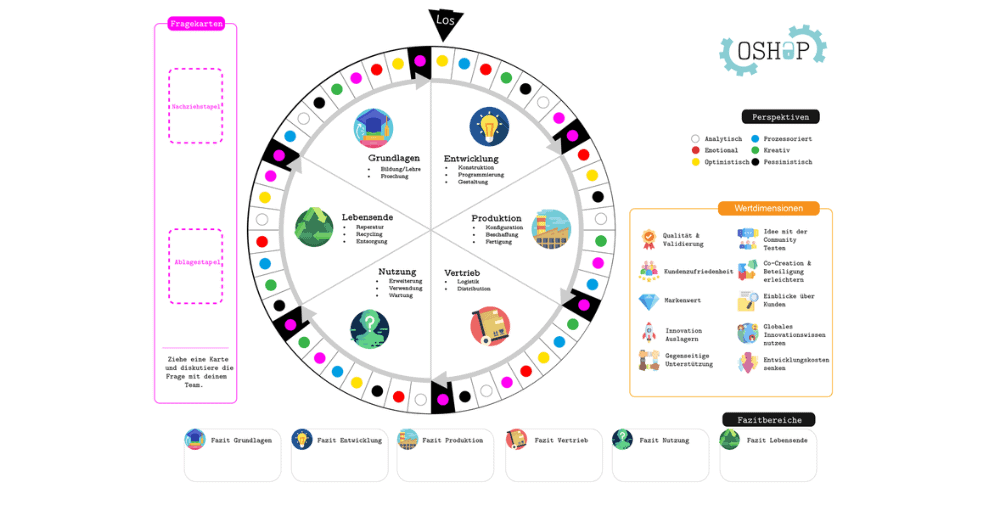
A central element of the workshop series is a specially developed simulation game. Participants examine their use case throughout the entire product life cycle, deliberately shifting their perspective along the way. With the help of various question and prompt cards, technical, economic, and organizational aspects are discussed collaboratively.
Topics include, for example, collaboration with communities, the use of existing innovation knowledge, or the question of what new value-creation opportunities can arise from an open development approach. The game-like structure makes it easier to get started with a topic that often seems abstract at first, while also creating space for discussion, shifts in perspective, and new ideas.
Initial trials show that this approach can break down barriers and support a structured exploration of open-source hardware. The Dresden-based startup allpacka has already tested the workshop series and used the simulation game to systematically explore potential open-source hardware approaches.
A knowledge transfer tool with potential beyond open-source hardware
What makes the simulation unique is that its methodological approach is not limited exclusively to open-source hardware. It demonstrates how complex research, technology, and knowledge transfer topics can be presented in a way that makes them more accessible to diverse target audiences and allows abstract issues to be translated into concrete use cases.
Thus, the simulation is not only a tool for teaching open-source hardware but also a transferable approach that can be applied to other complex subject areas in the future.
In the true spirit of open source, the simulation itself is also intended to be made openly accessible, shared, and further developed. In this way, a tool for teaching about open-source hardware also becomes a practical example of how open knowledge and technology transfer can work.
Try it out for yourself at the 3rd OSHOP Conference
Anyone who would like to learn about and try out the simulation game will soon have the opportunity to do so: On September 23 and 24, 2026, the open-source hardware community will gather for the 3rd OSHOP Conference in Halle (Saale).
As part of the conference, the simulation game will be put into practice in a workshop together with the participants. This will allow participants to explore different perspectives on open-source hardware and address specific questions in a playful way. In this way, participants can directly experience how new ideas and potential use cases emerge from what were initially abstract considerations.
In addition to the simulation game, the conference offers numerous other presentations, workshops, and discussion sessions on open-source hardware and brings together researchers, companies, makers, open workshops, and other interested parties to engage in dialogue.
Registration for the 3rd OSHOP Conference is available via the following link:
To register for the 3rd OSHOP Conference on September 23–24, 2026: https://pretix.eu/oshop/2026/
No time for the conference? OSHOP also offers a more casual option
If you can’t make it to the conference in September, you still don’t have to miss out on networking and the simulation game. We want to make open-source hardware accessible in a low-barrier way, outside of traditional event formats.
That’s why we’re planning an OSHOP get-together outside of HTWD—perhaps at a café or restaurant—as well as a group game night where participants can try out the simulation game in a relaxed atmosphere. After all, good ideas for open-source hardware don’t necessarily have to come from a seminar room.
If you’re interested in this kind of event, feel free to get in touch with us. We welcome players, curious minds, and anyone who’d like to get to know open-source hardware in a completely casual setting.
Funding and Further Information
The simulation game was developed as part of the OSHOP Transfer Space—Open Source Hardware Innovation Platform. OSHOP is funded by the Federal Ministry of Research, Technology, and Space (BMFTR) as part of the “T!Raum – Transfer Spaces for the Future of Regions” funding initiative. The goal of the initiative is to develop new approaches for the transfer of knowledge, ideas, and technology between science, industry, and society, and to anchor these approaches sustainably in the regions.
– – – – –
Related Links
👉 www.htw-dresden.de
👉 Go to the BMFTR article “Simulation Opens Doors to Open-Source Hardware”
Graphic: HTWD