While electronic devices have become an integral part of our daily lives, the consumption of critical raw materials and energy requirements in their production are steadily rising. According to the European Commission, the European Green Deal aims to achieve a climate-neutral Europe with a competitive economy by 2050, which is why new approaches are needed that consider sustainability not only at the end of a product’s life cycle, but also during the development phase.
This is precisely where the large-scale SUSTRONICS project comes in. The consortium, comprising 11 European countries, is developing new technologies and methods to make electronics more sustainable throughout their entire life cycle. The focus is on resource-efficient materials, printed electronics, energy-efficient manufacturing processes, and concepts for reuse, repair, and recycling.
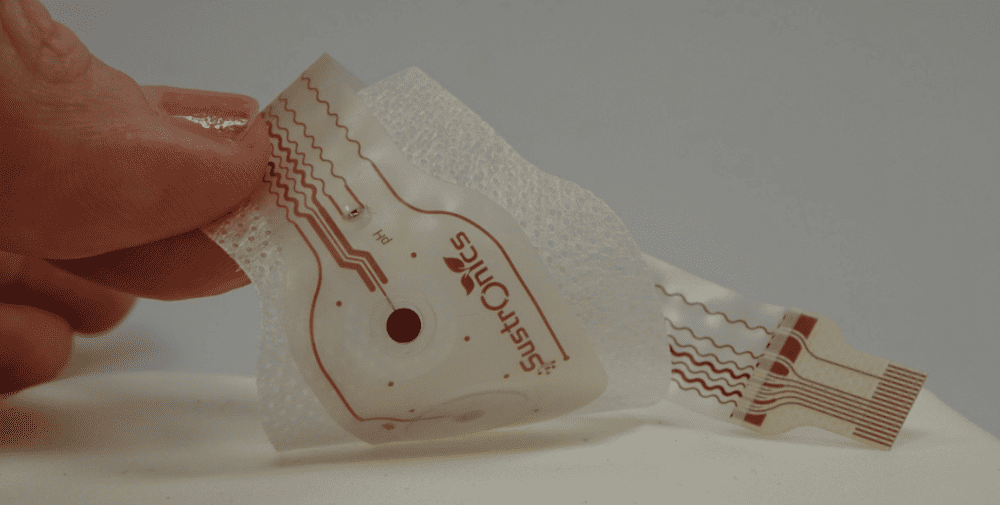
The scientists are testing the technologies provided by manufacturers in ten demonstrators from various application areas. These include, among others, medical diagnostic systems such as EEGs, smart wound dressings, and wearable sensors.
Sustainable Medical Technology in the Spotlight at Fraunhofer IZM
Reliability testing and life cycle assessments (LCA), conducted by the Fraunhofer Institute for Reliability and Microelectronics IZM, play a central role in the project, particularly for the demonstrators in the fields of medical and diagnostic technology. Using scientifically sound life cycle assessments, researchers led by Fraunhofer IZM scientist David Sánchez analyze the entire life cycle of the developed products—from raw material extraction through manufacturing to use and end-of-life. This enables them to identify “hot spots”—that is, specific processes in the product life cycle that have a very high environmental impact and whose identification allows for targeted optimization. Using various LCAs, in which they examined global warming potential, critical material use, and toxicity in greater detail, they discovered that the electrodes were almost solely responsible for the environmental impacts of glucose monitoring patches. The scientists feed these results directly back to their development partners so that the latter can replace materials, adjust manufacturing processes, or optimize product design even before the products move on to the next phase of development. As a result, project partner Onalabs was able to integrate an optical sensor into one such monitoring patch, thereby reducing its total carbon footprint by about 65 percent.
They were able to demonstrate that not only the technologies used but also the choice of materials plays an important role in smart wound dressings: “Simply by using different substrates and conductive inks—such as Thinstar and carbon as substitutes for silver—and incorporating recycled materials, the environmental impact of the flexible electronic modules in the product can be reduced by up to 95 percent compared to the standard combination of PET and silver,” summarizes David Sánchez from the Environmental Department at Fraunhofer IZM.
Sustainability as the New Standard in Production
Sustronics aims to establish sustainability as an integral part of European electronics development. The methods and results developed in the project are intended to be applied beyond the demonstrators and provide an important foundation for companies, enabling them to systematically incorporate environmental aspects throughout the entire development process.
Sánchez summarizes: “By providing meaningful data for life cycle assessment, Fraunhofer IZM is making an important contribution to the environmentally friendly design of electronic products, starting as early as the R&D phase. Sustronics offers a holistic approach and can serve as a flagship project for a sustainable circular economy—for stakeholders from industry, research, and politics.”
The project ran from June 1, 2023 to May 31, 2026 and was supported under the Chips Joint Undertaking (Grant Agreement 101112109), including additional funding from the Netherlands, Austria, Germany, Spain, Finland, France, Latvia, Poland, and Sweden. This work was also funded with €1.71 million from the Federal Ministry of Research, Technology, and Space (BMFTR) and the Swiss State Secretariat for Education, Research, and Innovation (SERI).
(Text: Lotta Jahnke)
Project Partners
Philips Electronics Nederland B.V., Philips Consumer Lifestyle B.V., Philips Medical Systems Nederland B.V., Nederlandse Organisatie voor Toegepast Natuurwetenschappelijk Onderzoek TNO, Signify Netherlands B.V., Mirec B.V., Avantium Renewable Polymers BV, Infineon Technologies Austria AG, CBMed GmbH, Medical University of Graz, SteadySense GmbH, Spanish National Research Council (CSIC), Onalabs Inno-Hub SL, Sigma Cognition SL, Rovira i Virgili University, 4E Antenna Finland Oy, VTT Technical Research Centre of Finland Ltd, Tampere University of Applied Sciences, Canatu Oy, UPM Raflatac Oy, Movesense Oy, Tervakoski Oy, Upc Konsultointi Oy, Screentec Oy, French Atomic Energy and Alternative Energies Commission (CEA), Symbiose, Faurecia Interieur Industrie, Institute of Electronics and Computer Science, Gdańsk University of Technology, PIEP Association for Innovation in Polymer Engineering, Plux – Wireless Biosignals S.A., RISE Research Institutes of Sweden AB, Beneli AB, SW Learning Well SE AB, University of Gothenburg, Essity Hygiene and Health AB, CSEM Centre Suisse d’électronique et de Microtechnique SA – Research and Development, Swiss Vault Systems GmbH, Inpher SARL, Würth – Elektronik GmbH & Co. KG, eesy-innovation GmbH, accensors GmbH, BSN medical GmbH, Vulpés Electronics GmbH, Fraunhofer Institute for Reliability and Microintegration IZM, Hamburg University of Technology
– – – – –
Related Links
👉 www.izm.fraunhofer.de
Photo: Fraunhofer IZM/Barbara Pahl