Autonomous driverless transport systems (AGVs) are indispensable for use in industry and warehouse logistics. However, they still face many challenges: Interaction with people places the highest demands on 3D sensor technology and evaluation systems. This is particularly true in the area of safety: AGV vehicles must not pose a danger to human employees.
Here, the integration of AI could bring about a significant improvement by evaluating the surrounding environment and reacting to the outside world in conjunction with safe emergency stop systems. There are two approaches to AI-based analysis: First, centralized processing in the cloud, where latency, however, precludes safety-critical functions. A second option is local processing, which, however, limits scalability and efficiency in multi-robot systems. In dynamic industrial environments in particular, there is a lack of flexible, distributed systems that can distribute processing loads across multiple devices.
Safe and Collaborative
The researchers in the PLATON project aim to close this gap with an integrated platform in which each autonomous transport vehicle is equipped with multiple spatially resolving radar sensors. These sensors measure distances to surrounding objects in 3D and enable both obstacle detection and the vehicle’s orientation in space. In addition, the same radar front end is used to capture high-resolution SAR radar images.
This allows safety- and time-critical signal processing to take place directly within the sensor. Information about obstacles can then be relayed to other vehicles. More complex tasks, such as collaborative mapping of the environment, can be distributed across the entire fleet. The platform grows with the fleet: Each new AGV contributes additional computing power, which is utilized dynamically.
A digital twin of the entire system and the sensor technology accelerates the commissioning of new AGV fleets by creating a virtual map of the environment even before physical deployment.
Radar Hardware at the Heart of the System
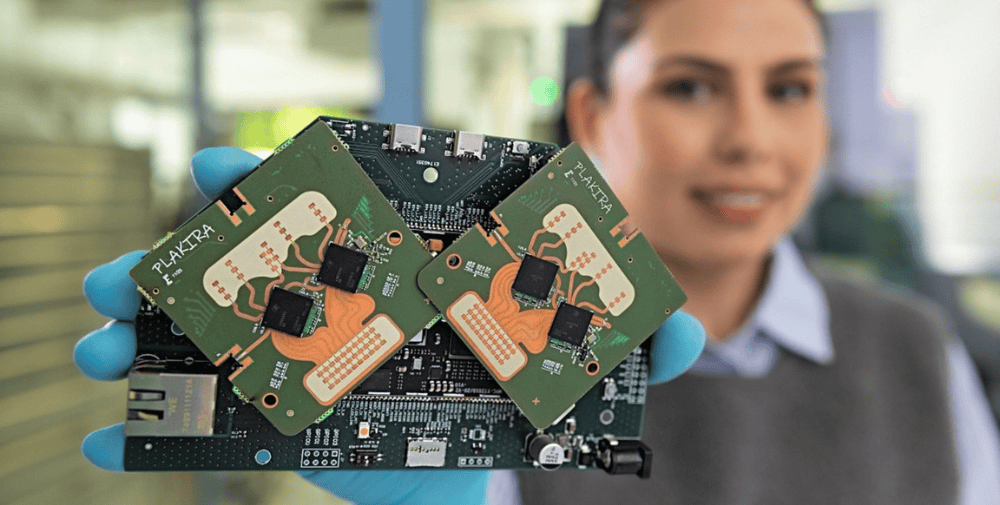
For these applications, the Fraunhofer Institute for Reliability and Microintegration IZM, in collaboration with the Fraunhofer Institute for High-Frequencyand Radar Technology FHR, developed a hybrid radar hardware system that simultaneously enables distance measurement in all spatial directions and imaging radar. To achieve this, two synchronized radar chips were mounted on a printed circuit board as the core of the system. This circuit board also incorporates the necessary hardware to meet both local and networked requirements. These capabilities and features were also demonstrated in a vehicle prototype. Together with the project partners’ prototypes—which, for example, offer enhanced capabilities for interacting with the environment—it illustrates what interaction between humans and autonomous robots might look like in the future.
The project “Distributed Computing Platform for Radar-Based 3D Environmental Sensing in Safe Autonomous Driving” (PLATON) was carried out from November 1, 2022, to April 30, 2026, by Pilz GmbH & Co. KG (project coordination), Creonic GmbH, let’s dev GmbH & Co. KG, Reeb Engineering GmbH, OFFIS e.V., and Fraunhofer IZM from November 1, 2022, to April 30, 2026. The project was funded by the Federal Ministry of Research, Technology, and Space as part of the program “Electronic Systems for Trustworthy and Energy-Efficient Decentralized Data Processing in Edge Computing” (OCTOPUS) (grant number: 16ME0750).
(Text: Steffen Schindler)
– – – – –
Related Links
👉 www.izm.fraunhofer.de
Photo: Fraunhofer IZM | Volker Mai