June 17, 2026. The Fraunhofer Institute for Photonic Microsystems (IPMS) presents Q-Dice, a quantum random number generator (QRNG) that derives true randomness from quantum vacuum fluctuations.
Categories

June 17, 2026. The Fraunhofer Institute for Photonic Microsystems (IPMS) presents Q-Dice, a quantum random number generator (QRNG) that derives true randomness from quantum vacuum fluctuations.
Categories
Tags
Contact info
Silicon Saxony
Marketing, Kommunikation und Öffentlichkeitsarbeit
Manfred-von-Ardenne-Ring 20 F
The system generates true random numbers at bit rates exceeding 4 Gbit/s based on intrinsically random and uncontrollable quantum effects. Compared to existing methods, Q-Dice does not rely on algorithms that are potentially vulnerable to attack and enables significantly higher data rates. This makes the system particularly suitable for security-critical applications. The quality of the generated random numbers has been validated using established and internationally recognized test procedures such as BSI AIS 20/31 and the NIST SP 800-22 test suite.
True randomness is a central prerequisite for modern cryptographic and security-critical systems, in which deterministic or insecure random number generators can cause vulnerabilities in encryption and authentication. By measuring inherently unpredictable quantum vacuum fluctuations, Q-Dice from Fraunhofer IPMS generates quantum entropy for a wide range of applications, including secure communication, data encryption (e.g., via QKD or PQC), authentication and access management, as well as large-scale simulations.
The system is designed with a strong focus on security requirements. It meets the strict requirements of the German Federal Office for Information Security (BSI) in accordance with AIS 20/31 and is classified as EAL3 (Evaluation Assurance Level) and PTG 3 (Physical Random Number Generator), which serves as important evidence of the system’s security.
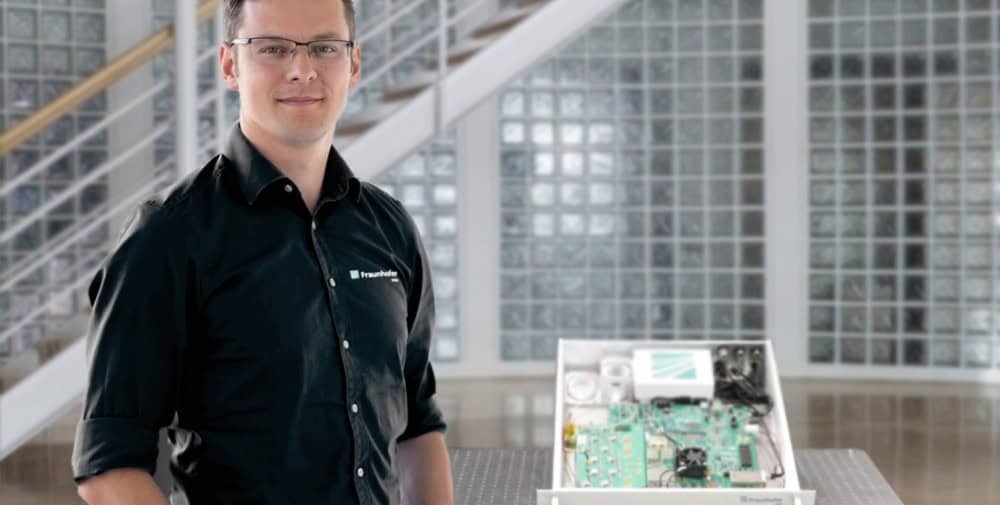
“With Q-Dice, we make high-quality quantum randomness practically usable and accessible,” says Dr. Alexander Noack, Head of the Data Communication & Computing Division at Fraunhofer IPMS. “Our technology is available both as a robust 19-inch rack system for use in customers’ own infrastructure and via our online Entropy-as-a-Service platform. This significantly lowers the barriers to adopting quantum-based security.”
To ensure maximum reliability, Fraunhofer IPMS brings together all core expertise in-house, enabling end-to-end development from photonics to system integration:
This end-to-end approach ensures precise control over the quality, stability, and performance of entropy harvesting. The same physical noise source forms the basis for both hardware-based and cloud-based access to quantum entropy.
Fraunhofer IPMS offers Q-Dice in two configurations to support different deployment and operational requirements:
An all-in-one hardware solution for use in data centers and on-premises environments.
Q-Dice Specifications
BSI AIS 20/31 and the NIST SP 800-22 test suite
A secure online interface provides direct access to quantum-generated randomness without requiring any special hardware installation. The service enables rapid evaluation, prototype development, and the scalable integration of quantum entropy into software systems and cloud-based applications.
As the technology transitions into the implementation phase, Fraunhofer IPMS is focusing on collaborative growth. “Our goal is to work together to further raise the bar for security and trust in the digital age. That’s why we’re inviting partners to test the technology and jointly develop practical applications,” Noack concludes.
Fraunhofer IPMS is a leading international research and development service provider for electronic and photonic microsystems. Our technologies find applications in industry, mobility, biotechnology, and medical technology. At the same time, we address key future fields such as quantum technologies and neuromorphic computing. Through our research in the field of green microelectronics, we contribute to a resource-efficient and sustainable world.
As an expert in secure data communication solutions, the Data Communication and Computing (DCC) business unit develops innovative technologies in the future-oriented fields of IP cores, Li-Fi (light-based data transmission), and quantum technologies. These developments pave the way for novel and secure communication solutions in key industries such as mobility, telecommunications, industrial automation, and energy supply.
You need to load content from reCAPTCHA to submit the form. Please note that doing so will share data with third-party providers.
More InformationYou are currently viewing a placeholder content from Turnstile. To access the actual content, click the button below. Please note that doing so will share data with third-party providers.
More InformationYou are currently viewing a placeholder content from Facebook. To access the actual content, click the button below. Please note that doing so will share data with third-party providers.
More InformationYou are currently viewing a placeholder content from Google Maps. To access the actual content, click the button below. Please note that doing so will share data with third-party providers.
More InformationYou are currently viewing a placeholder content from OpenStreetMap. To access the actual content, click the button below. Please note that doing so will share data with third-party providers.
More InformationYou are currently viewing a placeholder content from Instagram. To access the actual content, click the button below. Please note that doing so will share data with third-party providers.
More InformationYou are currently viewing a placeholder content from X. To access the actual content, click the button below. Please note that doing so will share data with third-party providers.
More Information