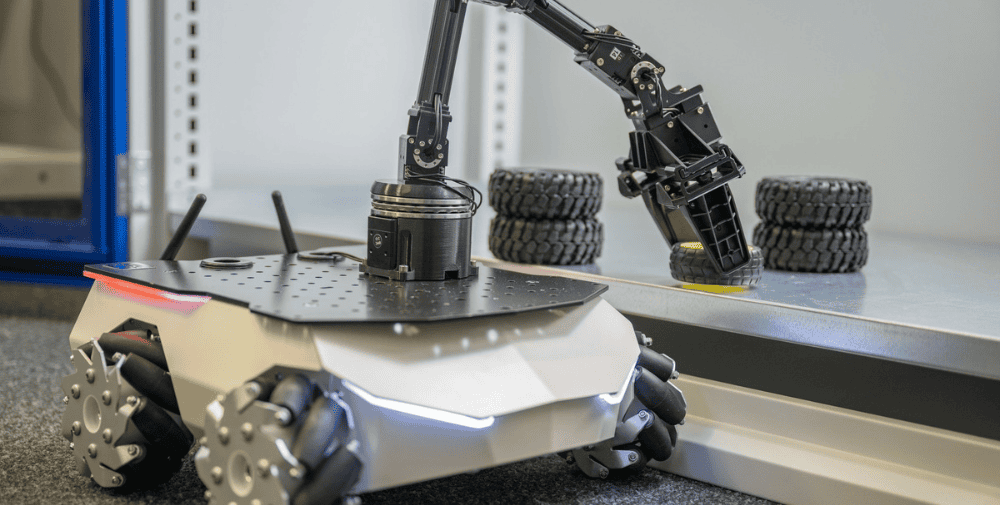
Helping with household chores, bringing food to patients, assisting during surgeries, harvesting tomatoes in a greenhouse, lending a hand on a construction site, or stocking shelves at a supermarket: “Cognitive robots must be capable of more than just performing the same task 24 hours a day on the factory floor. They must perceive what is happening around them, react, act independently to some extent, adapt, and work together with their human counterparts to perform a variety of tasks,” explains Jens Kober. He is the new research team leader at the Fraunhofer Institute for Manufacturing Engineering and Automation (IPA) and heads the new Department of Learning and Interactive Robots at the Institute for Artificial Intelligence at the University of Stuttgart.
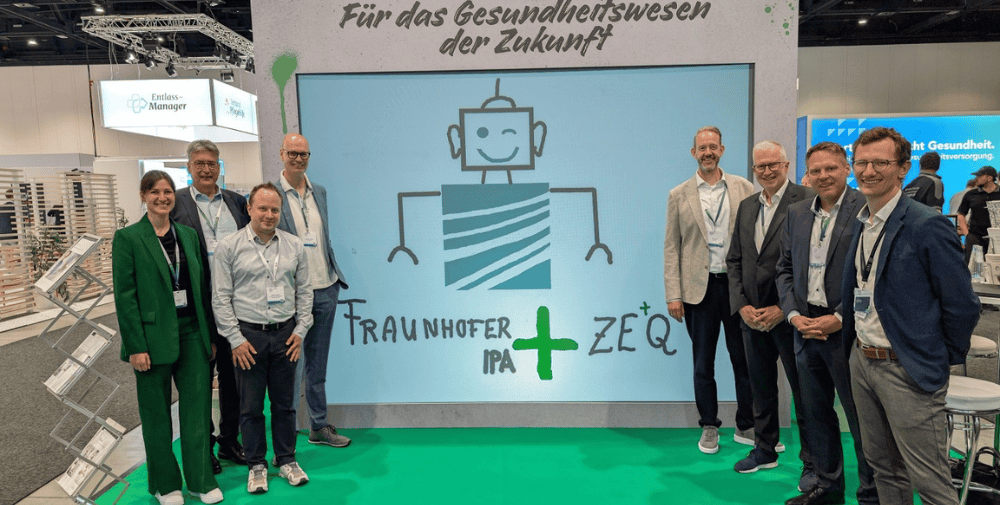
The Fraunhofer Institute for Manufacturing Engineering and Automation IPA and the management consulting firm ZEQ have launched a strategic partnership to support hospitals, rehabilitation clinics, and long-term care facilities in the use of assistive robots and AI-based solutions. The goal of the collaboration is to provide these institutions with structured and low-threshold access to robotics—from the initial potential analysis through to integration into ongoing operations. ZEQ contributes its expertise in clinical strategy, change management, and organizational consulting; while Fraunhofer IPA is responsible for technological assessment, system integration, and scientific evaluation.
In addition to physical assistive robotics, the partners are also exploring AI-supported applications, such as process analysis, intelligent resource planning, automated documentation, and data-driven evaluation. In this way, the collaboration combines technological innovation with the question of how new solutions can be integrated into clinical workflows in a meaningful, safe, and accepted manner.
Consult First, Then Implement Strategically
At the heart of the joint offering is a modular approach: In the first step, the partners work with the hospital to analyze which processes are suitable for robot deployment, what infrastructure is in place, and which available robot platforms are viable options. Building on this, feasibility studies, pilot projects, and finally the rollout can follow.
The range of robot types under consideration includes, among others, autonomous transport robots for pick-up and delivery services, cleaning and disinfection robots, interaction robots for patient guidance, providing patient information, and collecting patient data, as well as exoskeletons that assist nursing staff with physically demanding tasks. A unique selling point of the collaboration is what is known as “multi-task integration”: The Fraunhofer IPA is expanding existing robot platforms so that a single robot can perform multiple tasks—from material transport to the collection of vital signs to automated documentation. In addition, Fraunhofer IPA integrates this robot platform into a hospital’s existing infrastructure, enabling it to open doors or operate elevators.
Relief for Staff, Added Value for Patients
The shortage of skilled workers in hospitals and long-term care facilities calls for new solutions. “Robotics and AI do not demonstrate their value in healthcare simply by placing technology on the ward. What matters is that they solve a specific care or organizational problem, are accepted by staff, and are integrated into operations in an economically viable manner. This is precisely where we see the strength of our collaboration with Fraunhofer IPA: We combine technological feasibility with strategy, process understanding, and change management,” explains Nico Kasper, CEO of the management consulting firm ZEQ.
“Robotic technology for hospital use is already widely available. What’s missing is systematic integration into clinical workflows. This is exactly where our collaboration comes in: We combine organizational consulting with technical implementation expertise to create robust solutions for everyday ward operations,” adds Andreas Traube, Head of the Healthcare Industry Division at Fraunhofer IPA.
Stronger Together Than the Sum of Our Parts
The decisive added value arises from the interplay of both perspectives in every project phase:
- Needs-based rather than technology-driven: ZEQ ensures that the starting point is not a robot platform or AI application, but a concrete problem in everyday hospital life. Fraunhofer IPA then assesses which technical solution is actually feasible and cost-effective. This results in robust use cases rather than glossy concepts.
- Acceptance considered from the very beginning: Robotics projects can fail due to resistance from staff if they are not sufficiently informed and involved. ZEQ supports the change process on the ward—from communication and training to the active involvement of employees. This significantly increases the likelihood of successful long-term operation.
- End-to-end responsibility instead of lost coordination: In past practice, a consulting firm would develop a concept that was then handed over to a technology partner—resulting in lost information, delays, and unclear responsibilities. In this collaboration, ZEQ and Fraunhofer IPA work together in an integrated project team from the initial analysis through to scaling.
- Economic viability meets technical feasibility: ZEQ develops the business case, while Fraunhofer IPA validates the technical feasibility. Investment is made only when both align. This protects clinics from bad investments.
- Multi-task integration as a unique advantage: Fraunhofer IPA expands existing robot platforms so that a single robot can perform multiple tasks. This capability is not freely available on the market and makes the use of robots significantly more cost-effective. AI-supported functions can help control processes more intelligently, make data usable, and further reduce documentation efforts. ZEQ ensures that this potential is translated into clinical workflows and business models.
Joint Network and Flagship Projects
In addition to providing direct consulting and implementation support for individual hospitals, the partners plan to establish an innovation network for robotics in healthcare. Through consortium projects, webinars, and joint flagship projects, the goal is to pool experiences and strengthen knowledge transfer between hospitals, research institutions, and industry.
– – – – –
Further Links
👉 www.ipa.fraunhofer.de
Photo: ZEQ