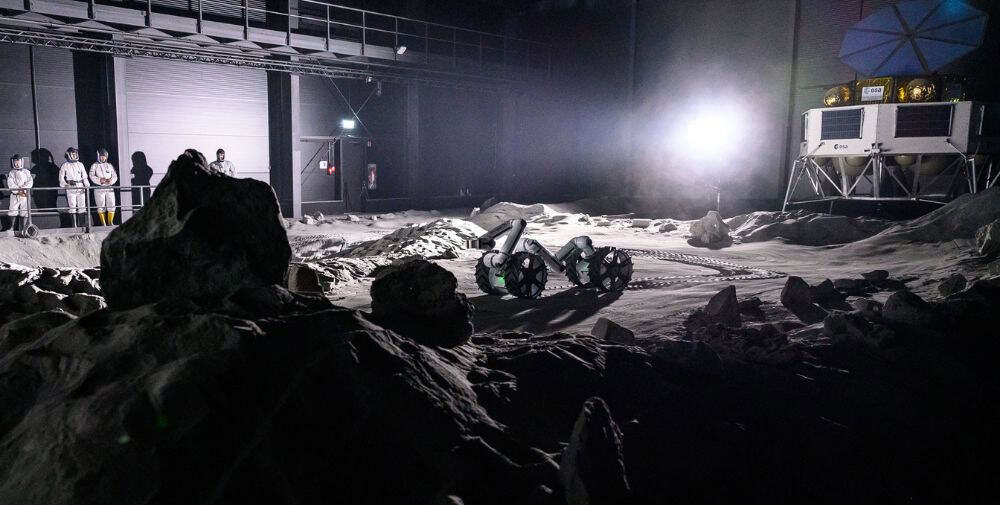
The MoonBots are a modular, self-reconfigurable robotic system that can autonomously adapt its structure and behavior to the different conditions on the lunar surface. By using AI-based learning and cooperative control strategies, MoonBots can change their modes of locomotion. They can also form units with multiple robots and work together on tasks such as transporting components or navigating uneven terrain. In the LUNA hall, the MoonBots were tested in a simulated polar environment on the moon. In a special configuration – the “dragon” – the robot combined two arms and two pairs of wheels. The “dragon” demonstrated its agility in the deformable LUNA lunar dust, successfully navigating through crater-like depressions, approaching interesting rocks and climbing up a steep slope. “The LUNA Analog Facility provided an excellent opportunity to evaluate the performance of our MoonBot robotic system. The hall is completely filled with a high-quality lunar soil simulator – an extremely rare feature in the world – which allowed us to collect valuable data on the traction mechanics between this dusty soil and the wheels of our rover. The sunlight simulator is another remarkable benefit of the facility. As we are focused on exploring the polar regions of the moon, where the angle of incidence of the sun is extremely low, we are particularly excited to demonstrate the capabilities of our robot in such a realistic and challenging environment. It really was as if we were already working at the South Pole of the Moon,” says Prof. Kazuya Yoshida.
Prof. Kazuya Yoshida from the Space Robotics Lab (SRL) of Tohoku University is leading the project “Self-Evolving AI Robot System for Lunar Exploration and Human Outpost Construction” under the Moonshot R&D Goal 3 of the Japanese Cabinet. The project team for the development of the MoonBot consists of researchers from the Osaka Institute of Technology, Kyoto University, Tokyo University of Science, the National Institute of Advanced Industrial Science and Technology (AIST) and Tohoku University.
700 square meters of lunar surface
In the LUNA hall there is, among other things, a 700 square meter simulated lunar surface. It is filled with “earthly moon dust”, which is deceptively similar to real regolith. The fine and sharp-edged regolith can cling to technical devices and cause problems. Stones and rocks in the hall are modeled on lunar geology and a sun simulator creates lighting conditions just like on the moon.
An area lowered by three meters also allows drilling techniques to be tested. In future, experiments can be carried out on an inclined plane on an adjustable ramp. The “Gravity Offloading System” will soon simulate the moon’s gravity. For this purpose, trolleys and cable systems will be installed on the ceiling so that astronauts or rovers will move with one sixth of their own weight, just like on the moon. The FLEXhab, a living area for astronaut missions, has been available since April of this year. The EDEN LUNA research greenhouse will be connected as a further external module in the future. LUNA, the “Moon on Earth”, was officially opened on September 25, 2024. The state of NRW is funding the joint DLR and ESA project with 25 million euros. LUNA can be used by national and international research institutions, space agencies, universities, industrial companies and start-ups.
“LUNA is a pioneering facility for preparing future astronautical and robotic lunar missions. The equipment and integration into the research environment enable a wide range of simulations for lunar activities. With LUNA, we have a unique facility in the center of Europe where companies and institutes can test their technologies before they are used on the moon. In addition, astronauts and the teams in the control centers can train their missions as realistically as possible,” says Dr. Anke Pagels-Kerp, DLR Executive Vice President Space Administration.
The LUNA facility is connected to the data networks of the National Space Operations Center (GSOC) in Oberpfaffenhofen, to which the DLR Microgravity User Support Center (MUSC) and the European Astronaut Center (EAC) are also connected. The Human Exploration Control Center (HECC) – the European control center for the future Artemis lunar missions – is also being established at GSOC
Long tradition of cooperation with Japan
Japan has been one of DLR’s most important non-European partner countries for over three decades. DLR is involved in around 300 areas of cooperation with Japan, including around 160 in the space sector alone. The strategic partnership with the Japan Aerospace Exploration Agency (JAXA) is a core component of its activities. In October 2018, the Franco-German asteroid lander MASCOT made an important contribution to researching the ground composition of the asteroid Ryugu as part of the Japanese asteroid mission Hayabusa2. The close collaboration will continue with the Mars moon mission MMX and the asteroid probe DESTINY+, among others. There are also collaborations with the National Institute for Advanced Industrial Science and Technology (AIST), Tokyo University of Science, the Railway Technical Research Institute and around 50 other Japanese research institutions and companies.
Joint research activities between the Space Robotics Lab (SRL) at Tohoku University and DLR, particularly in the field of space robotics, began in the 1990s. In 2013, a cooperation agreement was signed between Tohoku University and DLR to strengthen the overall collaboration with the university. The latest MoonBot campaign in LUNA is an extension of the long-standing and fruitful collaboration.
– – – – – –
Further links
👉 www.dlr.de
Photo: DLR