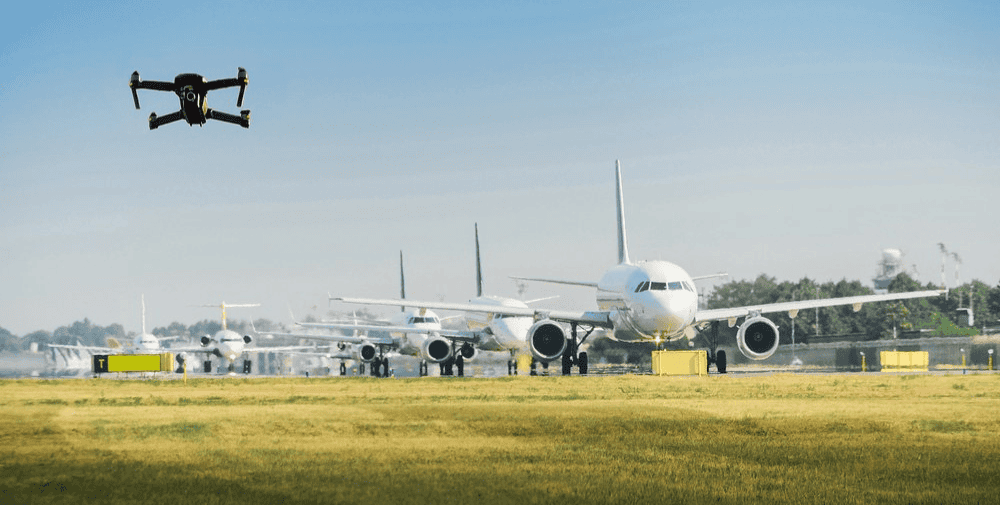
More incidents at major airports
The basis of the study at the DLR Institute of Air Transport is a data set from the German Federal Aviation Office with 226 reported drone incidents in 2025. From this, 116 relevant incidents were identified at a total of 25 commercial airports.
In 2025, drone sightings with an impact on flight operations were reported most frequently at major international hubs and commercial airports. Around 70 percent of the approximately 200 recorded drone-related flight detour are also associated with incidents at these locations.
The impact varies depending on the type of airport. Large hubs often respond by closing individual runways, while smaller commercial airports more frequently impose more extensive operating restrictions. Regional airports usually only have one runway and therefore have to shut down their entire operations more often.
Operational disruptions with far-reaching consequences
The effects of unauthorized drone flights range from delays and holding patterns to detour and partial or complete shutdowns. They interfere directly with tightly synchronized schedules and have economic consequences for both airlines and airports.
For airlines, delays, detour and cancellations primarily result in additional operating costs, such as longer flight times, additional fuel consumption and expenses for passenger care and replacement transportation. Airports are particularly affected by a reduction in the number of flight movements as a result of cancellations, which leads to a loss of revenue from fees. Additional losses can arise in the “non-aviation” sector such as retail, gastronomy and parking.
Damage assessment and economic effects
The damage assessment in the study is based on three components: Delay costs, which vary depending on aircraft type, length of delay and flight phase affected; rerouting costs based on international averages; and cancellation costs, which include lost revenue, changes in operating costs, passenger care expenses and alternative transportation solutions.
The analysis indicates a minimum economic loss of around €60 million for the year 2025. The damage estimate increases to up to 160 million euros if average network effects of delays are also taken into account – i.e. consequential costs that can arise due to disruptions and delays – as well as cancellations assessed as potentially disruptive.
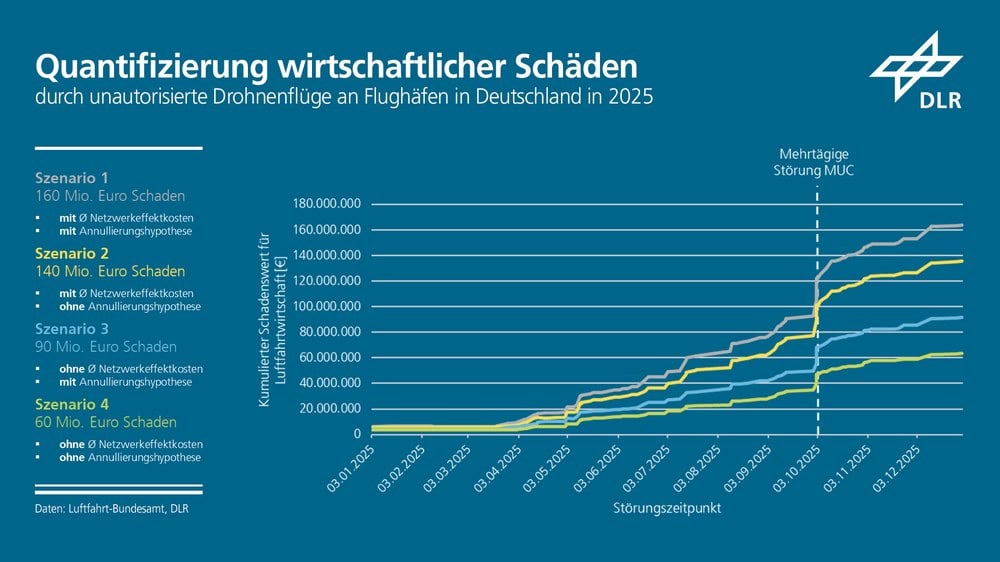
Quantification of economic damage caused by unauthorized drone flights at airports. Graphic: DLR
Detection and defense technologies are gaining in importance
In view of the increasing number of drone incidents at airports, the development of suitable detection and defense technologies is also gaining in importance. A particular challenge here is the variety of drones that can trigger incidents, as well as the diversity of the environments that need to be protected in the future. Under the leadership of the Institute of Flight Systems, DLR is therefore researching and developing appropriate technologies from initial detection to successful defense against drones and testing them at the National Test Center for Unmanned Aircraft Systems in Cochstedt.
Conclusion: Network effects drive costs
“Even short disruptions trigger considerable consequences in the highly networked air traffic system. Particularly in the case of longer events or repeated disruptions, the economic impact increases significantly as soon as systemic buffer capacities are exhausted. In these cases, costs develop dynamically and in leaps and bounds. On individual flights, there may also be a safety-relevant shortfall in fuel reserves. The results can also form a basis for cost-benefit analyses, for example for evaluating investments in drone detection and drone defence systems,” says Dr. Florian Linke.
– – – – – –
Further links
👉 www.dlr.de
Photo: Magnific.com/Alexandre Rotenberg