Saxony’s semiconductor and software industry is bucking the trend and creating 1,500 new jobs. Saxony’s high-tech industry is thus continuing on its growth trajectory. As of September 30, 2025, the number of employees in the microelectronics and ICT sectors rose to approximately 82,500.
Compared to the previous year, this represents an increase of approximately 1,500 jobs, or just under two percent. The growth is distributed almost evenly between the semiconductor industry and the software sector. “This trend shows that the investments made in recent years are increasingly taking effect. While many sectors continue to suffer from the weak economy, the high-tech industry in Saxony continues to grow and create high-quality jobs,” explains Prof. Dr. Frank Schönefeld, Chairman of the Executive Board of Silicon Saxony. This development is particularly noteworthy given the overall economic situation. While Germany’s economy is stagnating, Saxony’s microelectronics and software industries continue to grow and create additional jobs. The sector is thus reaffirming its role as one of the Free State’s most important engines of growth. “The current trend underscores the long-term appeal of the region as a business location. At the same time, we are only at the beginning of a new phase of growth. Numerous investments along the entire value chain, as well as the increasing importance of artificial intelligence, digitalization, and technological sovereignty, open up additional prospects for the coming years,” Schönefeld continued. From the cluster’s perspective, the forecast of more than 100,000 employees by the end of the decade remains realistic.
Growth Driven by a Wave of Investment Among SME Suppliers
The growth from 81,000 to 82,500 employees is no coincidence, but rather a reflection of a broadening investment dynamic within the Silicon Saxony ecosystem. In addition to large-scale factory projects, SMEs across the entire semiconductor value chain are increasingly investing in new locations, capacity, and services. These include, among others, providers of cleanroom and factory infrastructure, specialty gases, chemical supplies, measurement technology, automation, robotics, exhaust gas and wastewater treatment, and industrial AI solutions. In the past 12 months alone, companies such as Air Liquide, Exyte, Sempa Systems, InSeCoTec (part of the Japanese Murata Machinery network), Mitutoyo Europe, MIC Marketech International Corp., Taiwan Puritic Corporation, Onto Innovation, SMC Corporation, EBARA Precision Machinery Europe, VOXCLEAN, Innowave Tech, and other international suppliers have expanded their presence in Saxony or announced new activities. These investments demonstrate that growth drivers are no longer limited to chip manufacturing itself, but are increasingly encompassing the entire industrial ecosystem. “This development proves that Silicon Saxony is far more than the sum of its individual factories. An increasingly dense network of specialized technology companies, suppliers, and service providers is growing around the major facilities. It is precisely this breadth of value creation that makes the region resilient and creates additional jobs far beyond actual chip production,” says René Reichardt, Managing Director of DAS Environmental Expert GmbH and member of the Silicon Saxony Executive Committee.
Silicon Saxony Days 2026 Grow into a European High-Tech Summit
With more than 2,000 participants, the 20th Silicon Saxony Days 2026 are reaching a new level. For the first time, the event will take place over three days, establishing itself as one of Europe’s most significant high-tech gatherings. Representatives from industry, academia, politics, and startup ecosystems will discuss current developments in semiconductors, software, artificial intelligence, and digital transformation. This year’s new event format coincides with another anniversary. The high-tech cluster was founded on December 19, 2000, and is using its flagship event to celebrate its 25th anniversary together with its members and the industry. “Silicon Saxony’s 25-year history is an impressive success story for Saxony, Germany, and Europe. What began as a strong regional initiative has grown into one of Europe’s most significant microelectronics and IT clusters, which today encompasses nearly the entire value chain and boasts excellent international connections. This development was made possible by the entrepreneurial spirit of those involved, the excellence of our scientific and research institutions, and the continuous political support of the Free State of Saxony. We will continue to reliably support and actively shape the further development of Silicon Saxony in the future. After all, Silicon Saxony drives innovation, creates value, generates skilled jobs, and offers future prospects far beyond the industry itself,” says Saxony’s Minister President Michael Kretschmer.
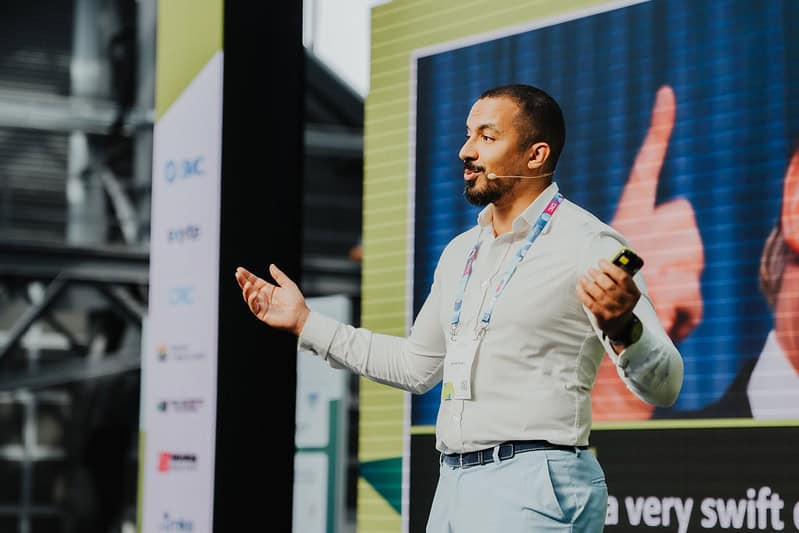
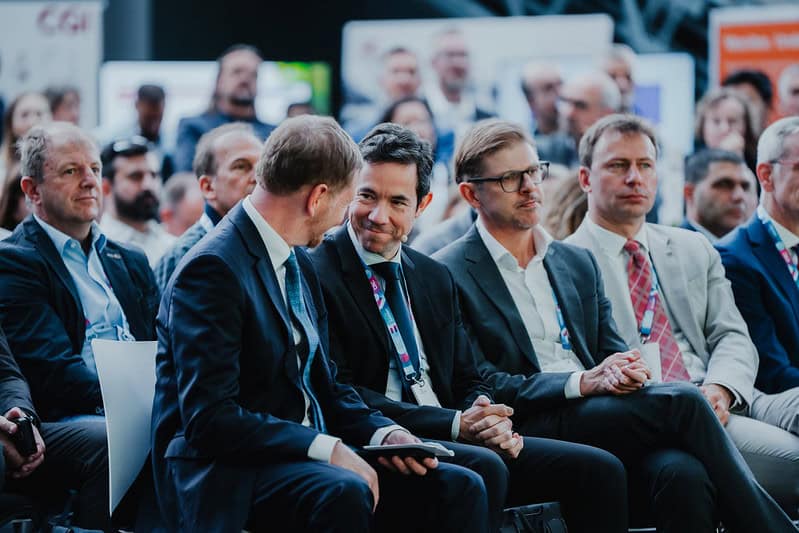
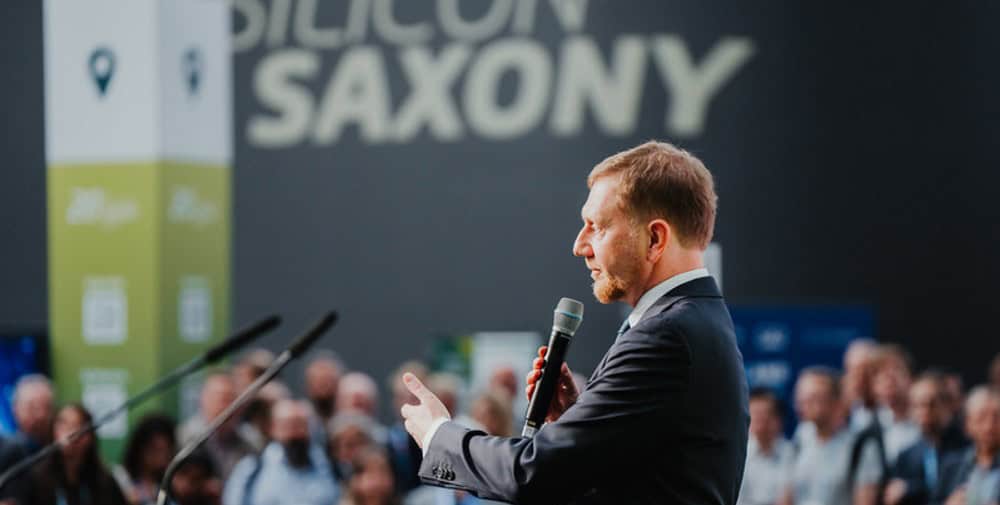
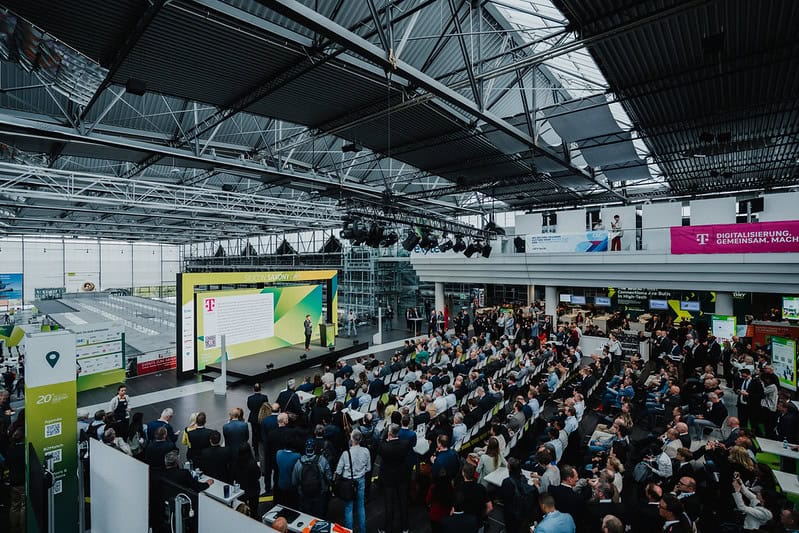 Image 1: Salah Nasri, CEO and Co-Founder, International Semiconductor Industry Group. Image 2: Saxony’s Minister President Michael Kretschmer, Pierre Chastanet, Head of the Unit for Microelectronics and Photonics at the European Commission, and Matthias Ecke, Member of the European Parliament, S&D Group (from left to right) | Images: mio motion
The event is attracting significant international attention thanks to the participation of 14 business and innovation delegations from Europe, North America, and Asia. Taiwan is this year’s Special Partner of the Silicon Saxony Days. In addition, members of the
Silicon Europe Alliance are meeting in Dresden. The signing of a Memorandum of Understanding between Saxony and Finland will further strengthen international innovation ties. Another highlight is
IPCEI Connect, which brings together representatives of numerous European IPCEI projects and key players in the European semiconductor value chain. For several days, Dresden will thus become a central hub for the European microelectronics community. This is particularly true for the startup scene. In addition to the current participants in the Ignite Next program, around 75 other startups will showcase their work both as part of Infineon’s Robotics Challenge and as part of the Silicon Saxony Startup Awards, which are being presented for the first time this year.
“The Silicon Saxony Days are more than just an industry event. They embody a new kind of collaboration. Technological sovereignty, AI infrastructures, and Europe’s competitiveness cannot be shaped in Brussels alone. They emerge where industrial expertise, research, and international partnerships converge—for example, in strong regions like Silicon Saxony. What sets us apart is not only what we have built ourselves, but also the way we have done it: in close collaboration with partners at the regional, national, European, and global levels. It is precisely this principle that makes us a role model and an active driver of European semiconductor policy. “Anyone discussing the EU Chips Act 2.0 or contemplating the future of European AI infrastructure can—or rather, should—rely on the experience of leading clusters like Silicon Saxony. Because here, we don’t just produce—we shape the future,” says Frank Bösenberg, Managing Director of Silicon Saxony. Against the backdrop of geopolitical tensions, the global race for AI infrastructure, and the discussion surrounding a future EU Chips Act 2.0, the role of Europe’s leading semiconductor clusters continues to grow in importance. Saxony benefits from a unique combination of industrial manufacturing expertise, excellent research, growing software expertise, and strong international networks. “Anyone talking about Europe’s competitiveness, artificial intelligence, and technological sovereignty must also talk about semiconductors and software. And anyone talking about semiconductors and software cannot ignore Silicon Saxony,” says Bösenberg.
Sustainability Is Becoming a Strategic Competitive Factor in the Electronics Industry
In addition to semiconductors, artificial intelligence, and digitalization, sustainability is also increasingly becoming a focus of the electronics industry. With the “Sustainability Gate” organized by Hüthig Medien, the Silicon Saxony Days 2026 are creating, for the first time, a platform for discussion on resource efficiency, the circular economy, sustainable product design, and the reduction of electronic waste. Companies, research institutions, and technology partners will discuss concrete approaches to more sustainable value creation in the electronics sector. “Sustainability is increasingly becoming a driver of innovation and a competitive factor for the electronics industry. With the Sustainability Gate, we are creating a platform where companies, research institutions, and technology partners can discuss concrete solutions and best practices. After all, in the long term, economic success, technological innovation, and sustainability will have to be considered more and more in tandem,” says Petra Gottwald, Editor-in-Chief of Electronics at Hüthig Medien. The scope ranges from sustainable electronics design and circular value creation models to concrete best practices in development, production, and the supply chain. In this way, the Silicon Saxony Days underscore their commitment to actively shaping not only technological innovations but also the sustainable transformation of the European electronics industry.
The Sustainability Gate is complemented by the Zero Emissions Fab Gate, organized by DAS Environmental Expert. While the Sustainability Gate addresses sustainability across the entire electronics value chain, the Zero Emissions Fab Gate focuses specifically on the challenges facing modern semiconductor fabs. International experts from semiconductor manufacturing, plant engineering, and environmental technology will discuss practical solutions for emissions reduction, water reuse, resource efficiency, and the reliable operation of future high-tech factories. Topics range from exhaust gas and wastewater treatment to sustainable infrastructure and resilient water management concepts for the next generation of AI and semiconductor factories.
Facts and Figures at a Glance:
|
2021 |
2022 |
2023 |
2024 |
2025 |
Growth in percent
(compared to the previous year) |
Microelectronics & ICT in Saxony
(total employees)
|
73,000 |
76.100 |
81,000 |
81,000 |
82,500 |
+1.85% |
| Software Industry |
36,613 |
39,249 |
40,011 |
40,000 |
40,847 |
+2.12% |
Sources: Figures compiled by the SMWA (2011, 2013, 2015, 2017, 2019) as well as by Silicon Saxony (2012, 2014, 2016, 2018, 2019, 2020, 2021, 2022, 2023, 2024, 2025) using data from the Saxony State Statistical Office and the Saxony Employment Agency (2011–2025), number of employees as of September 30 of the respective year.
_ _ _ _ _
About SILICON SAXONY
With over 700 members, Silicon Saxony is Saxony’s largest high-tech network and one of the largest microelectronics and IT clusters in Germany and Europe. As a self-financed association, Silicon Saxony has been connecting manufacturers, suppliers, service providers, colleges and universities, research institutes, public institutions, and industry-relevant startups in Saxony and beyond since its founding in 2000. The overarching goals of the network’s work include expanding and strengthening Saxony’s position as Europe’s leading microelectronics hub, as well as driving the parallel development of Saxony into a software hub.
_ _ _ _ _
Image material
Images will be available starting June 15, 2026, at 1:30 p.m. for download.
Use by media outlets is free of charge. Image credit: © Silicon Saxony, mio motion