How often do you use AI? A third of Germans do it at least once a week, according to a recent Bitkom study – from the kitchen to code. Federal Digital Minister Karsten Wildberger, asked at the press conference on the acquisition of Aleph Alpha by Cohere about his last use of AI, replied briefly: “This morning. Claude.” And Singapore’s Foreign Minister Vivian Balakrishnan has published his personal AI assistant on GitHub. It runs on a Raspberry Pi, is based on Claude, uses NanoClaw, and autonomously builds a structured memory from speeches, articles and meeting notes. “Invaluable,” he writes. “I don’t dare switch it off.”
KI has therefore arrived: In everyday life, in politics, on the desk. But what about in production? According to a Cisco study from April 2026, almost two thirds of German companies use AI in ongoing industrial processes, 20% of which report widespread, mature use. That sounds like a lot. But if you take a closer look, you will notice that the way in which AI is moving into a chip factory is fundamentally different from the way a minister puts together his morning speech notes.
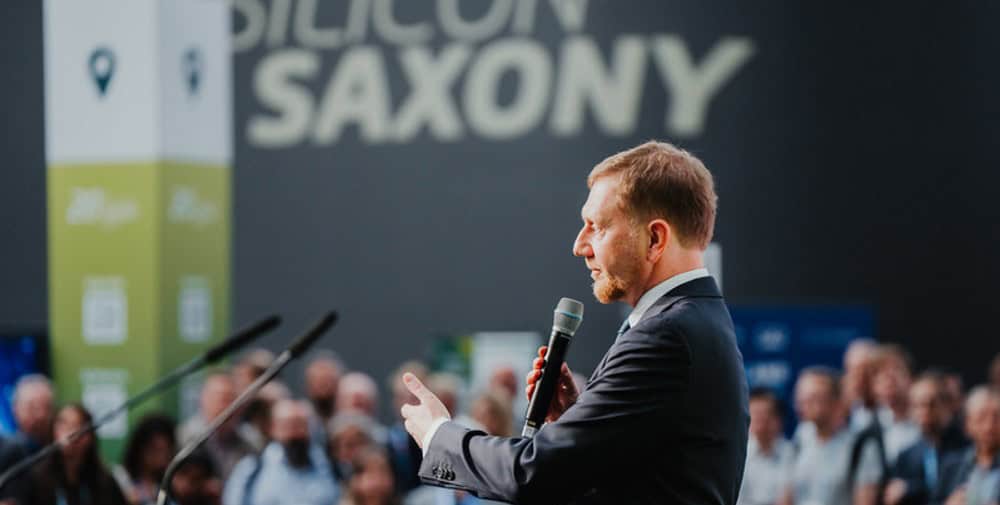
This week, more than 200 people from the semiconductor industry gathered in Catania, Sicily: Chip manufacturers, equipment suppliers and also from the research sector. The occasion: the apc|m Europe, the European conference for Advanced Process Control and Manufacturing, which has been organized by Silicon Saxony for years. APC – Advanced Process Control – refers to the automatic control of manufacturing processes on the basis of measurement data: Measured values from one process step flow into the next as correction values, the system adjusts itself and the process remains stable. In an industry where a single process step on a wafer can affect hundreds of chips, this is not a side note, but the core of what determines quality and yield. This community has been discussing data-driven manufacturing long before “AI” became a buzzword – and is therefore asking the question of what lies behind it more seriously than many a technology trade fair.
One difference that plays a bigger role than it seems at first glance is the difference between deterministic and probabilistic systems. A classic APC control system is deterministic – same input, same output, always. This predictability is not a technical detail, but the basis for certification, quality assurance and accountability in high-volume production. ML models, on the other hand, are probabilistic: they provide predictions with probabilities and uncertainty ranges. A model that says “this process step has a 94 percent probability of a drift problem” is useful – but how do you qualify it? According to what standard? Who decides what happens to the six percent residual risk? It is precisely these questions that explain why the introduction of ML in manufacturing is slower than in other areas – not because of a lack of will, but because of justified requirements for traceability and control.
Because almost everything now has AI written all over it. In part, this is justified – but in part, it is primarily marketing. And marketing is sometimes bigger than reality. Artificial intelligence (AI) is the generic term for everything that enables machines to perform cognitive tasks. This includes classic APC rules as well as modern language models. Machine learning (ML) refers to the subset in which the system learns patterns from data instead of being explicitly programmed: Fault detection on process systems, predictive maintenance, virtual measurement technology without a physical sensor. Deep learning, the further development with multi-layer neural networks, is particularly suitable for image analysis – such as the automatic detection of defects on wafers. And then there is the latest wave: generative AI and language models, which are changing the work of the engineers upstream and downstream rather than the production itself. In APC circles, there is also the view that for many problems in the fab, the simpler method with deep domain knowledge works better than complex neural networks – because the available data per plant and recipe is simply too scarce.
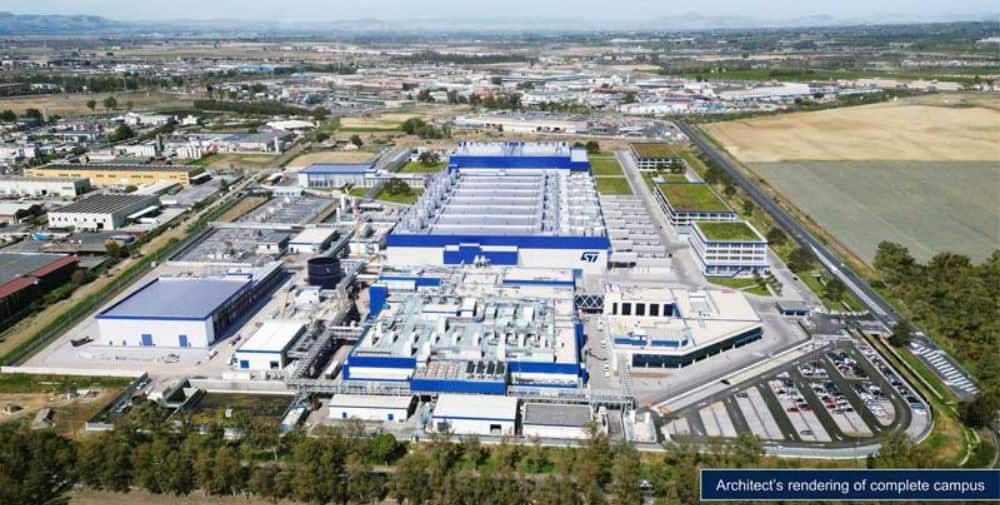
Catania as a conference venue is no coincidence. One of the most ambitious semiconductor projects in Europe is currently under construction there: STMicroelectronics is building a globally unique SiC campus for around five billion euros, the first fully integrated production facility for silicon carbide on one site, funded with around two billion euros as part of the EU Chips Act. Meanwhile, the Chips Act 2.0 is in the pipeline, and SEMI Europe has just published a position paper calling for greater involvement of industry and targeted support for smaller players along the value chain.
But back to AI in production:
At the Hannover Messe a week earlier (April 20-24), the platform promises – digital twins, autonomous production processes – dominated. The research project Semiconductor-X demonstrated this: Resilient data pipelines are needed before algorithms can take effect in the fab – an often underestimated prerequisite.
What can be observed in concrete terms: Progress is being made, and some of it is measurable. Infineon received the AI Impact Award 2026 for a project that uses language models to automatically generate test code – 50 percent less effort in the short term, up to 80 percent in the long term. INFICON uses ML-supported anomaly detection to detect deviations in process systems that remain hidden in conventional systems. Applied Materials combines measurement technology and AI-supported image analysis for defect detection and process optimization. The Dresden-based company Connected Worker Intelligence, which has just spun off as an independent company, brings AI to the “last meter” of value creation – to the worker at the machine, in real time. This points to something fundamental: hardware and software are not opposites in modern semiconductor production, but two sides of the same chip.
What is still outstanding is not so much the individual solution as its seamless connection: Digital twins, data-based process control, AI-supported inspection – much of this already exists. What is still missing in most factories is the fully integrated use of AI across the entire process chain: a seamless flow of data that automatically transfers findings from one step to the next, integrates systems from different manufacturers and clearly regulates responsibilities. This does not have to be a failure; it is likely to be the way in which high-volume production sensibly integrates AI – carefully, validated, step by step. The questions behind this are less technical and more organizational: Who has access to which data? Who checks the model before it goes into production? Who is responsible if a probabilistic recommendation leads to a production outage?
After this week in Catania, after the Hannover Messe and with a look at the figures, one thing is clear: AI in semiconductor manufacturing is far more than just a hype topic – even if widespread, end-to-end integrated use is still some way off. The exchange of ideas will remain important. The apc|m Europe will meet in Dublin next year. The Silicon Saxony working groups offer the opportunity to discuss the topic in greater depth throughout the year. And the Silicon Saxony Days in Dresden in June will bring the community together again – also with this topic on the agenda.
Do you use AI – privately, professionally, experimentally? And if so, what has changed for you? We look forward to hearing your opinions and experiences and, of course, your feedback in general, for example by email to redaktion@silicon-saxony.de.
Post: Frank Bösenberg
– – – – – –
Further links
👉 apc|m Europe
👉 Silicon Saxony Days
Photo: STMicroelectronics