
Company type
Home | Mitglieder |
Embedded AI

Small companies (<50 employees or <10 million annual turnover)
Target markets
Electronics·Infrastructure·Machinery and Equipment·Mobility·Public Sector·Services
Industries
Materials·Research & Development·Software·Upstream Industry
Portfolio
Algorithmendesign·Analog and Digital Signal Processing·Audio-·Communication·Custom / Individual software··HMI-Design·Medical Technology / Pharma·Micro- / Nanoelektronics·Rail / Automotive·Semiconductor Industry·Software·Software Entwicklung·Sprach- und Bildverarbeitung
Certificates

Contact
Schnorrstraße 70
01069 Dresden
01069 Dresden
+49 351 6533 3808
Contact Person
Dr. Rico Petrick
Geschäftsführung
About this member
What does Embedded AI do
Algorithms in the Application
Our vision is to embed algorithmic and AI systems into products and applications wherever it makes sense, to relieve and adapt to humans or processes.
We generate and deliver Embedded AI as the intelligent core of the application in various industries such as automotive, medical technology, industrial and home automation, government, energy supply, and many more.
Can we also support you in ensuring the future viability of your products? The movie shows how it could be done…
Technologies
Embedded AI offers algorithm development for
AI Systems and Recognition Method,
Machine Learning and Data Engineering as well as
Signal and Image Processing.
To implement these in the application, you will also receive from us the development of
Electronics and Embedded Systems,
Software for all platforms of Server, Mobile Device down to the Microcontroller, as well as
Connectivity: Client-Server or Internet of Things (IoT).
X-UWB™
X-UWB – Extended Automotive UWB Platform – is a unified system architecture that significantly expands conventional UWB-based secure car access by enabling a wide range of additional interior and exterior sensing applications (e.g., presence detection, intrusion monitoring, and gesture-based functions) through activation of the UWB radar mode on the same hardware infrastructure.
The X-UWB platform is defined by the following core characteristics:
- One X-UWB node hardware for ranging AND radar – One physical UWB anchor
infrastructure supports both UWB ranging and CIR-based sensing (UWB radar) without
additional RF hardware.
- Modular building block architecture – X-UWB is structured as a
scalable building block system consisting of clearly defined hardware, software, and feature
layers. This modularization enables reuse across vehicle platforms and segments.- Hardware building blocks
- Distributed UWB anchor nodes (UWB transceiver (incl. on-chip CPU) + antennas)
- Central ECU or domain controller integration
- Standardized communication interfaces (e.g., CAN, LIN, Ethernet)
- Software building blocks
- Ranging engine (IEEE 802.15.4z secure ToF processing)
- Radar/Sensing engine (CIR acquisition, preprocessing, feature extraction)
- Security layer (authentication, distance bounding, anti-relay protection)
- Fusion and decision layer (multilateration, zone classification, event logic)
- Feature building blocks
- Secure access (Entry / Go / Phone-as-Key)
- Interior sensing (Presence, CPD, Occupant Monitoring)
- Exterior sensing (Kick Gesture, Motion Detection, Approach Detection)
- Configuration-dependent advanced features (e.g., micro-movement detection)
- Scalable topology concept – Anchor placement and sensing coverage can be adapted to vehicle segment and feature requirements, enabling an optimized cost–feature ratio.
- Sensor consolidation capability – Multiple dedicated sensor modules (e.g., radar, ultrasonic, IR ToF, capacitive sensors) can be partially or fully consolidated onto the UWB platform.
- System-level simplification and cost advantages – Reduced sensor diversity lowers integration effort, ECU interfaces, wiring complexity, and overall E/E architectural fragmentation.
- Software-defined feature enablement – Functional expansion is achieved through software activation and configuration rather than additional hardware deployment.
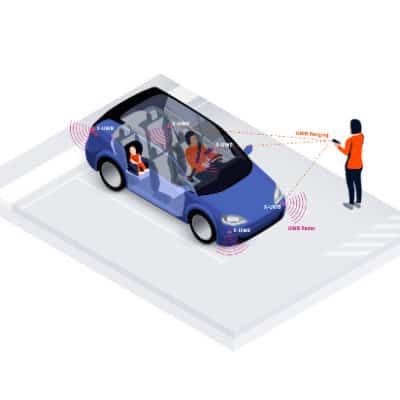
X-UWB - Plattform

