
Company type
Home | Mitglieder |
kraftwerk TUBES GmbH
Small companies (<50 employees or <10 million annual turnover)
Target markets
Energy·Infrastructure·Logistics·Mobility·Water and Environment
Industries
Machinery & Equipment·Materials·Production·Research & Development·Technology
Portfolio
Aerospace·Data Centers·Energy Systems·Fuel Cells·Hydrogen·Maritime / Shipping·Materials / Components·Micro- / Nanoelectronics·Rail / Automotive·Renewable energies
Certificates

Contact
Collenbuschstraße 22
01324 Dresden
01324 Dresden
+49 351 250 88 78 0
Contact Person
Robert Ekkert
+49 163 7314177
Head of Operations & Digital Strategy

About this member
kraftwerk develops and manufactures advanced solid oxide fuel cells (aSOFC) in Dresden, Germany. At the core of the technology is a metal-ceramic tubular cell: an ultra-thin nanocrystalline ceramic functional layer on a mechanically robust tubular support. The cell converts the chemical energy of the fuel electrochemically into electrical energy; the primary energy conversion therefore takes place without a combustion engine.
What sets it apart from planar solid oxide cells is its thermomechanical behaviour. The tubular architecture tolerates rapid heat-up and cool-down as well as repeated thermal cycling at SOFC operating temperatures of around 800 to 850 °C; during validation, a stack module completed 30 thermal cycles between roughly 400 and 850 °C. This is precisely where planar designs fail — and precisely why this architecture puts mobile applications within reach.
Operation on methane is substantiated by our own test campaigns. Beyond that, the platform is designed for hydrogen and reformable fuels: natural gas and LNG, biogas, methanol and synthetic hydrocarbons. Ammonia requires an upstream conversion step. Methane is reformed internally — the exhaust heat recovered in the process is returned to the system as chemical energy. In dynamic FTIR measurements, no NOx was detected within measurement accuracy under the conditions tested.
The design is modular throughout: several TUBES form a STACK; the STACK sits together with the injection nozzle in a BOX; BOX, insulation, control, system components and power electronics make up a MODULE. Manufacturing is based on modular ten-cell building blocks. This yields systems from the 30 kW class as the building unit up to megawatt-scale installations — for stationary supply, data centres and maritime applications. For vehicles, kraftwerk combines these into the SURFBOARD: the complete onboard energy system consisting of aSOFC MODULE, battery MODULE, ultracapacitors and tank. The power generator itself requires no platinum-group catalyst and no lithium- or cobalt-based storage materials, which reduces dependence on critical raw material markets.
The core aSOFC platform is assessed at TRL 7; individual subsystems and application configurations are at different levels of maturity. kraftwerk holds 33 granted patents. In a multi-year development programme with Volkswagen, modular stack module boxes were jointly built and technically characterised (project final report 2021); in 2024 a Volkswagen-confirmed industrialisation and cost assessment followed. In 2025 the company won the Climatech Challenge at EGYPES in Cairo.
1 MW System in a Container
Solid oxide fuel cell system with 1,000 kW net output in a 10-foot container (3,029 × 2,438 × 2,591 mm).
The design is modular: the 30 kW class is the building unit, and several modules work redundantly together so that no single module is a point of failure. The primary energy conversion is electrochemical, without a combustion engine — hence the low noise level and an exhaust in which, in dynamic FTIR measurements under the conditions tested, no NOx was detected within measurement accuracy. Methane is reformed internally; the recovered exhaust heat is returned to the process as chemical energy.
Applications: industrial sites, data centres, grid support, maritime applications, off-grid supply and charging parks — power generation at the point of consumption, on existing fuel infrastructure.
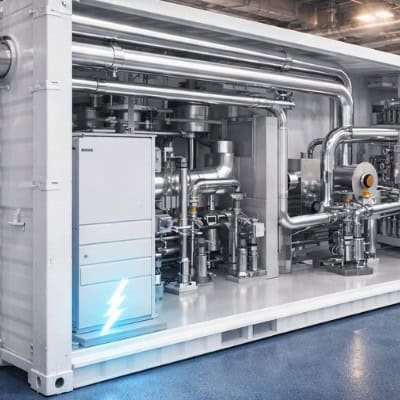
1 MW system in a container (rendering: kraftwerk)
SURFBOARD™ 30 — Energy Module for Vehicles
The SURFBOARD is the complete onboard energy system: aSOFC MODULE, battery MODULE, ultracapacitors and tank. It generates the electricity in the vehicle instead of carrying it along.
The traction and buffer battery can therefore be sized considerably smaller than in a purely battery-electric vehicle; its size is determined by the duty cycle and the required peak power. The ultracapacitors cover load peaks when pulling away and accelerating. This saves weight, raw materials and installation space — vans and trucks keep more payload.
Refuelling takes minutes, on existing fuel infrastructure. Applications: commercial vehicles, passenger cars, maritime and mobile applications.
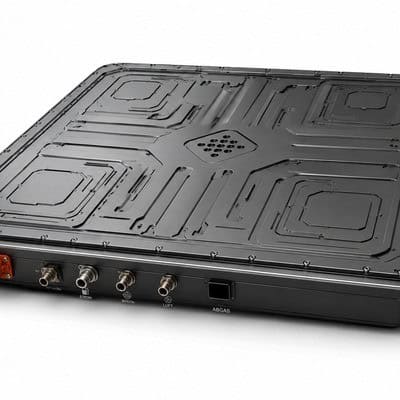
SURFBOARD™ 30 (rendering: kraftwerk)
kraftwerk TUBE — the Fuel Cell
The TUBE is the cell the systems are built from: a metal-ceramic micro-tube with nanocrystalline ceramic functional layers on a mechanically robust tubular support. The fine microstructure and the tubular support architecture make the cell thermomechanically robust — it tolerates rapid heat-up and cool-down and repeated thermal cycling at operating temperatures of around 800 to 850 °C.
Several TUBES form a STACK; the STACK sits together with the injection nozzle in a BOX; BOX, insulation, control, system components and power electronics make up a MODULE. Manufacturing uses scalable forming and coating processes instead of machining brittle ceramic plates.
The power generator requires no platinum-group catalyst and no lithium- or cobalt-based storage materials. Important for understanding: the cell does not store energy, it converts it — the energy is in the fuel, not in the component. Developed and manufactured in Dresden.
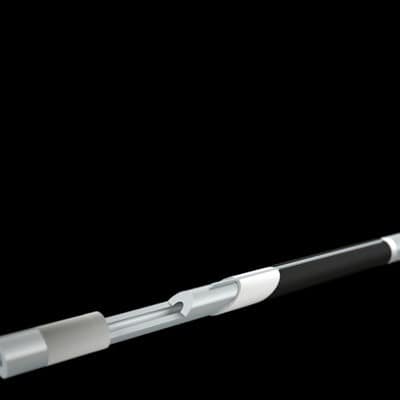
kraftwerk TUBE, ceramic micro-tube (photo: kraftwerk)

